Change models are often treated as if leaders must choose one and defend it.
Lewin or Kotter.
ADKAR or agile change.
Top-down or bottom-up.
Planned change or emergent change.
In practice, this is the wrong debate.
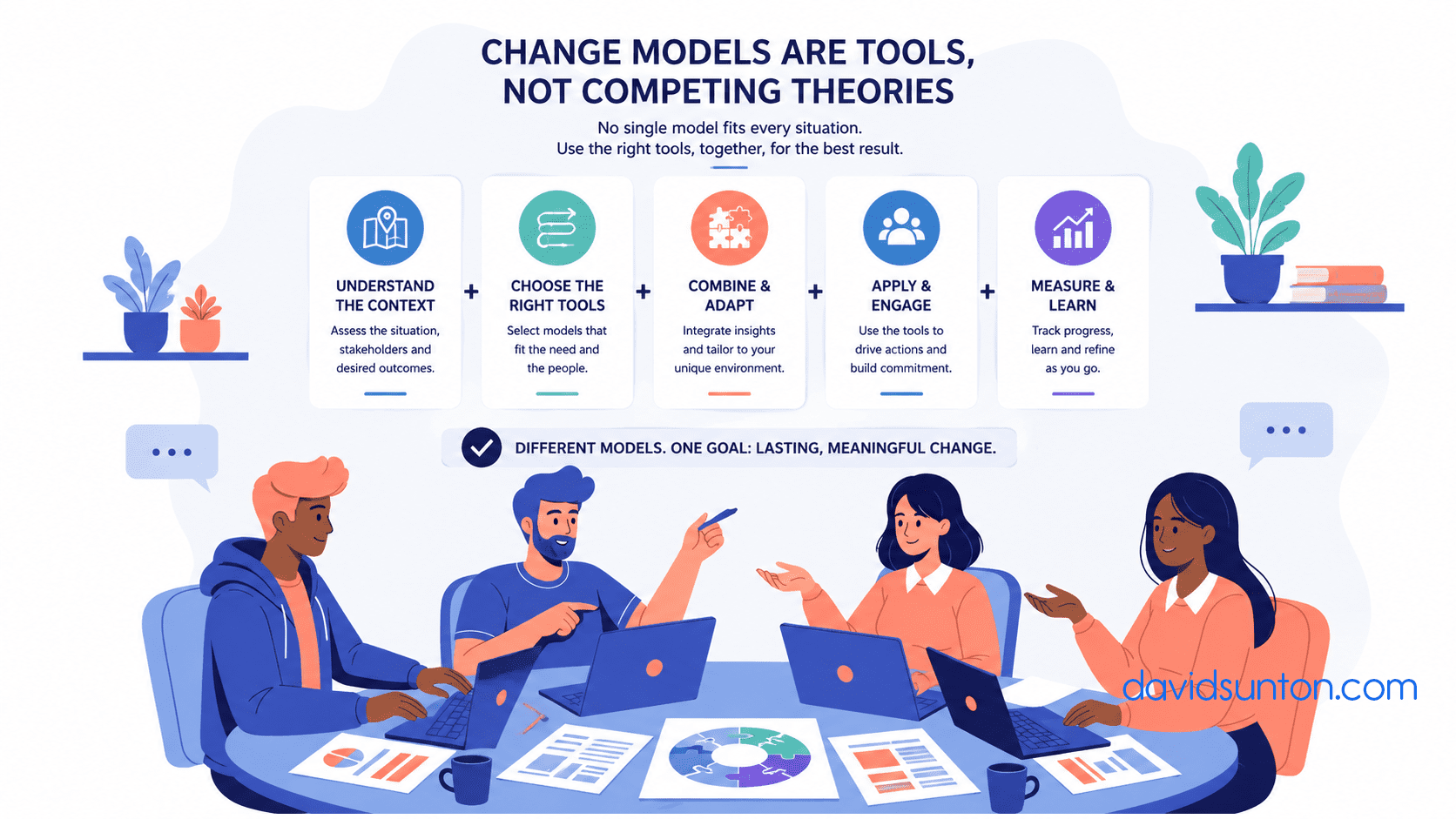
Most change models are not competing belief systems. They are tools. Each helps leaders see a different part of the transformation challenge. The value is not in choosing one model and applying it mechanically. The value is in knowing which model helps answer which question, at which point in the change journey, and for which group of stakeholders.
Table of Contents
This matters because transformation is rarely a neat, linear process. It is not simply a matter of announcing a vision, launching a project, training people, and waiting for adoption. Transformation involves strategy, process, systems, behaviour, incentives, power, trust, resistance, governance and sustained reinforcement.
No single model can fully explain all of that.
The better leadership question is not “Which change model is best?”
The better question is “What do we need to understand right now?”
Models Are Maps, Not The Territory
A good change model is like a map. It gives orientation. It simplifies complexity. It helps leaders identify important features of the terrain.
But the map is not the territory.
The real organisation is always messier than the model. People interpret change differently. Teams move at different speeds. Resistance appears in unexpected places. Priorities shift. Sponsors lose focus. Systems do not behave as expected. A pilot works in one area but struggles in another. A technically sound solution fails because the workflow does not fit operational reality.
This is especially true in AI-enabled transformation.
An AI project may begin as a technology initiative, but it quickly becomes a change problem. It may require new data practices, new decision rights, new review processes, new workflows, new risk controls and new levels of trust. Users may ask whether the AI output is reliable. Managers may wonder who is accountable for AI-assisted decisions. Compliance teams may worry about privacy, transparency and auditability. Frontline employees may fear that the technology will reduce their judgement or replace parts of their role.
No change model solves all of these issues by itself.
But several models, used together, can help leaders ask better questions.
The Mistake: Turning Change Management Models Into Checklists
One of the most common mistakes in transformation is turning change models into checklists.
This happens when leaders take a model and treat it as a sequence of tasks to complete rather than a way of thinking.
Create urgency. Tick.
Build a coalition. Tick.
Communicate the vision. Tick.
Train users. Tick.
Go live. Tick.
Reinforce the change. Tick.
The problem is that change does not become real just because the checklist has been completed. A communication may have been sent, but that does not mean people understand the change. Training may have been delivered, but that does not mean people feel able to use the new system. A sponsor may have endorsed the project, but that does not mean middle managers are reinforcing the new behaviour. A system may have gone live, but that does not mean the old workflow has stopped.
Models become dangerous when they create the illusion of progress.
They are useful when they help leaders diagnose reality.
Lewin: Diagnose The Conditions For Change
Kurt Lewin is often reduced to the simple phrase “unfreeze, change, refreeze.” That version is useful as a basic metaphor, but it can also become too simplistic if leaders treat it as a rigid three-step formula.
Lewin’s deeper value is the idea that behaviour is shaped by the whole field around it. People do not change simply because they are told to change. Their behaviour is held in place by forces such as habits, incentives, relationships, norms, systems, power structures, information flows and perceived risks.
This is a powerful starting point for transformation diagnosis.
Lewin helps leaders ask:
- What is holding the current state in place?
- What forces are pushing for change?
- What forces are restraining change?
- What needs to be prepared before movement is realistic?
- What support is required during transition?
- What will help the new way become embedded?
In an AI transformation, this lens is critical.
For example, an organisation may want employees to use an AI knowledge assistant to reduce repeated internal queries and improve productivity. The technology may work. The content may be loaded. The interface may be simple.
But the current state may still be held in place by powerful forces.
Employees may trust their colleagues more than the AI assistant. Managers may not use the tool themselves. The knowledge base may be incomplete. People may fear that asking basic questions through the system makes them look less competent. Some teams may have developed their own informal workarounds. Others may not believe the assistant reflects the latest policy or process.
Lewin’s value is not just in saying “prepare, move, embed.”
Its value is in helping leaders see the forces that make change difficult before blaming people for poor adoption.
Force Field Analysis: Understand Resistance Before Pushing Harder
Force Field Analysis builds directly on this idea.
It helps leaders identify the driving forces that support change and the restraining forces that hold it back. The practical value is that it encourages leaders to stop assuming resistance is irrational. Resistance often reveals something important about the system.
Driving forces might include customer pressure, rising cost, regulatory requirements, competitive threats, executive sponsorship, productivity goals or the need for better data.
Restraining forces might include poor communication, low trust, change fatigue, capability gaps, unclear accountability, weak data quality, fear of job impact, system complexity or conflicting incentives.
The leadership mistake is to focus only on increasing the driving forces.
Push harder.
Communicate more.
Set tougher deadlines.
Escalate non-compliance.
But in many transformations, pushing harder simply increases resistance. A better approach is often to reduce the restraining forces.
If people do not trust an AI recommendation engine, more executive enthusiasm will not solve the issue. Leaders may need to improve explainability, clarify human review, validate data quality, define accountability and involve users in testing.
If managers are not reinforcing a new process, another all-staff communication will not fix the problem. Leaders may need to diagnose whether managers understand the change, believe in it, have time to support it, or are being measured against conflicting priorities.
Force Field Analysis helps leaders ask a more useful question:
“What is making the current behaviour rational?”
That question changes the quality of the transformation conversation.
ADKAR: Diagnose Individual Adoption
ADKAR is valuable because it brings change down to the individual level.
Organisations do not change in the abstract. People change. Teams change. Managers change. Customers may also need to change how they interact with the organisation.
ADKAR focuses on five adoption conditions:
- Awareness of the need for change
- Desire to participate and support the change
- Knowledge of how to change
- Ability to apply the change in practice
- Reinforcement to sustain the change
This model is especially useful when leaders assume that communication equals adoption.
A person may be aware of a change but have no desire to support it.
They may want to support it but lack the knowledge to use the new process.
They may understand the process but lack the ability to apply it under real workload pressure.
They may use the new way briefly, but return to old habits if reinforcement is weak.
In AI transformation, ADKAR helps leaders diagnose trust and behaviour at a practical level.
For example, a professional services firm may introduce an AI tool to draft client reports, summarise discovery notes and recommend next-step actions. The leadership team may see obvious productivity benefits. But individual consultants may experience the change differently.
Some may not understand why the tool is needed. Some may worry that it reduces the quality of their professional judgement. Some may not know how to prompt the tool effectively. Some may try it once, receive a weak output, and stop using it. Some may use it but remain unsure what they are allowed to share, edit or rely on.
ADKAR helps leaders diagnose the adoption gap with more precision.
The problem may not be “people are resistant.”
The problem may be lack of awareness, weak desire, insufficient knowledge, limited ability or missing reinforcement.
Each requires a different response.
Kotter: Mobilise Momentum Across The Organisation
Kotter’s 8-Step model is useful because it focuses on momentum, mobilisation and leadership attention.
Large transformations often fail not because the first launch goes badly, but because momentum fades. The initial excitement passes. Sponsors become distracted. Teams return to urgent operational work. Early resistance is underestimated. Short-term wins are not made visible. The organisation declares success too early.
Kotter helps leaders think about how to build and sustain movement.
It encourages leaders to create urgency, build a guiding coalition, form a clear vision, communicate it, remove barriers, generate short-term wins, consolidate gains and anchor the change in culture.
This is valuable because transformation is not just an analytical exercise. It is also a mobilisation challenge.
People need to believe the change matters. Leaders need to stay aligned. Middle managers need to translate the change locally. Early wins need to create confidence. Barriers need to be removed quickly. The organisation needs to see that the change is not another temporary initiative that will disappear when attention shifts.
In an AI transformation, Kotter can be useful when moving from pilot to scale.
A small AI pilot may show promise in one team. But scaling it across the organisation requires more than a technical rollout. Leaders need a coalition across business, technology, risk, legal, operations, HR and frontline teams. They need a clear narrative about why the change matters. They need visible use cases that create confidence. They need to remove policy, data, process and capability barriers. They need to avoid declaring victory after the pilot.
Kotter is not a perfect recipe, but it is a useful lens for sustaining organisational energy.
How To Use Models Together
The practical value of change models increases when leaders use them together rather than treating them as alternatives.
Each model can answer a different diagnostic question.
Lewin helps ask: What is holding the current state in place?
Force Field Analysis helps ask: What forces are supporting or restraining the change?
ADKAR helps ask: What does each individual or stakeholder group need in order to adopt the change?
Kotter helps ask: How do we create urgency, coalition, momentum and reinforcement across the organisation?
Used together, these models provide a richer view of transformation.
They help leaders move from generic change activity to targeted diagnosis and action.
Example: Applying Multiple Models To An AI Workflow Change
Imagine an organisation wants to introduce an AI-enabled workflow to triage customer enquiries, summarise key information, recommend next actions and route complex cases to the right specialist.
A technology-led approach might focus mainly on implementation:
Select the tool.
Configure the workflow.
Connect the systems.
Train users.
Go live.
A change-led approach would diagnose more deeply.
Using Lewin, leaders would ask what currently holds the existing workflow in place. Perhaps teams rely on manual judgement because past routing rules were inaccurate. Perhaps specialists do not trust upstream classification. Perhaps customer data is incomplete. Perhaps informal relationships help work move faster than the official process.
Using Force Field Analysis, leaders would identify driving forces such as faster response times, reduced backlog and improved consistency. They would also identify restraining forces such as poor data quality, fear of job redesign, unclear exception handling and concerns about AI accuracy.
Using ADKAR, leaders would examine whether frontline staff understand why the workflow is changing, whether they want to use it, whether they know how to interpret AI recommendations, whether they can apply it during real customer pressure, and whether managers reinforce the new process.
Using Kotter, leaders would build urgency around customer experience and operational performance, create a cross-functional coalition, communicate the future workflow, remove barriers, show early wins and avoid declaring success before adoption is sustained.
Using a campaign mindset, leaders would tailor messages for frontline employees, team leaders, risk teams, customer service managers and executives. They would use stories, examples, FAQs, demonstrations, feedback loops and visible leadership behaviour to build confidence.
The result is a better transformation approach.
The models are not competing.
They are working together.
The Risk Of Model Loyalty
Leaders can become too loyal to a single model.
This can narrow their thinking.
If everything is viewed through a project delivery lens, adoption becomes an end-stage activity.
If everything is viewed through ADKAR, leaders may focus heavily on individual readiness but underplay structural barriers.
If everything is viewed through Kotter, leaders may focus on urgency and coalition but miss operational workflow details.
If everything is viewed through process design, leaders may optimise the workflow but underestimate emotion, identity, trust and politics.
If everything is viewed through agile change, leaders may celebrate experimentation but underinvest in governance and reinforcement.
Every model reveals something.
Every model also hides something.
That is why leaders should use models with discipline, but not with blind loyalty.
What Leaders Should Do Instead
Rather than asking which model to use, leaders should start with the change problem.
They should ask:
What are we trying to change?
Who needs to behave differently?
What is holding the current state in place?
What forces support or restrain the change?
What does each stakeholder group need in order to adopt the new way?
Where do we need urgency, coalition and visible leadership?
What needs to be embedded into process, systems, governance and routines?
How will we know whether adoption is happening?
Which model helps us answer the most important question right now?
This approach is more practical than model selection.
It turns change models into a toolkit.
A Practical Change Model Toolkit
For leaders managing transformation, a simple toolkit might look like this.
Use Lewin when you need to understand the broader conditions that make change difficult.
Use Force Field Analysis when you need to identify the forces supporting and restraining change.
Use ADKAR when you need to diagnose individual or stakeholder adoption gaps.
Use Kotter when you need to build urgency, leadership alignment, momentum and reinforcement.
Use a campaign approach when you need to influence belief, meaning and behaviour over time.
Use process mapping when you need to understand how work actually flows.
Use benefits realisation when you need to ensure the change delivers measurable value after go-live.
The strength is not in any one tool.
The strength is in knowing when and how to use each one.
Why This Matters For AI Transformation
AI transformation makes this toolkit even more important.
AI initiatives often fail when organisations treat them as technology deployments rather than operating model changes.
An AI solution may require people to trust a recommendation, review an output, approve an exception, change a workflow, rely on new data, follow new controls, or make decisions differently.
That means leaders must diagnose more than technical feasibility.
They must diagnose business value, process fit, data readiness, risk, accountability, adoption and reinforcement.
A model alone will not make AI transformation successful. But the right combination of models can help leaders avoid common mistakes:
Starting with the tool instead of the problem.
Automating a poor process.
Assuming communication equals adoption.
Treating resistance as negativity instead of information.
Scaling a pilot before the operating model is ready.
Declaring victory at go-live.
Ignoring governance until risk appears.
Underestimating middle managers.
Failing to reinforce the new behaviour.
AI may be new, but many of the reasons AI transformation fails are familiar change-management problems.
The models help leaders see those problems earlier.
Final Thought
Change models are not there to make transformation look neat.
They are there to help leaders ask better questions.
Lewin helps leaders understand the field.
Force Field Analysis helps leaders understand the forces.
ADKAR helps leaders understand individual adoption.
Kotter helps leaders mobilise momentum.
None of these models is complete on its own.
All of them can be useful when applied with judgement.
The goal is not to prove that one model is right.
The goal is to make the transformation work.
That requires leaders to move beyond model loyalty and into practical diagnosis.
Because in real transformation, the best leaders do not ask, “Which theory should we follow?”
They ask, “What is really happening here, and which tool will help us lead the change better?”