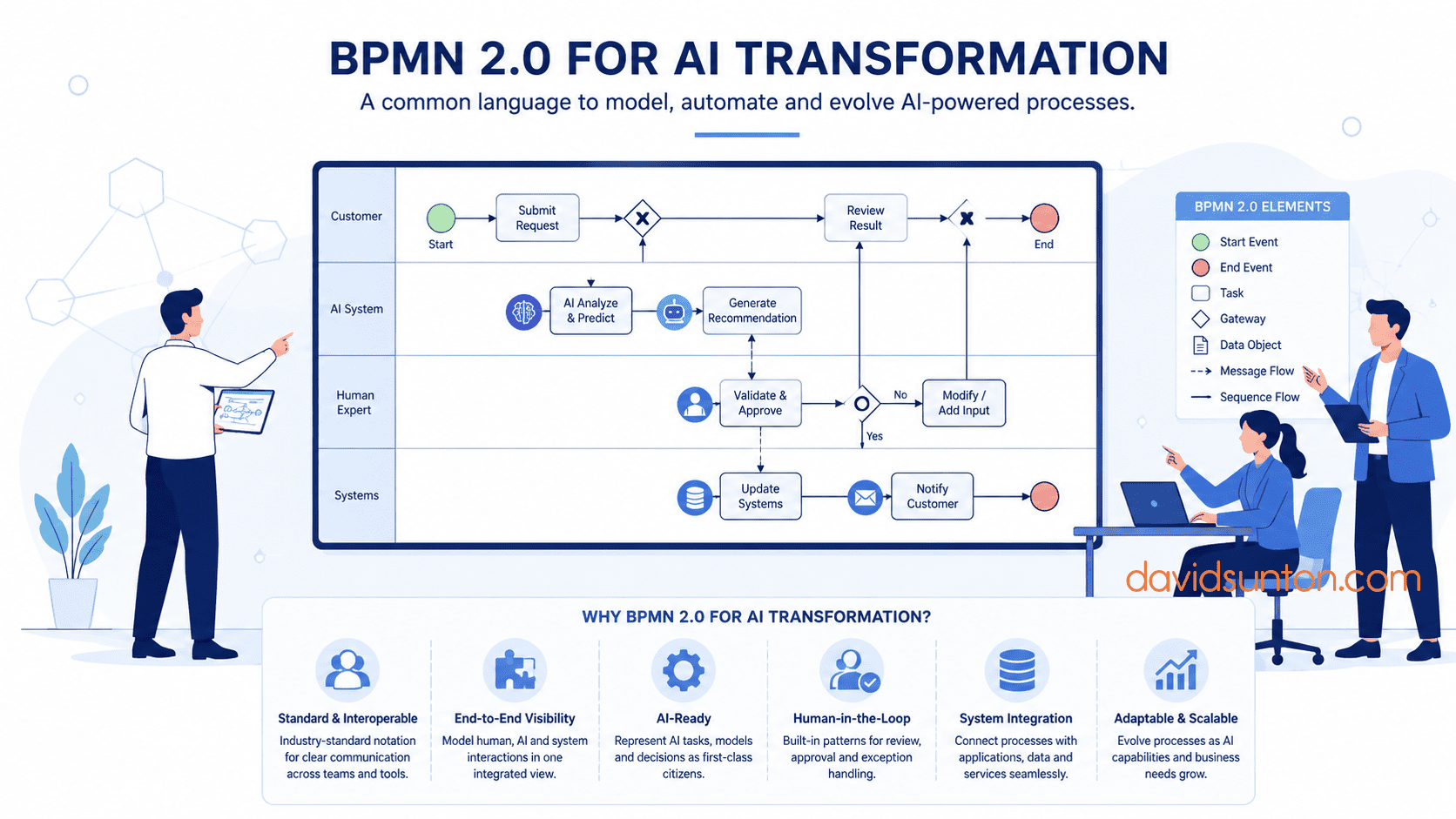
BPMN stands for Business Process Model and Notation. It is a standard way to visually model how business processes work, including activities, events, decisions, handoffs, roles, systems and outcomes.
The “2.0” refers to the modern version of the BPMN standard, which expanded and formalised the notation so process models could be more precise, consistent and useful across business and technical teams. In simple terms, BPMN 2.0 is not just a drawing style. It is a shared process language that can help organisations describe how work flows and, in more advanced environments, connect process models to workflow execution.
BPMN 2.0 is often treated as a process diagramming method.
That is true, but it understates its value.
For AI transformation, BPMN 2.0 can do something more important than create diagrams. It can help leaders, business teams, process owners, technology teams and change leaders develop a shared understanding of how work actually happens before AI, automation or agents are introduced.
That shared understanding matters because AI does not create value in isolation.
Table of Contents
AI creates value when it is embedded into a clear process, supports the right decisions, uses the right data, involves humans at the right points, handles exceptions properly and operates within governance boundaries people can trust.
Without process clarity, AI transformation becomes risky.
An organisation may automate a broken workflow.
An AI agent may act without clear authority.
A human review step may become a bottleneck.
A model output may go to the wrong person.
An exception may have no escalation path.
A system integration may update the wrong record.
A process may look efficient in a pilot but fail when it meets real operational complexity.
BPMN 2.0 helps reduce these risks by making the work visible.
It shows the sequence of activities, decision points, handoffs, events, systems, roles, exceptions and outcomes. It helps teams ask better questions before implementation begins. It creates a practical bridge between business process design and AI-enabled execution.
The question is not simply, “Can we use AI here?”
The better question is, “How does the work flow, where should AI assist, and what needs to be designed around it for the change to succeed?”
That is where BPMN 2.0 becomes valuable for AI transformation.
AI Transformation Needs Process Visibility
Many AI initiatives begin with a capability discussion.
Can AI summarise this?
Can AI classify that?
Can AI generate a response?
Can AI extract information?
Can AI detect patterns?
Can AI route work?
Can AI perform tasks across systems?
These are useful questions, but they are incomplete.
Before leaders decide where AI should be used, they need to understand the process around the AI capability.
For example, if AI summarises a customer enquiry, who receives the summary? What do they do with it? Does it support routing, prioritisation, response drafting or escalation? What happens if the summary is incomplete or wrong? Is there a human review step? Is the summary saved into a system? Does it become part of the customer record?
If AI classifies a document, what categories are allowed? What happens when the classification is uncertain? Who handles exceptions? Does classification trigger an approval workflow? Does it update an ERP or CRM? How is the decision audited?
If an AI agent takes action, what triggers the action? What permissions does it have? What systems can it access? What decisions can it make? When must it stop and ask a human?
These are process questions.
BPMN 2.0 gives teams a way to answer them visibly.
It moves the discussion from abstract AI potential to the real flow of work.
BPMN 2.0 Is More Than Boxes And Arrows
At a surface level, BPMN diagrams can look like boxes and arrows.
Tasks. Events. Gateways. Sequence flows. Pools. Lanes. Messages. Start points. End points.
But the value of BPMN is not the symbols alone.
The value is the discipline it brings to process thinking.
BPMN asks teams to clarify:
What starts the process?
Who performs each task?
What happens next?
Where does a decision occur?
What conditions determine the path?
What message or data moves between participants?
What system is involved?
Where does the process end?
What happens when something goes wrong?
These questions are highly relevant to AI transformation.
AI often fails when teams skip over process detail. They know the intended outcome, but they have not mapped how work moves from trigger to completion. They know the AI output, but not the human action that follows. They know the automation step, but not the exception path. They know the tool, but not the governance model.
BPMN helps make those missing details visible before they become implementation issues.
Mapping The Current State Before AI
One of the most important uses of BPMN in AI transformation is current-state mapping.
Before designing an AI-enabled future process, leaders need to understand how work happens today.
Not how the policy says it happens.
Not how the process document says it should happen.
Not how executives think it happens.
How it actually happens.
This includes formal steps, informal workarounds, repeated handoffs, manual checks, approval delays, system gaps, duplicated effort, rework loops, unclear decisions and exception handling.
For example, a customer support process may appear simple at a high level:
Customer submits enquiry.
Support team reviews it.
Issue is resolved.
Case is closed.
But a BPMN current-state map may reveal a more complex reality.
The enquiry arrives through multiple channels. Staff manually identify the customer. Some cases need information from CRM. Others require product knowledge from a separate system. Some require manager approval. Some are escalated informally through chat. Some are handled differently by experienced staff. Some categories are unclear. Some cases are reopened because the first response was incomplete.
This matters for AI.
If the organisation introduces an AI agent into the simplified version of the process, the solution may fail.
If it introduces AI into the real process, the design can be far more practical.
Current-state mapping helps leaders avoid automating assumptions.
Designing The Future State With AI In Mind
Once the current state is visible, BPMN can help design the future state.
This is where AI-enabled transformation becomes practical.
The future-state process should show how work will flow after AI is introduced.
Where does AI enter the process?
What task does it perform?
What data does it need?
What output does it produce?
Who reviews that output?
What decision does it support?
What happens when the AI is confident?
What happens when the AI is uncertain?
What happens when the case is sensitive or high risk?
What system gets updated?
Where does the process end?
This is more useful than simply saying, “AI will automate triage” or “AI will support reporting.”
The future-state BPMN map turns the AI concept into a workflow.
It helps teams see what will actually change.
It also helps leaders explain the change to stakeholders. People can see where their role remains, where AI assists, where decisions happen and how exceptions are handled.
This supports adoption because users are less likely to trust a vague AI initiative than a clearly designed workflow.
BPMN Helps Identify Where AI Should Assist
Not every task in a process should be automated.
Not every decision should be delegated to AI.
Not every manual step is waste.
Some manual steps exist because judgement is required. Some exist because risk is high. Some exist because data is incomplete. Some exist because systems do not integrate. Some exist because historical workarounds became normal.
BPMN helps leaders identify where AI can assist safely and usefully.
AI may be well suited to tasks such as:
- classifying inbound requests
- summarising long records
- extracting data from documents
- retrieving relevant knowledge
- drafting responses
- recommending next actions
- flagging anomalies
- routing work
- preparing decision support
- monitoring exceptions
But BPMN also helps identify where human involvement remains necessary.
Humans may need to handle sensitive cases, approve high-risk actions, interpret ambiguous context, manage customer relationships, apply professional judgement, resolve exceptions or make final decisions.
The point is not to replace every human task.
The point is to design the right relationship between AI assistance, human judgement and process control.
BPMN gives that relationship a visible structure.
BPMN Makes Human-In-The-Loop Design Concrete
Human-in-the-loop is often discussed as a principle.
BPMN helps turn it into a process design.
A diagram can show exactly where human review occurs, what triggers it, who performs it, what decision is made and what happens next.
This is important because “human-in-the-loop” can mean many different things.
A human may review every AI output.
A human may review only exceptions.
A human may approve high-risk actions.
A human may validate extracted data.
A human may monitor quality.
A human may provide feedback to improve the AI system.
A human may intervene only when confidence is low.
Each design has different implications for risk, efficiency, workload and accountability.
For example, an AI document processing workflow may include a gateway after data extraction:
If confidence is high and required fields are complete, the process continues to system update.
If confidence is low or fields are missing, the case moves to human review.
If the document contains a sensitive clause or financial threshold breach, the case moves to specialist approval.
This is human-in-the-loop as a workflow, not a slogan.
BPMN helps leaders define human judgement with precision.
BPMN Highlights Decisions And Gateways
AI transformation often changes decision flows.
That makes gateways one of the most important BPMN elements for AI-enabled process design.
A gateway shows where the process path changes based on a condition, decision or event.
For AI transformation, gateways can help define:
Is the AI confidence score high enough?
Is the request low risk or high risk?
Is human approval required?
Is the customer verified?
Is the data complete?
Does the case match an approved category?
Is the issue urgent?
Is escalation required?
Should the agent proceed, recommend or stop?
These decisions need to be explicit.
If they remain vague, the AI-enabled process becomes difficult to govern.
For example, an AI agent may be allowed to automatically respond to simple customer enquiries. But a gateway should define what counts as simple. It may depend on category, customer type, confidence level, sentiment, topic sensitivity, regulatory risk or missing information.
BPMN helps show these conditions in the process.
This supports both technical design and governance because the rules are visible.
BPMN Helps Design Exception Handling
Exceptions are where many AI-enabled workflows fail.
The standard path may look simple.
The enquiry is clear. The data is complete. The AI output is accurate. The user accepts the recommendation. The workflow completes.
But real work is full of exceptions.
Information is missing.
Data conflicts.
Customers are unclear.
Documents are incomplete.
Systems are unavailable.
AI confidence is low.
Policy is ambiguous.
A case is urgent.
A customer is angry.
A request falls outside the approved scope.
BPMN helps teams design what happens when the normal path fails.
It can show escalation routes, manual review, error handling, alternative paths, timeout events, boundary events and exception outcomes.
This is important because exception design protects trust.
If users do not know what to do when AI is wrong or uncertain, they may stop using it. If customers experience unresolved exceptions, service quality suffers. If risk teams cannot see how exceptions are handled, governance confidence weakens.
A well-designed AI process should not assume everything will go right.
It should show what happens when things go wrong.
BPMN is useful because it makes exception handling visible before implementation.
BPMN Supports Governance And Accountability
AI governance often becomes abstract.
Policies, principles, frameworks and risk statements are important, but they need to connect to actual work.
BPMN helps connect governance to the process.
It can show:
Who owns each step.
Where approval is required.
Where audit logs are created.
Where human review occurs.
Where risk checks happen.
Where data is accessed.
Where decisions are made.
Where exceptions are escalated.
Where the AI agent is allowed to act.
Where it must stop.
This makes governance practical.
For example, a policy may state that AI cannot make final decisions on high-risk customer complaints. A BPMN process can show exactly how high-risk complaints are identified, where they are routed, who reviews them and how the decision is recorded.
A policy may state that AI outputs must be auditable. A BPMN process can show where outputs are logged and who can review them.
A policy may state that human approval is required before system updates. A BPMN process can show the approval task and the system update that follows.
Governance becomes more effective when it is embedded into process design.
BPMN Helps Align Business And Technical Teams
One of the biggest challenges in AI transformation is translation.
Business teams understand the work, customers, risks and operational reality.
Technical teams understand systems, data, integrations, models and automation possibilities.
Change teams understand adoption, stakeholder impact and behaviour.
Risk teams understand controls, compliance and accountability.
These groups often use different language.
BPMN creates a shared visual language.
It helps business teams explain how work happens.
It helps technical teams understand what needs to be built or integrated.
It helps change teams see who is affected and where behaviour needs to shift.
It helps governance teams see where controls are required.
This alignment matters because many AI project issues are not caused by lack of technical capability. They are caused by misunderstandings about process, ownership, decision rights, exceptions and user behaviour.
A BPMN model gives teams something concrete to discuss, challenge and improve.
It reduces ambiguity.
It also helps identify assumptions early.
BPMN Can Support AI Agent Design
AI agents need process design because they operate inside workflows.
BPMN can help define the agent’s role.
In a BPMN model, an AI agent may be represented as a task performer, a system participant, or part of an automated service task, depending on the level of detail required.
The important point is not the exact notation choice.
The important point is clarity.
What does the agent do?
When does it act?
What data does it use?
What system does it access?
What output does it produce?
What decision does it support?
When does it escalate?
What human review follows?
What is logged?
For example, an AI agent in a customer support workflow may perform several tasks:
Classify enquiry.
Summarise issue.
Retrieve relevant policy.
Recommend next action.
Route case.
Escalate low-confidence or sensitive cases.
Each task can be placed into the workflow with clear conditions and handoffs.
This prevents the agent from being treated as a vague capability.
It becomes part of an orchestrated process.
BPMN Helps Avoid Automation-First Thinking
Automation-first thinking starts with the question, “What can we automate?”
Process-led thinking starts with a better question: “How should this work happen?”
This distinction is critical for AI transformation.
If organisations begin with automation, they may accelerate poor workflows. They may remove human judgement where it is still needed. They may create new risks. They may solve a visible symptom while leaving the root cause untouched.
BPMN encourages leaders to examine the process first.
What is the purpose of the process?
Where does value get created?
Where does waste occur?
Where are decisions made?
Where are customers affected?
Where are risks introduced?
Where are people overloaded?
Where does AI genuinely help?
This makes AI transformation more disciplined.
It helps leaders avoid the trap of digitising confusion.
The goal is not just to automate work.
The goal is to design better work.
Example: BPMN For AI Customer Enquiry Triage
Consider an organisation that wants to use AI for customer enquiry triage.
A vague AI idea might be:
“Use AI to handle customer enquiries.”
A BPMN-informed process design would be more specific.
The workflow begins when an enquiry is received through email, web form, chat or phone transcript.
The AI classifies the enquiry type.
The AI summarises the customer issue.
The system checks whether the customer is verified.
A gateway determines whether the case is low risk, high risk, urgent or unclear.
Low-risk cases may receive a drafted response for agent review.
High-risk cases may be escalated to a specialist.
Unclear cases may require additional information from the customer.
Urgent cases may trigger priority handling.
The final response is reviewed, sent, recorded and monitored.
Exceptions are logged and reviewed to improve the process.
This process design clarifies where AI helps and where humans remain responsible.
It also shows the data, governance and adoption requirements.
Customer categories must be clear.
Knowledge sources must be approved.
Human review rules must be defined.
Escalation paths must be agreed.
Managers must reinforce the workflow.
Success metrics must track response time, routing accuracy, rework, customer satisfaction and exception volume.
The AI use case becomes practical because the process is visible.
Example: BPMN For AI Document Processing
Now consider AI document processing.
The organisation wants to use AI to read supplier documents, extract key fields and update internal systems.
Without process design, the initiative might focus only on extraction accuracy.
But the end-to-end workflow is broader.
A BPMN model may show:
Supplier document received.
Document type identified.
Required fields extracted.
Data validated against supplier and product records.
Gateway checks whether confidence is high and fields are complete.
If complete, the record moves to approval.
If incomplete, the case goes to human review.
If there is a pricing variance, it escalates to a category manager.
If there is a compliance issue, it escalates to risk or finance.
Approved updates are pushed to the ERP.
Audit log is created.
Supplier is notified if clarification is needed.
This process view shows that AI extraction is only one part of the workflow.
The real value comes from combining AI, validation, human review, approval, system update and auditability.
BPMN helps ensure the solution is not designed as a standalone tool, but as a governed business process.
BPMN And Adoption
Process design is not only a technical or operational activity.
It also supports adoption.
People are more likely to adopt an AI-enabled process when they can see how it works.
A BPMN model can help explain:
What changes in the workflow.
What the AI does.
What people still control.
Where decisions happen.
Where exceptions go.
How risks are managed.
What systems are involved.
What success looks like.
This visibility reduces uncertainty.
It helps users understand their role. It helps managers reinforce the new process. It helps risk teams confirm controls. It helps technical teams build the right integration. It helps leaders communicate the change in practical terms.
BPMN does not replace change management.
But it gives change management something concrete to work with.
Instead of communicating a vague AI initiative, leaders can explain a new way of working.
That makes adoption more realistic.
When BPMN May Be Too Much
BPMN is useful, but it should be applied with judgement.
Not every AI idea needs a complex process model.
A small internal productivity use case may only need a simple workflow sketch. A low-risk drafting assistant may not require detailed BPMN modelling. Early ideation may benefit from lighter process mapping before formal modelling.
The level of detail should match the complexity and risk of the use case.
BPMN becomes more valuable when:
- the workflow crosses multiple teams
- systems need integration
- decisions and approvals matter
- exceptions are common
- governance is important
- customer impact is significant
- AI agents may act across systems
- human-in-the-loop design is required
- the process will be scaled across the organisation
The goal is not to create beautiful diagrams.
The goal is to create enough process clarity to support better decisions, design, governance and adoption.
A Practical BPMN Lens For AI Transformation
Leaders can use a simple BPMN-inspired lens before starting an AI-enabled workflow project.
Start Event: What triggers the process?
Participants: Which teams, roles, systems or agents are involved?
Tasks: What work is performed, and by whom?
AI Tasks: Where can AI classify, summarise, retrieve, generate, recommend, route or act?
Gateways: Where are decisions made, and what conditions determine the path?
Human Review: Where is judgement, approval or escalation required?
Data Objects: What information is needed, created or updated?
Systems: Which tools or platforms are involved?
Exceptions: What happens when the normal path fails?
End Event: What outcome completes the process?
Governance: What needs to be logged, monitored, approved or audited?
This lens helps teams move from AI possibility to workflow clarity.
It also aligns naturally with AI-enabled process design and orchestration.
Final Thought
BPMN 2.0 matters for AI transformation because AI must be designed into work, not simply attached to it.
AI can classify, summarise, generate, predict, recommend, retrieve and act. But those capabilities only create value when they fit into a clear, governed and adoptable business process.
BPMN helps leaders see how work flows before they automate it.
It helps teams identify where AI belongs, where humans remain accountable, where decisions occur, where exceptions need handling and where governance must be embedded.
The strongest AI transformation efforts do not begin with the question, “Where can we add AI?”
They begin with a better question:
“How should this process work, and where can AI make it faster, smarter, safer or more scalable?”
That is why BPMN 2.0 is more than diagramming.
For AI transformation, it is a practical tool for turning process clarity into AI-enabled execution.