Human-in-the-loop is one of the most common phrases in AI transformation.
It is also one of the most misunderstood.
Many organisations use the phrase to reassure stakeholders that AI will not operate without human oversight. The intention is good. It signals that people will remain involved, judgement will not be removed entirely, and risk will be managed.
Table of Contents
But saying “we will keep a human in the loop” is not enough.
Which human?
In which loop?
At what point in the workflow?
Reviewing what output?
With what authority?
Against what standard?
Within what timeframe?
What happens if they disagree with the AI?
What happens if the AI is uncertain?
What happens if the human reviewer is unavailable?
What gets logged?
Who is ultimately accountable?
These are not minor implementation details. They are central design questions.
Human-in-the-loop is not just a governance principle. It is a workflow design decision.
If it is designed well, it can improve trust, quality, accountability and adoption. If it is designed poorly, it can create bottlenecks, confusion, false assurance, inconsistent decisions or unnecessary manual work.
AI systems do not need humans in every step.
They need humans in the right places, for the right reasons, with the right authority and support.
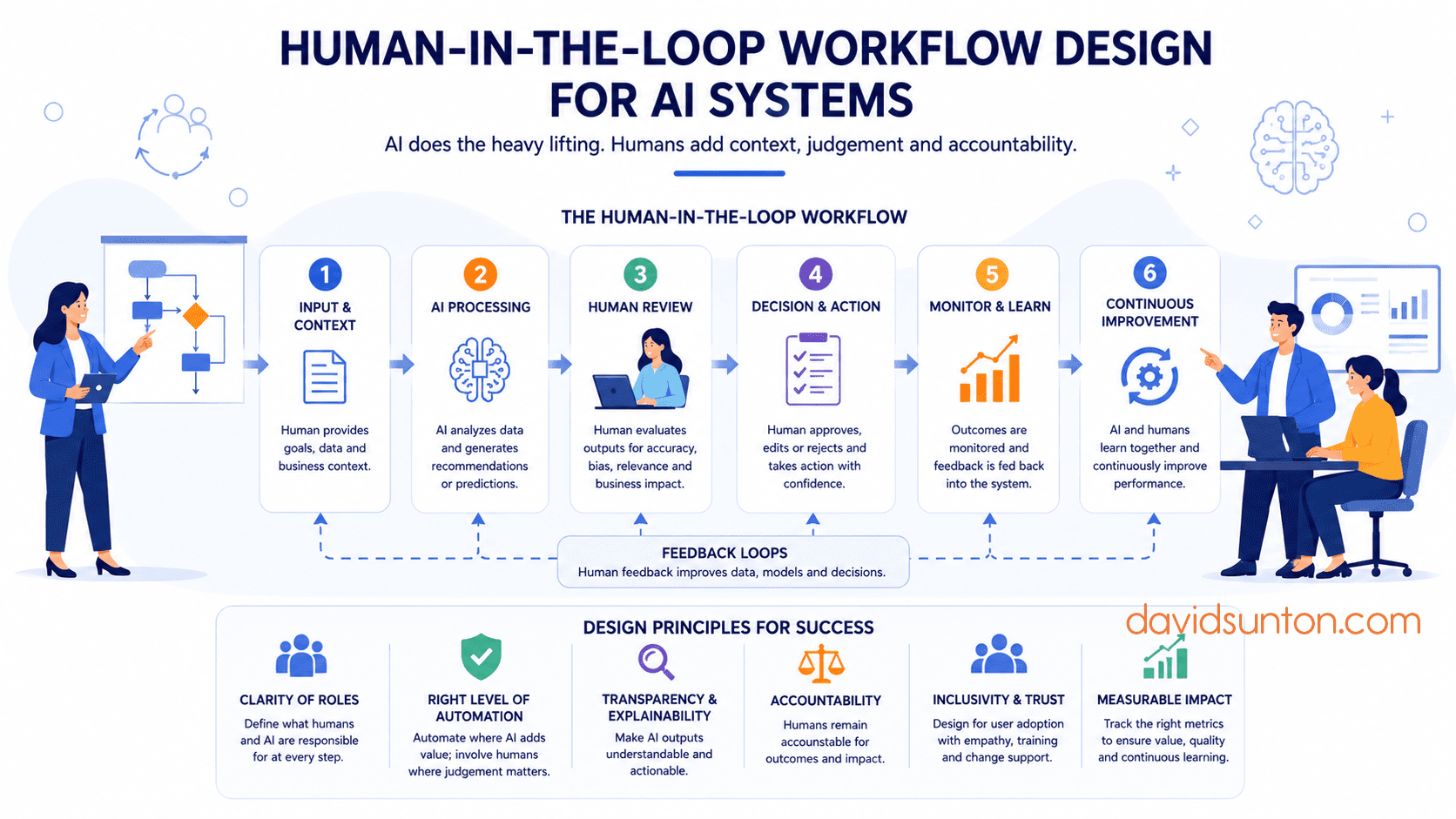
Why Human-In-The-Loop Matters
AI systems can classify, summarise, generate, recommend, predict, retrieve information, detect anomalies and perform tasks across systems. These capabilities can improve productivity, service quality, decision support and process efficiency.
But AI outputs are not always perfect.
They may be incomplete, outdated, biased, uncertain, overconfident, poorly contextualised or based on weak data. They may be technically plausible but operationally wrong. They may work well in standard scenarios but struggle with exceptions, ambiguity, sensitive cases or high-risk decisions.
This is why human judgement remains important.
Humans can interpret context, weigh trade-offs, understand customer emotions, apply ethical judgement, consider exceptions, challenge outputs, approve sensitive actions and remain accountable for decisions that should not be delegated entirely to AI.
However, the point is not to insert humans everywhere.
If humans review every AI output regardless of risk, the workflow may become slower than the original process. If humans only rubber-stamp AI outputs without understanding their responsibility, the organisation may create false control. If human review is unclear, users may not know whether they are expected to trust, challenge, approve or ignore the AI.
The value comes from deliberate design.
Human-in-the-loop should answer a practical question:
Where does human judgement add value, reduce risk or create accountability in this workflow?
Human-In-The-Loop Is Not One Design
There is no single human-in-the-loop model.
Different AI use cases need different forms of human involvement.
In some workflows, humans review every output before action.
In others, humans review only exceptions, high-risk cases or low-confidence outputs.
Sometimes humans approve final decisions.
Sometimes humans monitor quality.
Sometimes humans provide feedback to improve the AI system.
Sometimes humans override AI recommendations.
Sometimes humans handle escalations when the system reaches a boundary.
Sometimes humans are involved before the AI acts, by setting rules, approving knowledge sources or defining constraints.
These are all different forms of human-in-the-loop design.
For example, an AI assistant that drafts internal meeting summaries may only need light human review before the summary is shared.
An AI system that drafts customer-facing advice may need stronger review depending on topic, risk and customer impact.
An AI agent that updates a CRM record may need human approval only for certain fields or conflicting data.
An AI system that supports compliance, health, financial, legal or safety-related decisions may require formal review, audit trails and clearly assigned accountability.
The design should match the use case.
The Risk Of Vague Human Oversight
Vague human oversight can create several risks.
The first risk is false assurance.
A process may include a human review step, but the reviewer may not know what they are responsible for checking. They may assume the AI output has already been validated. They may approve quickly because of workload pressure. They may not have enough context or authority to challenge the output.
The second risk is bottlenecking.
If every AI output requires manual review, the workflow may slow down. The organisation may remove the benefit it hoped to create. Human review should be focused where it matters most.
The third risk is inconsistent judgement.
If review criteria are unclear, different reviewers may make different decisions. One person may approve an AI-generated response. Another may reject the same type of response. This reduces trust and process reliability.
The fourth risk is unclear accountability.
If an AI recommendation leads to a poor outcome, who is accountable? The user? The manager? The process owner? The AI vendor? The governance team? If this is not clear, adoption and risk management both suffer.
The fifth risk is user avoidance.
If people are unsure what AI is allowed to do or what they are responsible for reviewing, they may avoid using the system altogether.
Human-in-the-loop only works when the loop is explicit.
Start With The Workflow, Not The AI Output
A common mistake is to design human review around the AI output alone.
The AI produces something, then a human checks it.
That may be necessary, but it is too narrow.
Leaders should start with the end-to-end workflow.
What triggers the process?
What work needs to be done?
What task does AI perform?
What decision or action follows?
What is the risk if the AI is wrong?
What information does the human need to review it?
What authority does the human have?
What happens next?
For example, if AI drafts a customer response, the review process should not only ask whether the wording is acceptable. It should consider the customer context, policy rules, risk level, sensitivity, accuracy, tone, escalation requirements and whether the response should be sent at all.
If AI extracts information from a supplier document, the human review should be connected to the workflow. Is the reviewer validating field accuracy, checking margin impact, approving a price update, resolving missing information or confirming an exception path?
Human review should be designed around the decision or action the AI output supports.
That makes the loop more meaningful.
The Five Human Roles In AI Workflows
Human-in-the-loop design becomes clearer when leaders distinguish between different human roles.
1. Reviewer
A reviewer checks an AI output before it is used.
This may include reviewing a draft response, validating extracted data, checking a summary, confirming a classification or assessing a recommendation.
The reviewer role is useful when the AI output needs human validation before it affects a customer, system, decision or record.
However, reviewers need clear criteria.
What are they checking for?
Accuracy?
Completeness?
Tone?
Policy compliance?
Risk?
Missing information?
If review criteria are unclear, review quality becomes inconsistent.
2. Approver
An approver has authority to allow an action to proceed.
This role is stronger than review.
For example, a manager may approve an AI-recommended refund, a finance lead may approve a supplier price update, or a compliance officer may approve a high-risk customer communication.
Approvers need decision rights, accountability and visibility of the evidence behind the AI recommendation.
An approval step should be used when the action has meaningful consequence.
3. Exception Handler
An exception handler takes over when the AI cannot proceed safely or confidently.
Exceptions may occur because information is missing, data conflicts, confidence is low, the request falls outside scope, the topic is sensitive, or a system error occurs.
Exception handlers need context.
They should receive the AI output, the reason for escalation, relevant data and suggested next steps where appropriate.
Without good exception design, escalations become messy and frustrating.
4. Supervisor
A supervisor monitors performance across the workflow.
This role is less about approving individual outputs and more about observing patterns.
Are AI outputs accurate?
Are users accepting recommendations?
Are exceptions increasing?
Are certain categories causing errors?
Are humans over-relying on the AI?
Are users bypassing the process?
Supervision supports continuous improvement and governance.
5. Accountable Owner
The accountable owner is responsible for the process outcome.
This may be a business process owner, operational leader, risk owner or product owner.
The accountable owner ensures the AI-enabled workflow continues to deliver value, manage risk and improve over time.
This role is critical because AI systems should not become ownerless after go-live.
Someone must remain accountable for the process, not just the technology.
Match Human Involvement To Risk
Human-in-the-loop design should be risk-based.
Not every AI output needs the same level of human review.
A low-risk internal summary may only require user editing.
A customer-facing message may require review before sending.
A financial adjustment may require approval.
A legal, health, safety or compliance-related recommendation may require specialist oversight.
A low-confidence output may need escalation.
A high-confidence, low-risk task may be automated within defined boundaries.
Leaders can think in levels.
Low risk: AI assists, human uses judgement as needed.
Moderate risk: AI drafts or recommends, human reviews before action.
High risk: AI supports, human approves final decision.
Critical risk: AI provides input only, accountable experts make decisions under formal governance.
This risk-based approach prevents two mistakes.
It prevents over-control, where every output is reviewed and the process becomes inefficient.
It prevents under-control, where AI is allowed to act in areas where human judgement and accountability are essential.
Design For Confidence, Uncertainty And Escalation
AI systems often produce outputs with different levels of confidence or reliability.
The workflow should respond to that variation.
If confidence is high and risk is low, the process may continue automatically or with light review.
If confidence is low, the case may move to human review.
If the topic is sensitive, the case may escalate regardless of confidence.
If required information is missing, the workflow may ask for clarification.
If the output conflicts with policy or data, the process may stop and require specialist review.
This is where gateways and decision rules matter.
For example, an AI triage system may classify customer enquiries. The workflow could be:
High confidence and low-risk category: route automatically.
Low confidence: send to human triage.
Sensitive category: escalate to specialist team.
Missing customer information: request clarification.
Multiple possible categories: route to human review with suggested options.
This design is far stronger than saying “humans will review when needed.”
It defines when review is needed and why.
Avoid The Rubber-Stamp Problem
One of the biggest risks in human-in-the-loop design is rubber-stamping.
This happens when humans approve AI outputs without meaningful review.
It may occur because people are busy, because the AI output looks confident, because the interface encourages quick approval, because reviewers lack expertise, or because management expects speed.
Rubber-stamping is dangerous because it creates the appearance of human oversight without the substance of human judgement.
To avoid this, leaders should design the review task carefully.
Reviewers should understand what they are checking.
The system should show relevant evidence, sources or reasoning where possible.
High-risk approvals should require deliberate action.
Reviewers should be able to edit, reject, escalate or provide feedback.
Metrics should track not only approval rates but also override rates, error patterns and review quality.
Managers should reinforce that meaningful review matters.
Human oversight should not be a checkbox.
It should be a value-adding control.
Avoid The Bottleneck Problem
The opposite risk is creating too much human review.
If every AI output must be manually checked, the organisation may lose the productivity benefit. Reviewers may become overloaded. Work may queue up. Users may become frustrated. Leaders may conclude that AI is not delivering value.
Sometimes full review is necessary, especially in high-risk contexts. But in many workflows, review can be designed more intelligently.
Leaders can use risk-based routing.
Low-risk cases can move faster.
High-risk cases can receive stronger review.
Low-confidence outputs can be escalated.
Routine cases can be sampled for quality monitoring.
Exceptions can be prioritised.
Specialist review can be reserved for sensitive or complex matters.
The goal is not to remove humans.
The goal is to use human judgement where it creates the greatest value.
A well-designed human-in-the-loop workflow balances speed, quality and control.
Human-In-The-Loop For AI Agents
Human-in-the-loop becomes even more important when AI agents can act across systems.
An AI agent may not only generate information. It may create tasks, update records, send messages, trigger workflows, make recommendations, retrieve knowledge, compare data or coordinate multi-step activities.
This raises important design questions.
What actions can the agent complete independently?
What actions require human approval?
What actions are prohibited?
What systems can the agent access?
What fields can it update?
What happens if data conflicts?
What happens if the agent reaches an unfamiliar scenario?
Who monitors the agent’s actions?
For example, an AI agent that processes supplier price updates may extract new prices, compare current prices, calculate margin impact and prepare updates. But human approval may be required before changes are pushed into the ERP.
An AI sales agent may draft follow-up emails and recommend next actions, but a salesperson may approve customer communication.
An AI customer service agent may resolve standard enquiries but escalate complaints, refund requests, legal threats or emotional distress to a human.
The more an agent can act, the more carefully the human-in-the-loop model must be designed.
Human-In-The-Loop And Accountability
AI does not remove accountability.
It changes how accountability needs to be designed.
Leaders must decide who is accountable for the final outcome of the AI-enabled workflow.
If AI recommends an action and a human approves it, the human may be accountable for the decision, but the organisation is still accountable for designing the system, training the reviewer, maintaining the data and monitoring performance.
If AI acts automatically within defined rules, the process owner remains accountable for ensuring those rules are appropriate.
If AI produces a draft that an employee edits and sends, the employee needs to understand their responsibility.
Accountability should be clear at multiple levels:
- user accountability for how AI outputs are applied
- manager accountability for reinforcing proper use
- process owner accountability for workflow performance
- data owner accountability for information quality
- governance accountability for controls and risk oversight
- executive accountability for responsible deployment and business value
Without this clarity, human-in-the-loop design may create confusion rather than confidence.
Designing The Review Experience
Human-in-the-loop is not only about process rules. It is also about user experience.
If reviewers are expected to check AI outputs, they need the right information at the right time.
A good review experience should show:
- the AI output
- the source information or supporting context
- the confidence level, if available
- the reason for escalation
- the relevant policy or rule
- the recommended action
- the options available to the reviewer
- the consequence of approval or rejection
- a way to provide feedback
If reviewers need to search across multiple systems to validate the AI output, the process may become too slow.
If the interface makes approval easy but challenge difficult, rubber-stamping becomes more likely.
If feedback is not captured, the organisation loses learning.
The review experience should support human judgement, not burden it.
Human Feedback Loops Improve AI Systems
Human-in-the-loop should not only control risk in individual cases.
It should also help the AI system improve.
When humans correct classifications, edit drafts, reject recommendations, escalate exceptions or flag poor outputs, that information can become valuable feedback.
Leaders should design feedback loops that capture:
Which outputs were accepted.
Which outputs were edited.
Which outputs were rejected.
Which cases required escalation.
Which errors occurred repeatedly.
Which knowledge sources were missing or outdated.
Which prompts, rules or workflows need improvement.
This feedback helps improve the model, knowledge base, process design, training and governance.
It also helps leaders see whether the system is becoming more useful over time.
A human-in-the-loop workflow should therefore support both control and learning.
The Role Of Middle Managers
Middle managers play an important role in human-in-the-loop adoption.
They help teams understand when to trust AI, when to question it, when to escalate and how to apply governance rules in real work.
They also set expectations.
If managers only focus on speed, employees may approve AI outputs too quickly.
If managers show distrust of AI, teams may avoid using it.
If managers do not reinforce review quality, human-in-the-loop may become superficial.
Managers need guidance on:
What the AI system is designed to do.
Where human review is required.
What good review looks like.
How to handle errors or uncertainty.
What metrics will be monitored.
How to support users.
How to escalate concerns.
Human-in-the-loop design does not stick because a workflow says it should.
It sticks because managers reinforce the right behaviour.
Measuring Human-In-The-Loop Performance
Leaders should measure whether human-in-the-loop design is working.
Useful measures may include:
- review volume
- review cycle time
- approval rates
- rejection rates
- override rates
- escalation rates
- error rates
- low-confidence output frequency
- reviewer workload
- user trust
- customer impact
- compliance issues
- benefit realisation
The goal is to understand whether human involvement is adding value.
If review rates are high but error detection is low, the process may be over-controlled.
If approval is nearly automatic, rubber-stamping may be occurring.
If escalations are frequent, the AI or data may need improvement.
If review cycle time is too long, bottlenecks may be reducing value.
If users avoid the workflow, adoption needs attention.
Measurement helps leaders refine the balance between automation, human judgement and governance.
A Practical Human-In-The-Loop Design Lens
Leaders can use a simple lens when designing human-in-the-loop workflows.
Trigger: What causes human review or approval?
Role: Who is responsible for review, approval, exception handling or supervision?
Input: What information does the human need to make a good judgement?
Authority: What can the human approve, reject, edit, escalate or override?
Criteria: What standard should the human use to assess the AI output?
Action: What happens after the human decision?
Accountability: Who owns the final outcome?
Evidence: What must be logged or auditable?
Feedback: How does human input improve the AI system or workflow?
Reinforcement: How will managers ensure the loop is followed properly?
This lens turns human-in-the-loop from a vague reassurance into a practical workflow design.
Example: Human-In-The-Loop In Customer Service
Consider an AI-enabled customer service workflow.
The AI classifies inbound enquiries, summarises customer context, retrieves relevant policy information and drafts a response.
A weak human-in-the-loop design would simply say:
“Agents will review AI responses before sending.”
A stronger design would define the review workflow.
Low-risk enquiries receive an AI-drafted response that the service agent reviews and edits before sending.
High-risk categories, such as complaints, refunds, legal concerns or vulnerable customers, are escalated to specialist review.
Low-confidence classifications are routed to human triage.
The reviewer must check accuracy, tone, policy alignment and customer context.
The system logs the AI draft, human edits, final response and escalation reason.
Repeated corrections are reviewed weekly to improve knowledge sources and classification rules.
Managers track approval rates, escalation patterns, response times and customer satisfaction.
This is a proper human-in-the-loop workflow.
It defines who reviews, what they review, when escalation happens, what is logged and how the system improves.
Example: Human-In-The-Loop In Document Processing
Now consider an AI document processing workflow.
The AI reads supplier documents, extracts fields, checks them against internal records and prepares updates.
A weak design would say:
“Humans will check exceptions.”
A stronger design would define the exception logic.
If all required fields are extracted with high confidence and match internal records, the case proceeds to approval.
If confidence is low, fields are missing or data conflicts, the case moves to human validation.
If the change affects margin beyond a threshold, a category manager must approve.
If the change affects payment terms, finance must review.
If the supplier document is unclear, the system drafts a clarification request for human review.
All approvals, edits and system updates are logged.
This design protects accuracy, accountability and auditability without forcing humans to manually review every standard case.
Common Mistakes To Avoid
There are several common mistakes in human-in-the-loop design.
The first is making the loop too vague.
If people do not know what they are reviewing or approving, the control is weak.
The second is making the loop too broad.
If everything requires review, productivity gains may disappear.
The third is making the loop too shallow.
If humans simply rubber-stamp AI outputs, risk remains.
The fourth is ignoring exceptions.
Human review often matters most when the normal path fails.
The fifth is failing to design accountability.
Someone must own the final outcome and the performance of the workflow.
The sixth is not measuring the loop.
If review quality, cycle time and error patterns are not measured, leaders cannot improve the design.
The seventh is treating human-in-the-loop as a post-go-live fix.
Human judgement should be designed into the workflow from the beginning.
Final Thought
Human-in-the-loop is not a safety phrase to add to an AI project plan.
It is a practical design choice that shapes workflow, governance, adoption and accountability.
The goal is not to keep humans involved everywhere.
The goal is to involve humans where judgement, trust, risk and accountability matter most.
That requires leaders to define triggers, roles, review criteria, authority, escalation paths, evidence, feedback loops and ownership.
When human-in-the-loop is designed well, AI systems become more trusted, more useful and more governable.
When it is designed poorly, human oversight becomes a bottleneck, a rubber stamp or a false sense of control.
The strongest AI workflows do not ask only, “Should a human be involved?”
They ask:
“Where does human judgement create the most value, and how do we design that judgement into the workflow?”
That is how human-in-the-loop becomes more than a principle.
It becomes part of making AI transformation work.