Transformation rarely fails because the ambition is wrong; more often, it fails because leaders move too quickly from vision to implementation before diagnosing what must actually change.
Table of Contents
Most transformation efforts begin with a reasonable ambition. A business wants to improve customer experience, reduce operating cost, modernise technology, introduce AI, redesign processes, improve productivity, or respond to market pressure. The case for change often makes sense. The strategy may be sound. The technology may work. The project team may even deliver the system, platform, model, workflow, or operating model on time.
Yet the transformation still fails to create the value that leaders expected.
This is one of the most common mistakes in transformation: confusing implementation with adoption.
A project can go live successfully and still fail as a transformation. The system may be deployed, the training may be completed, the process may be documented, and the announcement may be sent across the organisation. But if people do not change how they work, if managers do not reinforce the new behaviours, if the process does not fit operational reality, or if benefits are not measured and sustained, the transformation remains incomplete.
This is especially important in AI-enabled transformation. AI is not simply a new tool that can be dropped into an organisation. It changes workflows, decisions, roles, risks, trust, accountability and behaviour. The more powerful the technology, the more important the human and organisational change becomes.
Before leaders ask why people are not adopting the change, they should first ask whether the change has been properly diagnosed.
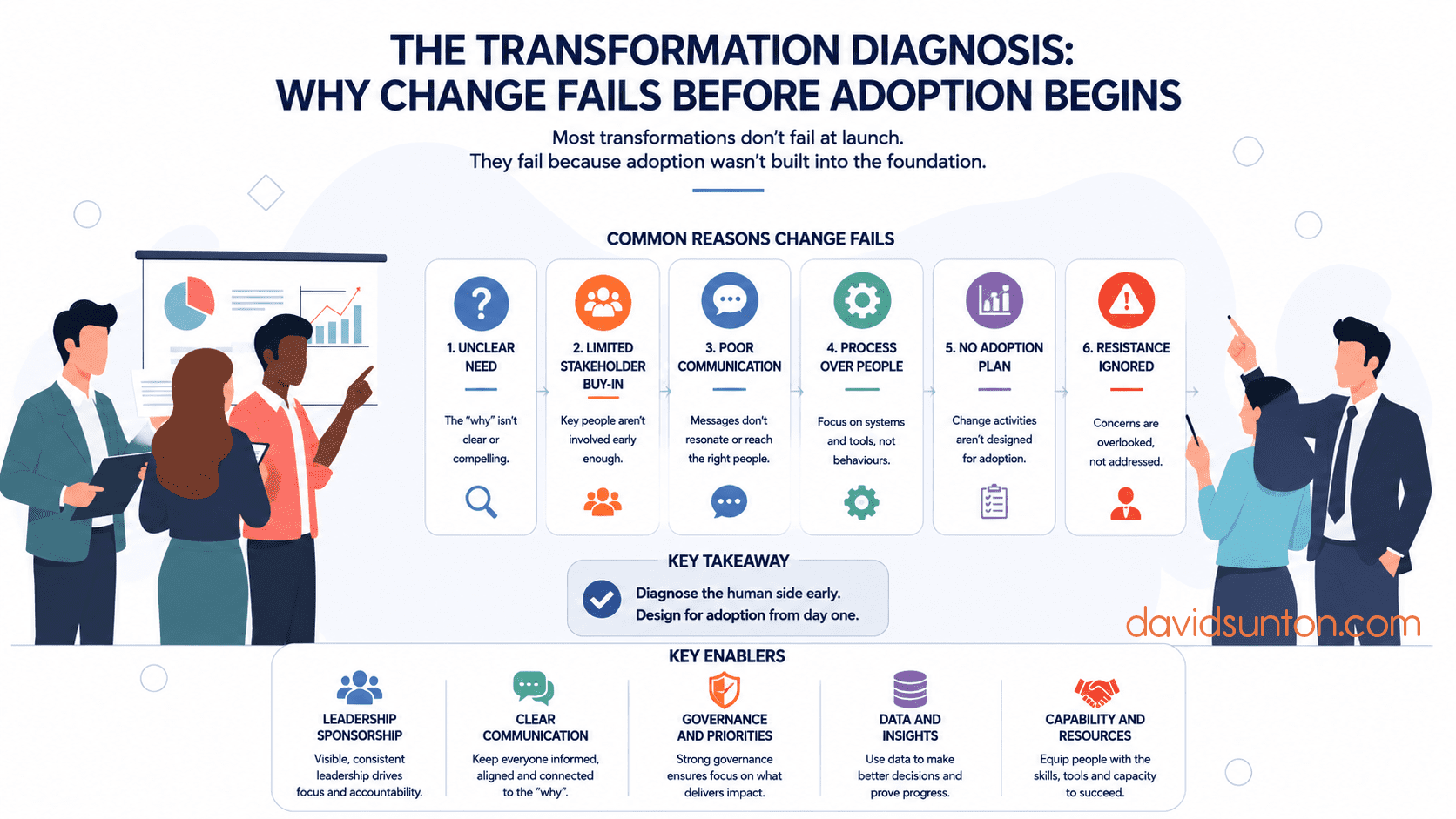
Transformation Failure Usually Starts Before Implementation
Many transformation programs struggle because they begin with a solution before the organisation has clearly understood the problem.
The conversation often starts with statements such as:
“We need AI.”
“We need automation.”
“We need a new CRM.”
“We need to digitise this process.”
“We need to restructure.”
These statements may point to a real opportunity, but they are not yet clear problem statements. They describe a preferred direction or a type of solution, not necessarily the underlying business issue.
A stronger starting point would ask:
What business problem are we solving?
What current behaviour, process, cost, risk, delay or customer pain point needs to change?
What outcome would prove that the transformation has worked?
Who needs to adopt the new way of working?
What might prevent adoption?
What needs to change in the process, system, governance or culture for the benefit to be sustained?
Transformation does not fail only at the end. Often, it fails at the beginning because leaders move too quickly from ambition to implementation without enough diagnosis.
Failure Point 1: The Current State Is Poorly Understood
Good transformation starts with an honest view of the current state.
This sounds obvious, but many organisations diagnose the current state too narrowly. They focus on visible symptoms such as slow processes, poor reporting, duplicated work, customer complaints, missed opportunities or rising costs. These are important, but they are usually only the surface-level indicators.
Underneath those symptoms are often deeper causes:
- unclear accountability
- manual workarounds
- inconsistent decision rights
- poor data quality
- fragmented systems
- competing priorities
- weak governance
- low trust
- capability gaps
- change fatigue
- incentives that reinforce the old behaviour
If leaders only diagnose what is visible, they risk designing a solution for the symptom rather than the cause.
For example, an organisation may decide to automate a slow approval process. But the real issue may not be the approval step itself. It may be unclear delegation, inconsistent risk appetite, missing information, poor upstream data, or managers who do not trust the decision-making process. Automating the workflow may make the process faster, but it may also accelerate confusion, rework or poor-quality decisions.
This is why current-state diagnosis should include more than process mapping. It should examine how work actually happens, how decisions are made, where exceptions occur, what people believe, what they fear, what they avoid, and what informal practices keep the organisation functioning.
The question is not only “what is the process?”
The better question is “what is really happening, and why?”
Failure Point 2: The Future State Is Too Vague
Many transformation programs describe the future state in language that sounds compelling but is difficult to operationalise.
Words such as agile, digital, customer-centric, AI-powered, data-driven, efficient, scalable and modern can be useful at a strategic level, but they are not enough to guide adoption.
A future state needs to be specific enough for people to understand what will actually change.
Leaders should be able to explain:
- what work will be done differently
- which decisions will change
- which roles will be affected
- what behaviours will be expected
- which systems or tools will support the new way of working
- what governance will be required
- how success will be measured
- what benefits should be sustained after go-live
Without this clarity, people are left to interpret the transformation for themselves. Different teams may form different assumptions. Middle managers may translate the change inconsistently. Employees may comply at a surface level while continuing to rely on old habits.
This is a major reason why transformations lose momentum. The organisation may understand the direction but not the practical implications.
The future state must be more than a vision. It must become a working model that people can understand, test, adopt and improve.
Failure Point 3: Delivery Is Mistaken For Adoption
Project delivery is necessary, but it is not the same as change adoption.
Delivery focuses on producing outputs: systems, processes, training materials, communications, workflows, dashboards, policies, operating models or AI capabilities.
Adoption focuses on whether people actually use those outputs in the intended way and whether the organisation changes how it works.
The difference matters.
A project team may deliver a new platform, but sales teams may still track work in spreadsheets.
A business may launch a new AI assistant, but employees may not trust its responses.
A company may redesign a process, but managers may continue approving exceptions through informal channels.
An organisation may run training sessions, but people may not have enough confidence, time or reinforcement to apply the new way of working.
This is not a failure of communication alone. It is often a failure to treat adoption as a core transformation workstream.
Adoption requires more than telling people what is changing. It requires understanding what will make the change useful, trusted, practical and worthwhile in the flow of work.
Leaders should diagnose adoption early by asking:
Who needs to change their behaviour?
What will make the new way easier or harder than the old way?
What incentives, routines, measures or management behaviours reinforce the current state?
What support will people need after go-live?
How will we know whether the change is being adopted, not just delivered?
If adoption is not designed into the transformation, it is usually left to chance.
Failure Point 4: Resistance Is Treated As A Problem To Overcome
Resistance is often treated as an obstacle. In many cases, it is actually useful data.
When people resist change, leaders should not automatically assume they are being negative, difficult or unwilling to adapt. Resistance can reveal issues that the transformation team has not yet understood.
People may resist because they do not understand the purpose of the change. They may not trust the decision-making process. They may fear loss of status, competence, control, relationships or job security. They may see operational risks that leaders have missed. They may have been through previous change efforts that promised improvement but delivered more work.
In AI transformation, resistance can also come from concerns about data quality, accountability, transparency, bias, privacy, job redesign or the loss of human judgement.
These concerns should not be dismissed. They should be diagnosed.
The best transformation leaders do not simply try to silence resistance. They use it to improve the change.
Sceptics can become risk advisors.
Frontline teams can become process testers.
Middle managers can become translators of strategy into local adoption.
Subject matter experts can help identify exceptions, controls and practical failure points.
Resistance becomes dangerous when it is ignored. It becomes valuable when it is understood and channelled into better design, communication and implementation.
Failure Point 5: Governance And Reinforcement Are Added Too Late
Many transformations invest heavily in strategy, technology and implementation, but underinvest in what happens after go-live.
This is where benefits are either sustained or lost.
A new way of working must be reinforced through governance, routines, measures, leadership behaviour, system design, onboarding, coaching and accountability. Otherwise, people naturally drift back to familiar habits, especially under pressure.
This is not because people are lazy or resistant. It is because organisations are systems. Existing processes, incentives, reporting lines, performance measures and informal norms are powerful. If those forces continue to support the old way of working, the new way will struggle to survive.
Leaders should diagnose reinforcement by asking:
What will make the change stick after go-live?
Who owns the benefit after the project team moves on?
What behaviours need to be reinforced by managers?
What KPIs or leading indicators will show whether adoption is happening?
What governance is needed to manage risk, exceptions and continuous improvement?
How will new employees learn the new way of working?
What routines will keep the transformation alive after launch?
A transformation that is not reinforced becomes a temporary project. A transformation that is embedded becomes a new organisational capability.
What Leaders Should Diagnose First
Before pushing harder on delivery, leaders should step back and diagnose the transformation more broadly.
A practical starting point is to examine seven areas.
1. Purpose
Why does the transformation matter?
Leaders should be clear about the business reason for change. Is the goal to improve customer experience, reduce cost, increase speed, manage risk, improve productivity, enable growth, strengthen compliance, or build new capability?
If the purpose is vague, adoption will be weak. People need to understand why the change matters and why the current state is no longer enough.
2. People
Who needs to adopt the change?
Transformation happens through people. Leaders need to identify which groups are affected, what each group needs to do differently, what they may gain, what they may lose, and what support they need.
This includes executives, sponsors, middle managers, frontline employees, customers, partners and governance stakeholders.
3. Process
What workflow actually changes?
If a transformation does not change how work gets done, it may not be a transformation at all. Leaders need to understand the current workflow, the future workflow, decision points, handoffs, bottlenecks, exceptions and controls.
This is especially important for AI and automation. AI should not be inserted into a poor process without redesigning the work around it.
4. Systems
What tools, data and technology support the change?
Technology matters, but it should support the operating model rather than define it. Leaders should diagnose whether the systems are usable, integrated, reliable and aligned with the new way of working.
For AI initiatives, this also means examining data quality, data access, model limitations, human review points and system accountability.
5. Governance
What controls, decision rights and accountability are required?
Transformation often fails when governance is unclear. People need to know who owns the process, who can approve exceptions, who manages risk, who monitors outcomes and who has authority to improve the system over time.
Without governance, transformation becomes dependent on individual effort rather than organisational discipline.
6. Reinforcement
What will make the change stick?
Leaders need to diagnose how the new way of working will be reinforced. This includes manager behaviour, performance measures, communication, coaching, onboarding, recognition and consequences.
If the old system rewards old behaviour, the old behaviour will continue.
7. Benefits
What value needs to be sustained?
A transformation should not be judged only by whether it launched. It should be judged by whether it delivered and sustained the intended value.
Leaders should define the benefits clearly, measure adoption, track leading indicators, and continue reviewing outcomes after implementation.
Benefits realisation is not a finance exercise at the end of the project. It is a leadership discipline throughout the transformation.
The Leadership Shift: From Implementation To Adoption
The organisations that make transformation work do not treat change management as a communication plan or a training activity.
They treat it as a leadership and execution discipline.
They diagnose before they prescribe.
They understand the current state before designing the future state.
They treat resistance as information, not inconvenience.
They design adoption into the work, not after the work.
They embed change into process, systems, governance, routines and measures.
They keep focusing on benefits after go-live.
This leadership shift is becoming more important as organisations pursue AI transformation. AI can improve productivity, decision-making, customer experience and operational performance. But only when it is connected to the right business problem, embedded into the right process, governed properly, trusted by users and adopted in daily work.
Technology may enable transformation, but it does not guarantee it.
Transformation succeeds when leaders choose the right opportunity, design the right process, engage the right people and reinforce the change until it becomes the new way of working.
Final Thought
When transformation fails, leaders often ask, “Why are people not using what we built?”
A better question is:
“What did we fail to diagnose before we built it?”
That question changes the conversation.
It moves leaders away from blaming people for poor adoption and toward understanding the system that shapes adoption. It encourages better problem framing, better process design, better stakeholder engagement and better reinforcement.
Most transformation failures are not caused by a lack of ambition.
They are caused by a gap between ambition, execution and adoption.
The leaders who close that gap are the ones who diagnose first, implement second, and keep leading long after go-live.