AI transformation does not succeed just because the technology works. It succeeds when the organisation clearly defines the business problem, designs the right solution, and leads people through the change required to adopt it.
Many AI initiatives struggle because organisations separate these two disciplines. The solution team focuses on tools, models, data, integration and technical feasibility. The change team, if one exists, is brought in later to help with communication, training and adoption.
Table of Contents
By then, many of the most important adoption decisions have already been made.
The workflow may already be designed.
The data assumptions may already be locked in.
The user experience may already be defined.
The governance model may already be incomplete.
The human review points may already be unclear.
The business outcome may already be loosely described.
The resistance may already be forming.
This is why AI transformation needs solution framing and change management from the beginning.
Solution framing helps define what the AI initiative is, why it matters, how it will work, what it depends on, what risks it creates and how it should be governed.
Change management helps ensure people understand, trust, adopt and sustain the new way of working.
One without the other is incomplete.
A technically strong AI solution can fail if people do not trust it, use it or integrate it into daily work.
A well-communicated change can fail if the solution is poorly framed, the workflow does not fit reality, the data is not ready or the governance is unclear.
AI transformation succeeds when solution design and change adoption are treated as one connected leadership challenge.
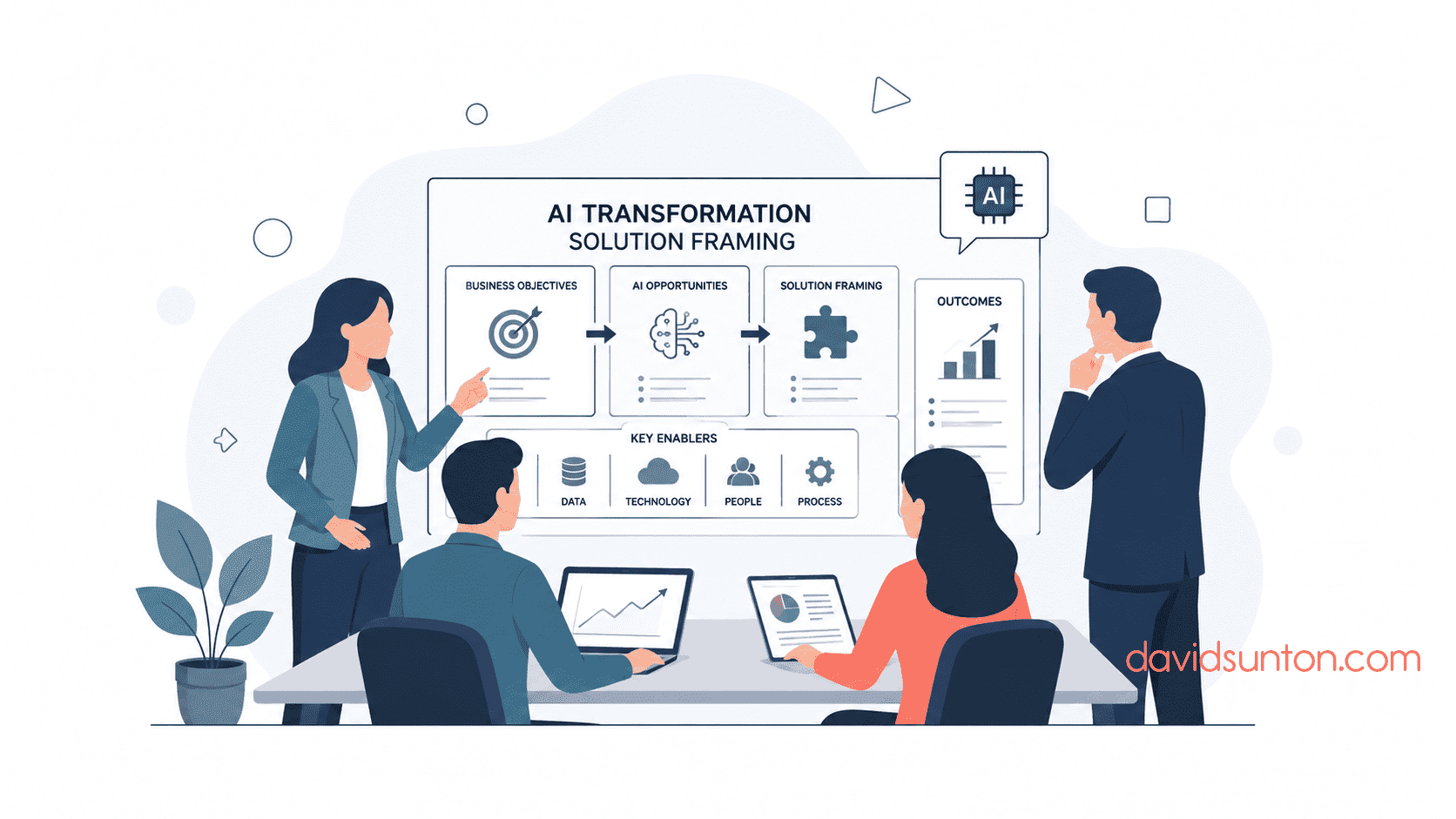
AI Transformation Is Not Just Implementation
Implementation is the visible part of an AI project.
A tool is configured. A model is tested. Data is connected. A workflow is built. A pilot is launched. Users are trained. A solution goes live.
These activities matter, but they do not automatically create transformation.
Transformation happens when the organisation changes how work gets done.
People make decisions differently.
Processes flow differently.
Managers reinforce different behaviours.
Data is captured and maintained differently.
Governance becomes part of daily operations.
Customers or employees experience a better outcome.
Benefits are sustained after launch.
This is why AI transformation cannot be treated as a technical deployment alone.
AI changes work. It can change how information is interpreted, how tasks are completed, how risks are reviewed, how exceptions are escalated, how people collaborate and how accountability is assigned.
For example, an AI assistant that summarises customer enquiries is not only a summarisation tool. It may change how service agents prepare responses, how team leaders monitor quality, how complex cases are escalated, how knowledge articles are maintained and how response time is measured.
An AI agent that updates internal systems is not only an automation. It may change permissions, audit requirements, exception handling, human approval points, process ownership and operational risk.
An AI recommendation engine is not only an analytics capability. It may change how managers make decisions, how staff interpret advice, how performance is reviewed and how accountability is shared between human judgement and machine-generated insight.
If leaders treat these initiatives only as implementation projects, they miss the real transformation work.
What Solution Framing Actually Means
Solution framing is the discipline of translating an AI opportunity into a practical business initiative.
It sits between idea and implementation.
An AI idea may say:
“Use AI to improve customer service.”
Solution framing asks:
What customer service problem are we solving?
Which customer journeys or enquiry types are in scope?
Who will use the AI?
What task will the AI perform?
What data or knowledge does it need?
Where does it fit in the workflow?
What output will it produce?
Who reviews or approves that output?
What happens when the AI is uncertain?
What risks must be controlled?
What systems need to be integrated?
What does success look like?
What will make users trust and adopt it?
That is solution framing.
It prevents AI projects from remaining too broad, too technical or too tool-led.
A well-framed AI solution should define the business problem, value logic, users, workflow, data requirements, AI pattern, governance, human-in-the-loop design, implementation scope and adoption pathway.
This does not mean every detail must be final before experimentation begins. AI initiatives often need iteration. But iteration should still be guided by a clear frame.
A pilot should test a real business use case, not simply demonstrate that AI can perform a task.
Why Solution Framing Matters
Solution framing matters because AI projects often fail in the gaps between the idea and the operating reality.
The idea may be attractive, but the workflow may be unclear.
The model may work, but the data may be unreliable.
The output may be useful, but no one may know who is accountable for acting on it.
The tool may save time in theory, but users may not trust it in practice.
The pilot may work for one team, but governance may not support scaling.
The business case may assume productivity benefits, but old workarounds may remain in place after go-live.
Solution framing helps expose these issues early.
It forces leaders to ask how the AI capability will create value in a specific business context.
It also helps prevent the common mistake of forcing AI into the wrong problem.
Some business problems do need AI.
Some need process redesign.
Some need better data governance.
Some need workflow automation.
Some need clearer accountability.
Some need system integration.
Some need training or management discipline.
Some need a combination of all of these.
Solution framing helps leaders decide where AI fits and where it does not.
That clarity is essential before implementation begins.
Change Management Cannot Be Added At The End
Change management is often treated as a late-stage activity.
Once the solution is nearly ready, the organisation prepares communication, training, stakeholder updates and go-live support.
This approach is too narrow for AI transformation.
By the time a solution is built, many change outcomes are already shaped by earlier design decisions.
If users were not involved in testing the workflow, adoption may be harder.
If managers were not prepared to reinforce the new way, behaviour change may be weak.
If governance was not built into the process, trust may be low.
If human review points were unclear, accountability may be uncertain.
If data quality issues were ignored, users may reject the output.
If resistance was not diagnosed early, concerns may become entrenched.
Change management should not be reduced to communication and training.
It should help shape the solution itself.
This includes understanding stakeholder impact, mapping adoption risks, involving users in design and testing, preparing managers, identifying resistance, clarifying behaviour changes, defining reinforcement and ensuring benefits can be sustained after go-live.
In AI transformation, change management is not a support activity.
It is part of solution quality.
AI Adoption Depends On Trust
AI adoption is different from many traditional technology changes because trust plays a central role.
People may use a standard system because they are required to. But AI often asks people to rely on outputs that are generated, predicted, summarised, classified or recommended by a system they may not fully understand.
That creates different adoption questions.
Can I trust this output?
What data was used?
What if the AI is wrong?
Am I still accountable?
When should I override it?
Who approved this use?
What am I allowed to enter?
Will this affect my role?
Will customers know AI was involved?
These questions cannot be answered through technical implementation alone.
They need clear governance, communication, training, workflow design and leadership reinforcement.
Trust is also affected by experience. If early outputs are poor, outdated, irrelevant or difficult to use, people may quickly lose confidence. Once trust is damaged, adoption becomes much harder.
This is why solution framing and change management must work together.
Solution framing defines the conditions for responsible AI use.
Change management helps people understand and adopt those conditions in practice.
Human-In-The-Loop Is Both Solution Design And Change Design
Human-in-the-loop is often described as a governance principle.
It is also a solution design and change management issue.
Leaders need to define where human judgement is required, who provides it, what they are reviewing, what authority they have, and what happens when they disagree with the AI.
This cannot be left vague.
A human review step that is poorly designed can become a bottleneck.
A human approval step that is unclear can create false assurance.
A process that relies too heavily on AI can create risk.
A process that requires too much manual checking can erase productivity gains.
The right human-in-the-loop design depends on the use case.
For low-risk internal drafting, human review may be simple and lightweight.
For customer-facing communication, review may depend on risk, confidence level, topic sensitivity or customer impact.
For compliance, legal, financial, health or safety-related decisions, human oversight may need to be stronger, more formal and more auditable.
From a change management perspective, people also need to understand their role in the loop.
Are they reviewers?
Approvers?
Decision-makers?
Exception handlers?
Quality monitors?
Feedback providers?
Accountable owners?
If this is unclear, adoption will suffer.
Human-in-the-loop is not something to add after the AI solution is built.
It is central to how the solution should be framed and how the change should be led.
Governance Creates Confidence
Some organisations treat AI governance as a constraint.
In reality, good governance creates confidence.
It helps users know what is allowed, what is not allowed, what data can be used, how outputs should be reviewed, when escalation is required and who is accountable.
Without governance, people may either avoid the AI or use it in inconsistent and risky ways.
Both outcomes weaken transformation.
Solution framing should define the governance requirements early:
What data can the AI access?
Which sources are approved?
What actions can the AI take?
What decisions require human approval?
What outputs need to be logged?
What risks need monitoring?
How are exceptions escalated?
Who owns ongoing performance and improvement?
Change management then helps translate governance into behaviour.
It ensures users understand the rules, managers reinforce them, risk teams have visibility, and governance does not remain buried in a policy document.
This is especially important for agentic AI, where systems may perform tasks, trigger actions or interact with multiple tools and data sources.
The more AI moves from recommendation to action, the more important governance becomes.
Process Design Connects AI To Value
AI creates value when it is embedded into a process.
A disconnected AI tool may be useful, but it may not transform the business.
For AI to create sustained value, leaders need to define how it changes the workflow.
What starts the process?
What task does AI perform?
What decision does it support?
Who uses the output?
What happens next?
Where are the handoffs?
Where are the exceptions?
Where does human review occur?
What systems are updated?
How is quality measured?
How is accountability maintained?
These questions link solution framing with process design.
They also link directly to change management because process change requires behaviour change.
For example, an AI tool that drafts client proposals may only create value if consultants change how they capture discovery notes, how they review AI-generated drafts, how approvals are managed and how final proposal content is reused.
An AI triage tool may only create value if frontline teams trust the classification, specialists accept escalations from the new workflow and managers stop allowing old routing shortcuts.
An AI reporting assistant may only create value if leaders agree on definitions, use the insights in decision forums and stop relying on conflicting manual reports.
Process design turns AI capability into operational value.
Change management turns process design into adoption.
Middle Managers Are Critical To AI Transformation
AI transformation is often sponsored by executives and delivered by project teams, but middle managers often determine whether it becomes real.
They translate the change into daily work.
They answer team questions.
They allocate time for learning.
They reinforce whether the new workflow matters.
They decide whether old workarounds continue.
They help teams interpret governance rules.
They observe whether users trust the AI or avoid it.
They raise operational issues that may not be visible to executives.
If middle managers are not engaged early, AI adoption can stall.
They may support the project in principle but lack the confidence, time or practical guidance to lead their teams through the change.
This is why change management must identify the role of middle managers during solution framing, not after go-live.
Managers need to understand:
What business problem the AI is solving.
How the workflow changes.
What behaviours need to be reinforced.
What risks must be managed.
What their team needs to stop doing.
What success looks like.
How adoption will be measured.
Where to escalate issues.
In many AI projects, the direct manager is the most important adoption signal.
If they do not reinforce the new way, teams will not treat it as real.
Resistance Should Improve The Solution
Resistance to AI is often treated as a problem to overcome.
It can also be a source of valuable design intelligence.
People may resist because they do not trust the data. They may see process exceptions that have not been considered. They may worry about customer impact. They may fear loss of judgement or role identity. They may have experienced previous technology rollouts that increased workload rather than reduced it. They may understand operational constraints that leaders have underestimated.
These concerns should not automatically stop the project.
But they should be used to improve it.
Sceptics can become risk advisors.
Frontline teams can become process testers.
Subject matter experts can validate AI outputs.
Managers can identify adoption barriers.
Risk and compliance teams can shape governance.
Customers or client-facing teams can help assess experience impact.
This is where solution framing and change management reinforce each other.
Change management surfaces stakeholder concerns.
Solution framing uses those concerns to improve workflow, governance, data requirements, human review and adoption design.
The goal is not to eliminate resistance.
The goal is to learn from it early enough to build a better solution and a stronger adoption pathway.
Solution Framing Without Change Management
Solution framing without change management creates a common risk: the solution may look good on paper but fail in practice.
The business problem may be clear.
The data may be identified.
The workflow may be designed.
The tool may be selected.
The governance may be documented.
But if people do not understand, trust, use or reinforce the new way, the transformation will not stick.
This often happens when adoption is treated as a post-implementation task.
Users are trained late.
Managers are informed rather than equipped.
Resistance is handled reactively.
Old workarounds remain available.
Success is measured by go-live rather than behaviour change.
Benefits are assumed rather than tracked.
The solution may be technically complete, but organisationally incomplete.
That is why change management needs to be part of the solution from the start.
Change Management Without Solution Framing
The opposite risk is also common.
Change management without strong solution framing can create enthusiasm around a poorly defined initiative.
The communication may be polished.
The training may be well delivered.
The sponsorship may be visible.
The stakeholder engagement may be active.
But if the solution itself is unclear, adoption will still be difficult.
Users may not know where the AI fits into the workflow.
Managers may not know what behaviour to reinforce.
Risk teams may not know what controls apply.
Data owners may not know what they are responsible for.
Benefits may be too vague to measure.
Human review may be unclear.
A weakly framed solution cannot be rescued by communication alone.
People may be willing to support the change, but the change itself may not be practical enough to adopt.
That is why solution framing and change management must work together.
What An Integrated Approach Looks Like
An integrated approach brings solution framing and change management together from the beginning.
It starts with the business problem.
What issue are we solving, and why does it matter?
It defines the value.
What outcome are we trying to improve, and how will we measure progress?
It frames the use case.
What will AI do, for whom, in which workflow, using which data?
It maps the process.
Where does the AI fit, what decisions are made, where are handoffs, and how are exceptions handled?
It designs governance.
What data, access, review, approval, escalation, audit and accountability controls are required?
It plans adoption.
Who needs to change behaviour, what support do they need, what resistance may appear, and how will managers reinforce the new way?
It measures outcomes.
How will adoption, usage, risk, process performance and benefits be tracked after go-live?
This approach treats AI transformation as a connected system.
It recognises that technology, process, people and governance are not separate workstreams that can be solved independently.
They shape each other.
A Practical Example
Imagine an organisation wants to use AI to support customer service teams.
A weak approach might begin with tool selection:
“We need an AI chatbot or agent. Let’s see what vendors can offer.”
A stronger approach begins with solution framing and change management together.
First, define the problem.
Customer response times are increasing because service teams spend too much time reviewing enquiry history, identifying issue type, searching for policy information and routing cases manually.
Second, define the value.
The organisation wants to reduce response time, improve routing accuracy, reduce rework and increase customer satisfaction.
Third, frame the solution.
AI will summarise enquiries, classify intent, retrieve relevant approved knowledge, recommend next action and route complex cases to the right team.
Fourth, design the workflow.
Human review will apply to sensitive, high-risk or low-confidence cases. Escalation rules will be defined. Outputs will be captured in the case management system.
Fifth, assess data readiness.
The organisation will review knowledge articles, policy documents, CRM data, case categories and escalation rules.
Sixth, define governance.
Approved knowledge sources, privacy rules, audit logs, confidence thresholds, review points and ownership will be established.
Seventh, plan adoption.
Frontline teams will test real cases. Sceptics will identify risks. Middle managers will be equipped to reinforce usage. Champions will support peers. Adoption metrics will track usage, routing accuracy, response time and exceptions.
This is no longer a generic AI project.
It is a framed transformation initiative.
The technology still matters, but it is now connected to problem, process, people, governance and adoption.
Why This Matters For Scaling AI
Many AI pilots fail to scale because they prove technical possibility without proving organisational readiness.
A small team may test a tool successfully. A controlled demo may look impressive. A narrow use case may produce promising results. But scaling across the business introduces new complexity.
Different teams may have different processes.
Data quality may vary.
Managers may reinforce adoption unevenly.
Risk controls may need to be stronger.
Integration requirements may increase.
Users may interpret the AI differently.
Exceptions may multiply.
Benefits may be harder to realise at scale.
Solution framing helps identify what is required to scale.
Change management helps prepare the organisation to scale.
Together, they turn AI pilots into repeatable capabilities.
Without them, organisations may end up with isolated experiments rather than transformation.
A Practical Leadership Checklist
Before starting an AI initiative, leaders should ask a set of integrated questions.
Problem: What business problem are we solving?
Value: What measurable outcome matters?
Use Case: What exactly will AI do, for whom and in what context?
Workflow: Where does AI fit into the process?
Data: What data is required, and is it ready enough?
Governance: What rules, controls and accountabilities are needed?
Human Review: Where does human judgement remain essential?
Stakeholders: Who needs to trust, use, approve or govern the AI?
Adoption: What behaviour needs to change?
Managers: How will middle managers reinforce the new way?
Resistance: What concerns may reveal design or adoption risks?
Benefits: How will value be measured and sustained after go-live?
These questions help leaders avoid treating AI as a tool deployment.
They also help teams design AI initiatives that are more practical, trusted and adoptable.
Final Thought
AI transformation needs solution framing and change management because AI does not create value in isolation.
It creates value when it is connected to the right business problem, embedded into the right workflow, supported by the right data, governed by the right controls and adopted by the people who need to use it.
Solution framing defines the shape of the AI initiative.
Change management makes that initiative usable, trusted and sustainable.
Together, they help organisations avoid the common trap of moving too quickly from AI ambition to implementation.
The strongest AI leaders do not ask only, “What can AI do?”
They ask:
“What solution are we really designing, and what change must the organisation make for it to work?”
That is where AI transformation becomes practical.
That is where adoption becomes possible.
And that is where AI starts to create sustained business value.