AI agents are often described as if they can independently complete work from beginning to end.
Ask the agent to handle a customer enquiry.
Ask the agent to update a system.
Ask the agent to prepare a report.
Ask the agent to follow up a lead.
Ask the agent to process a document.
Ask the agent to coordinate a workflow.
This language is useful because it helps people imagine what AI can do. But it can also create a dangerous misunderstanding.
In most organisations, work does not happen as isolated tasks. Work happens through processes.
Table of Contents
A customer enquiry may need to be classified, validated, summarised, checked against policy, routed to the right team, escalated if sensitive, recorded in the CRM and monitored for service quality.
A supplier document may need to be received, read, matched to purchase orders, checked for missing fields, sent for approval, updated in the ERP and stored for audit.
A sales lead may need to be qualified, enriched, prioritised, assigned, followed up, captured in a pipeline and reviewed by a manager.
An AI agent may perform parts of these workflows, but the agent is not the whole process.
That is why AI agents need process design.
They need clear triggers, tasks, data inputs, decision points, permissions, human review, escalation paths, exception handling, system integration, auditability and governance. Without these, AI agents may create activity, but not reliable business value.
The question is not simply, “What can the agent do?”
The better question is, “Where does the agent fit into the way work should happen?”
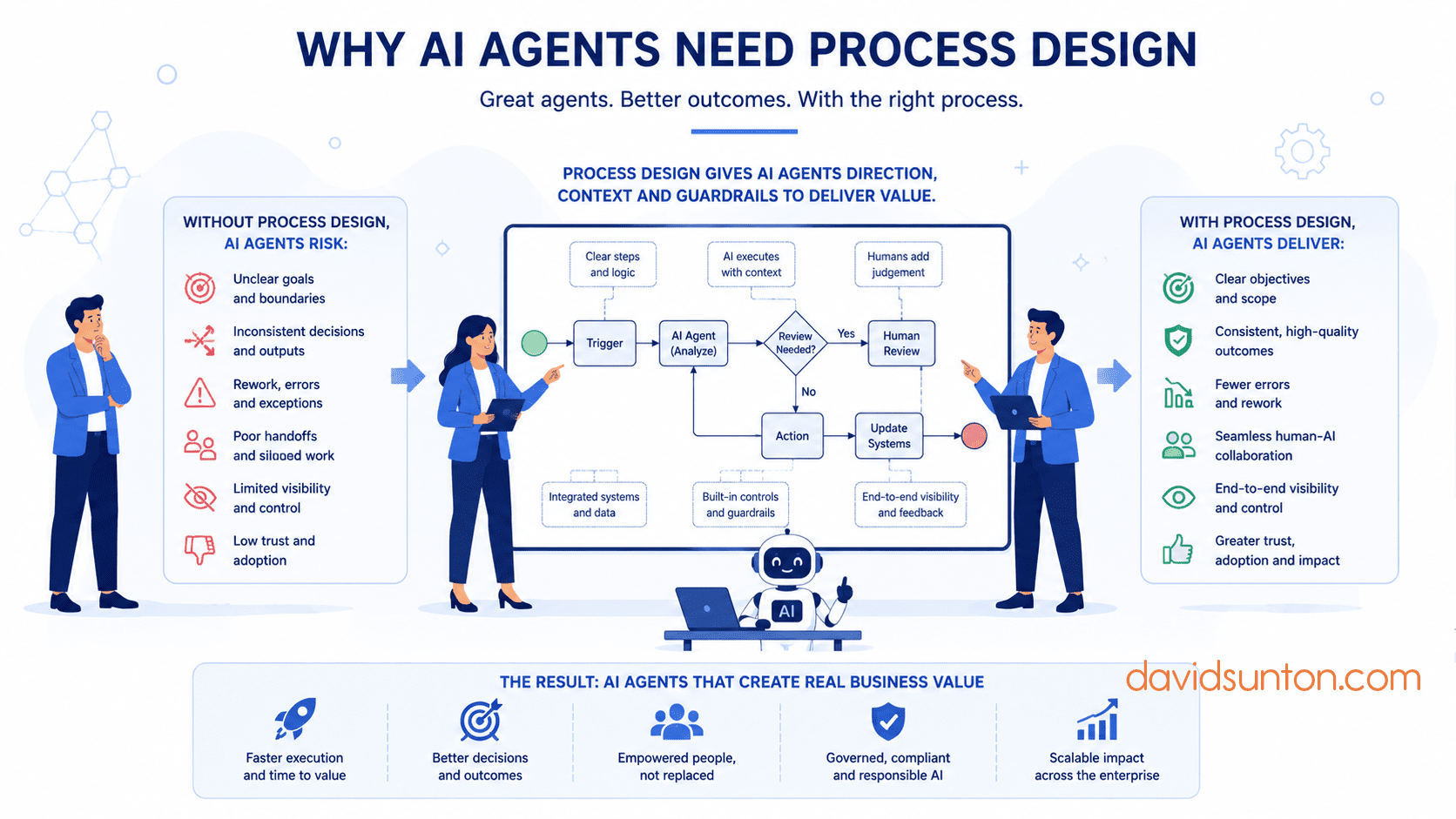
AI Agents Are Not Magic Workers
The term “AI agent” can make the technology sound more autonomous than it really is.
At a simple level, an AI agent is a system designed to perform tasks, make decisions within defined boundaries, use tools, interact with data or systems, and sometimes coordinate multiple steps toward a goal.
That sounds powerful, and it is.
But business environments are full of constraints.
There are policies, approval rules, customer expectations, data quality issues, system limitations, compliance requirements, security boundaries, exception scenarios and human judgement points.
An agent cannot be effective unless those constraints are designed into the workflow.
For example, an AI agent may be able to draft a customer response. But should it send the response automatically? Should it only draft for human review? Should it send only low-risk responses? What counts as low risk? What happens if the customer mentions a complaint, legal issue, cancellation, medical matter, payment dispute or personal data concern?
An AI agent may be able to update a CRM record. But which fields is it allowed to update? What source should it trust? What happens if the data conflicts? Should a salesperson approve the update? Should changes be logged? Can the agent overwrite existing information?
An AI agent may be able to route a support case. But what happens if the intent is unclear? What if the case belongs to more than one category? What if the customer is high value? What if the issue is urgent? What if the required team is unavailable?
These are not just technical questions.
They are process design questions.
Process Design Turns Agent Capability Into Business Value
AI agents can classify, summarise, retrieve, recommend, draft, check, route, update, escalate and coordinate.
But capability alone does not create value.
Value comes from improving how work flows through the organisation.
A process view helps leaders define how the agent contributes to a business outcome.
For example, if the objective is faster customer response, the process design may focus on triage, routing, knowledge retrieval and escalation.
If the objective is reduced manual administration, the process design may focus on information extraction, system updates and approval workflows.
If the objective is better sales conversion, the process design may focus on lead qualification, next-best action recommendations, CRM updates and manager review routines.
If the objective is stronger compliance, the process design may focus on document review, anomaly detection, audit trails and human approvals.
Without this process view, organisations risk deploying agents as disconnected tools.
The agent may perform a task, but the task may not improve the end-to-end workflow.
It may save time in one area but create rework in another.
It may automate an action but leave accountability unclear.
It may generate useful outputs that no one uses.
It may accelerate a poor process rather than improve it.
Process design ensures the agent is connected to a business result, not just a technical function.
Map The Process Before You Automate It
One of the most common mistakes in automation is digitising a poor process.
AI agents can make that mistake more expensive.
If a process is unclear, inconsistent or poorly governed, adding an AI agent may not fix it. It may simply make the confusion faster.
Before introducing an AI agent, leaders should map the current process.
What starts the work?
Who receives it?
What information is required?
What decisions are made?
What systems are used?
Where are the handoffs?
Where do delays occur?
Where does rework happen?
Where are exceptions handled?
What workarounds do people use?
What risks need to be controlled?
This current-state view is important because it reveals whether the process is ready for agentic support.
For example, an organisation may want an agent to automate invoice processing. But current-state mapping may show that invoice formats vary widely, purchase orders are often missing, approval rules differ by department, supplier master data is inconsistent and exception handling depends on informal knowledge.
In that case, the organisation may still use AI, but the process needs to be designed carefully. The agent may handle extraction and matching, but human review may be required for exceptions. Approval rules may need standardisation. Supplier data may need cleanup. Audit requirements may need definition.
Mapping the process does not slow transformation down.
It prevents leaders from automating uncertainty.
Agents Need Clear Triggers
Every workflow begins with a trigger.
A trigger is the event that starts the process.
For an AI agent, the trigger might be an inbound email, a customer call, a form submission, a new CRM lead, a document upload, a scheduled report, a threshold alert, a system event or a human request.
If the trigger is unclear, the agent’s role becomes unclear.
Leaders should define:
What starts the agent’s work?
Who or what initiates it?
Is the trigger manual, scheduled or automatic?
What conditions must be met before the agent acts?
What information must be available at the start?
What should the agent ignore?
For example, if an AI agent monitors inbound customer emails, should it act on every email? Only emails sent to a specific inbox? Only emails from verified customers? Only emails that match certain categories? Should it exclude complaints, legal matters or urgent safety issues?
Trigger design matters because it controls the front door of the workflow.
If the trigger is too broad, the agent may handle work it should not touch.
If the trigger is too narrow, valuable automation may be missed.
Good process design defines when the agent should enter the workflow and when it should stay out.
Agents Need Defined Tasks
An AI agent should have a clear task boundary.
In business language, people may say, “the agent will handle customer enquiries” or “the agent will process documents.” But those descriptions are too broad.
Leaders need to define the specific tasks.
Will the agent classify the enquiry?
Extract key details?
Summarise the case?
Retrieve relevant knowledge?
Draft a response?
Recommend a next action?
Update a system?
Escalate an exception?
Notify a manager?
Close a task?
Each task carries different data, risk, governance and adoption requirements.
For example, an agent that summarises a customer enquiry is lower risk than an agent that sends a final customer response. An agent that recommends an action is different from an agent that takes the action automatically. An agent that updates an internal note is different from an agent that changes a billing record.
Task clarity prevents role confusion.
It helps users understand what the agent does and what humans still own.
It also helps technical teams design the right permissions, integrations, controls and monitoring.
An agent without a defined task boundary can become a source of operational risk.
Agents Need Decision Rules
Processes contain decisions.
Some decisions are simple.
Some are judgement-based.
Some are policy-driven.
Some are risk-sensitive.
Some should be made by humans.
Some can be supported by AI.
Some can be automated within clear boundaries.
AI agent design needs to define which decisions the agent can make, which decisions it can recommend, and which decisions must remain with a person.
For example, an agent may be allowed to classify a support ticket as “billing”, “technical support” or “account update.” But it may not be allowed to decide whether a refund should be approved.
An agent may recommend that a customer enquiry is urgent. But a human may need to approve escalation for high-value or sensitive customers.
An agent may identify likely contract risks. But legal or commercial teams may need to review and decide the final position.
Decision rules should be explicit.
Leaders should define:
What decisions can the agent make?
What decisions can it recommend?
What decisions require human review?
What confidence threshold is required?
What rules override the agent?
What happens when the agent is uncertain?
Who is accountable for the final decision?
Without decision rules, agentic workflows become hard to trust and hard to govern.
Human-In-The-Loop Must Be Designed, Not Assumed
Many organisations say they will keep a human in the loop.
That is a good principle, but it is not enough.
Human-in-the-loop needs process design.
Leaders need to define where the human appears in the workflow, what the human reviews, what decision rights the human has, and what happens after review.
A human may review all agent outputs.
A human may review only low-confidence outputs.
A human may approve high-risk actions.
A human may handle exceptions.
A human may monitor quality.
A human may provide feedback to improve the agent.
Each design creates different operational implications.
Too much human review can remove the productivity benefit.
Too little human review can create risk.
Unclear human review can create false assurance.
For example, if an AI agent drafts supplier price updates, a category manager may review recommendations before the ERP is updated. But what exactly are they reviewing? Price accuracy? Margin impact? Supplier terms? Stock position? Promotion timing? Approval authority? If this is not defined, the review step may be inconsistent.
Human-in-the-loop should answer three questions:
Where does human judgement add value?
Where does human review reduce risk?
Where would human involvement create unnecessary friction?
The right answer depends on the workflow, data readiness, risk level and business outcome.
Agents Need Exception Handling
Exceptions are where many AI-enabled workflows fail.
The normal path may be easy to design.
A customer submits a standard enquiry. The agent classifies it. The knowledge source is available. The confidence score is high. The correct team is available. The response is simple.
But real work is full of exceptions.
The enquiry is ambiguous.
The customer provides incomplete information.
The data conflicts.
The system is unavailable.
The request falls into multiple categories.
The case is urgent.
The issue is sensitive.
The customer is angry.
The policy is unclear.
The agent’s confidence is low.
The workflow reaches a dead end.
Process design needs to define what happens in these situations.
Who receives the exception?
What information should be passed to them?
How urgent is the escalation?
What should the agent say or do while waiting?
How is the exception logged?
How are repeated exceptions reviewed?
What exceptions should improve the process or knowledge base?
An AI agent without exception handling may work well in a demo but fail in real operations.
Good exception design protects customers, users, compliance and trust.
It also creates learning because repeated exceptions show where the workflow, data or agent design needs improvement.
Agents Need System And Data Boundaries
AI agents often need access to systems and data.
That access must be designed carefully.
An agent may need to read a CRM record, update a ticket, retrieve a policy, check inventory, create a task, send a notification, draft an email or trigger a workflow in another system.
Each action requires boundaries.
What can the agent read?
What can it write?
What can it update?
What can it delete?
What data is restricted?
What actions need approval?
What should be logged?
What happens if systems conflict?
What happens if data is missing?
These boundaries are important because agentic AI can move from information support to operational action.
The more the agent can do, the more important permission design becomes.
For example, an agent that reads product information to answer questions carries different risk from an agent that updates pricing, changes customer records or triggers refunds.
System and data boundaries should be defined before deployment, not discovered after something goes wrong.
Agents Need Governance And Auditability
AI agents need governance because they can influence work, decisions and actions.
Governance should define who owns the agent, who monitors performance, who approves changes, who manages risk, who reviews exceptions and who is accountable for outcomes.
Auditability is also important.
Leaders may need to know:
What did the agent do?
What data did it use?
What output did it produce?
What action did it trigger?
Who reviewed it?
Who approved it?
What exception occurred?
What was escalated?
What changed in the system?
This matters for quality, compliance, customer trust, operational improvement and accountability.
Without auditability, it can be difficult to investigate errors, improve the workflow or build confidence in the agent.
Governance should not be treated as a barrier to agentic AI.
It is what makes agentic AI practical in real organisations.
Good governance gives leaders and users confidence that the agent is working within clear boundaries.
Agents Need Adoption Design
AI agents do not create value unless people use them, trust them and integrate them into their work.
This means adoption must be designed into the process.
Users need to understand what the agent does and does not do.
Managers need to reinforce the new workflow.
Risk and compliance teams need confidence in controls.
Process owners need to monitor performance.
Frontline teams need a way to report issues.
Champions may need to support local usage.
Old workarounds may need to be retired.
Adoption design should ask:
Who needs to change behaviour?
What will make users trust the agent?
What training or practice is required?
What concerns are likely?
What metrics will show adoption?
Who supports users after go-live?
What feedback loop will improve the agent?
How will managers reinforce the new process?
An agent may be technically capable, but if users do not understand when to rely on it, when to override it, or how to escalate issues, adoption will remain weak.
Agent adoption is not just a training problem.
It is a workflow, trust and reinforcement problem.
The AI-Enabled Workflow Lens
A practical way to design agentic workflows is to use an AI-enabled workflow lens.
This lens asks eight questions.
1. Trigger
What starts the workflow?
This defines when the agent becomes involved.
2. Task
What work needs to be performed?
This clarifies the agent’s role and the human role.
3. Decision
Where are choices made?
This identifies where the agent can decide, recommend or escalate.
4. Agent
Where can AI assist or act?
This defines the agent’s specific contribution.
5. Human
Where is review, judgement or approval required?
This ensures human accountability is intentionally designed.
6. System
What tools, data or platforms are involved?
This clarifies integration, access and permission requirements.
7. Exception
What happens when the normal path fails?
This protects the workflow from real-world complexity.
8. Governance
How is risk controlled and audited?
This creates confidence, accountability and improvement.
This lens turns AI agent design into process design.
It helps leaders move from a vague ambition such as “deploy an AI agent” to a practical workflow that can be tested, governed and adopted.
Example: A Restaurant Booking Agent
Consider a restaurant booking AI agent.
At first, it may sound simple.
The agent takes bookings.
But the real process is more complex.
The workflow may begin when a customer calls, emails or sends a message through WhatsApp. The agent needs to identify whether the customer wants a new booking, a change, a cancellation, a special request, a deposit payment, a large group booking or a function enquiry.
The agent may need to check availability, table capacity, seating rules, customer history, dietary requirements, deposit policies, cancellation rules and staff escalation paths.
Some decisions may be automated.
A standard booking for two people at an available time may be confirmed automatically.
Some decisions may need human review.
A large group, VIP customer, complaint, accessibility request, private event or unusual seating requirement may need escalation.
Some exceptions need clear handling.
The requested time may be unavailable. The customer may not provide required details. The booking system may be down. The customer may want a refund. The party size may exceed available capacity. The message may be unclear.
The agent also needs system boundaries.
Can it create bookings? Modify bookings? Take payments? Send confirmations? Update customer profiles? Access notes? Cancel bookings?
Without process design, the restaurant booking agent may fail in real customer situations.
With process design, the agent becomes part of a reliable service workflow.
Example: A Supplier Price-Change Agent
Now consider an AI agent that handles supplier price-change notices.
The agent receives supplier emails with attached price lists. It reads the documents, identifies affected SKUs, compares current and new prices, calculates margin impact, flags exceptions, prepares recommended updates and sends them for approval.
This sounds like an automation opportunity.
But process design is essential.
The trigger is the supplier email or document upload.
The task includes extraction, comparison, validation, recommendation and workflow preparation.
The decision points include whether the price change is valid, whether margin impact is acceptable, whether customer pricing needs adjustment and whether approval is required.
The human role may include category manager review, finance approval or exception handling.
The systems may include email, document storage, product information management, ERP, pricing tools and approval workflows.
Exceptions may include missing SKUs, conflicting supplier data, unclear effective dates, discontinued products, promotion conflicts or margin breaches.
Governance may require audit logs, approval records, role-based permissions and change history.
The agent can create significant value, but only if the workflow is designed properly.
The automation is not the solution.
The orchestrated process is the solution.
Workflow Automation, Orchestration And Agents
It is useful to distinguish between automation, orchestration and agentic workflows.
Automation performs a defined task.
For example, sending an email confirmation, extracting a field from a document or updating a status.
Orchestration coordinates work across people, systems, decisions and steps.
For example, moving a case from intake to triage to review to approval to resolution.
Agentic workflows use AI agents to perform or assist parts of that orchestrated process.
For example, an agent may classify the case, summarise context, recommend next action and escalate exceptions while the broader workflow coordinates human review, system updates and governance.
This distinction matters because many organisations think they need an agent when they first need process clarity.
An agent without orchestration may produce outputs but not outcomes.
A process without automation may remain slow and manual.
Orchestration connects the two.
The strongest AI-enabled processes combine clear workflow design, appropriate automation, well-bounded agents, human judgement and governance.
Why This Matters For Leaders
AI agents can be powerful, but they also increase the importance of leadership discipline.
Leaders need to avoid two extremes.
The first extreme is overestimating autonomy.
This happens when leaders assume agents can simply “do the work” without enough process design, governance or human review.
The second extreme is underusing capability.
This happens when organisations keep AI trapped in low-value tasks because they have not designed the workflows, permissions or controls needed for agents to support more meaningful work.
The practical middle ground is process-led agentic transformation.
Start with the business process.
Identify where work is slow, manual, inconsistent, risky or dependent on scarce expertise.
Define the future workflow.
Decide where AI can assist or act.
Design human review and escalation.
Set system and data boundaries.
Build governance and auditability.
Measure adoption and outcomes.
This approach helps leaders use agents responsibly while still capturing value.
Final Thought
AI agents need process design because business value does not come from autonomous task completion alone.
It comes from improving how work flows through the organisation.
An agent can classify, summarise, recommend, draft, update, route or escalate. But unless those actions are connected to a clear workflow, governed decision rules, human accountability, system boundaries and adoption support, the agent may create more uncertainty than value.
The strongest AI agent initiatives do not begin with the question, “What can the agent do?”
They begin with a better question:
“How should this work happen, and where can an AI agent improve it safely, reliably and measurably?”
That is why AI agents need process design.
It turns agent capability into operational value.
It turns automation into orchestration.
And it turns AI ambition into a workflow people can trust, use and improve.