Many AI projects begin in the wrong place: with the technology, rather than the business problem.
By the time the project is formally discussed, the organisation may already be asking which platform to use, which vendor to engage, which model to deploy, or which process to automate.
The ambition may be genuine. The business may want to improve productivity, reduce manual work, strengthen customer service, unlock data, improve decision-making, or explore new growth opportunities. Leaders may be under pressure to show that the organisation is not falling behind. Teams may be excited by what generative AI, automation or agentic workflows appear to make possible.
But before an AI project begins, there is a more important question:
Is this the right AI opportunity to pursue?
That question is often skipped.
Table of Contents
Instead of assessing the opportunity, organisations jump from interest to experimentation. They run pilots because the technology is available. They test tools because competitors are talking about AI. They automate tasks because the process looks inefficient. They ask vendors what is possible before they have clearly defined what is valuable.
This is how AI initiatives become tool-led, vendor-led or hype-led.
The result is predictable.
A pilot is launched, but the business value is unclear.
A model is built, but the data is not ready.
A tool is deployed, but users do not adopt it.
A workflow is automated, but the underlying process remains broken.
A proof of concept works in a controlled setting, but scaling it across the business is harder than expected.
A project appears innovative, but it does not become a sustained organisational capability.
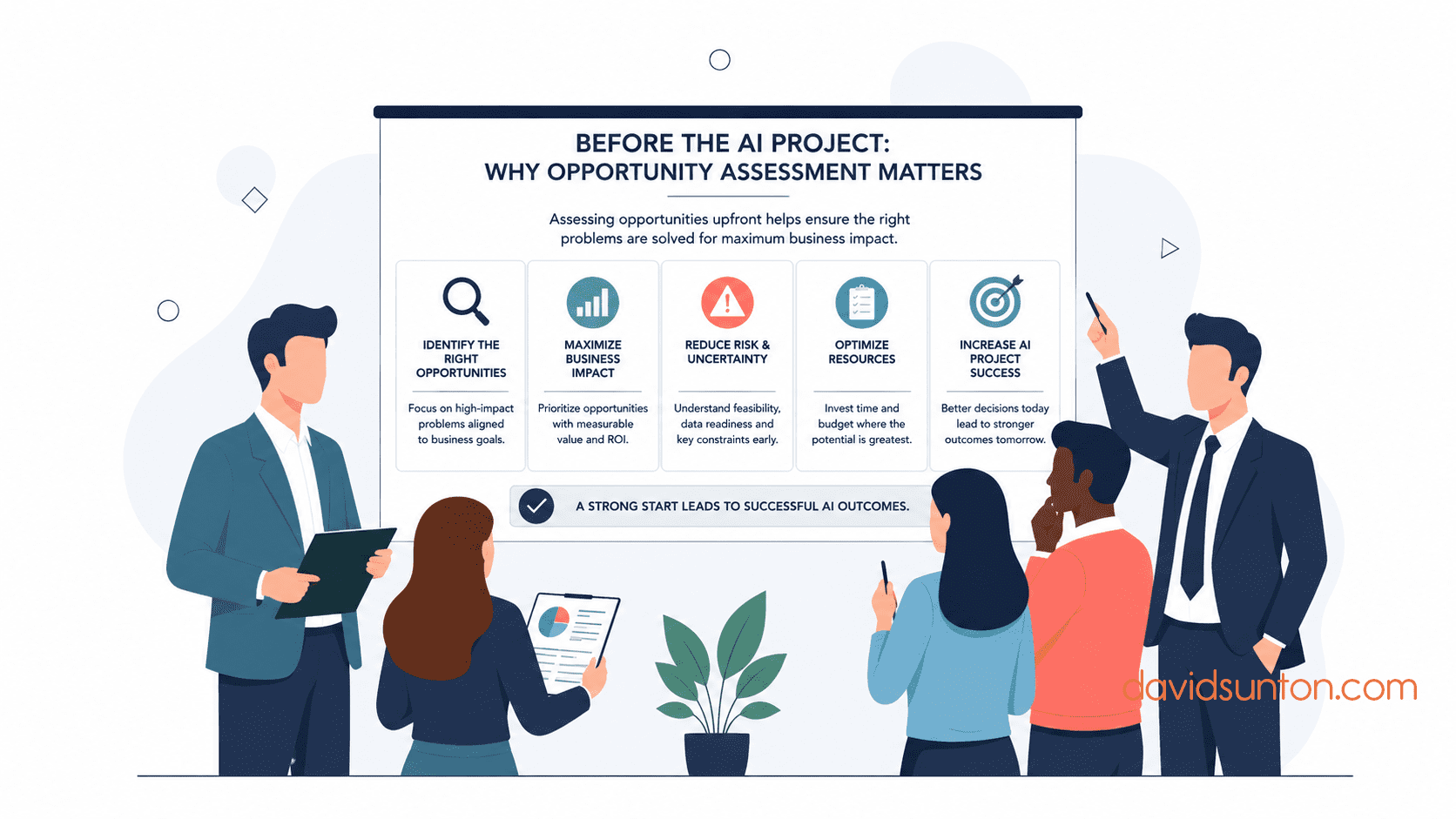
This is why AI opportunity assessment matters.
Before the AI project, leaders need to assess the business problem, the value potential, the AI pattern, the data requirements, the process fit, the people impact, the risk profile and the adoption pathway.
AI success begins before implementation.
It begins with choosing the right opportunity.
“We Need AI” Is Not A Problem Statement
Many AI conversations begin with a broad statement:
“We need AI.”
“We need to automate this.”
“We should use generative AI.”
“We need an AI agent.”
“We need to improve productivity with AI.”
These statements may signal a real opportunity, but they are not yet problem statements. They describe a desired direction or capability, not the specific business issue that needs to be solved.
A clear problem statement should explain what is happening today, why it matters, who is affected, what outcome is needed, and why the current way of working is no longer sufficient.
For example, “we need an AI chatbot” is not a problem statement.
A stronger problem statement might be:
“Our customer service team receives high volumes of repeated enquiries, response times are increasing, and customers are waiting too long for basic information. We need to reduce response time and free staff to focus on complex cases without reducing service quality or accountability.”
That is a better starting point because it identifies the operational issue, the affected users, the desired outcome and the constraints.
Similarly, “we need AI for reporting” is not enough.
A stronger problem statement might be:
“Managers spend several hours each week manually consolidating data from different systems, which delays decision-making and creates inconsistent reporting. We need faster, more reliable management insight while maintaining data governance and human review of key assumptions.”
The difference matters.
When leaders start with AI, the conversation becomes technology-centred.
When leaders start with the problem, the conversation becomes value-centred.
AI opportunity assessment begins by turning AI ambition into a clear business problem.
An AI Idea Is Not An AI Use Case
An AI idea is usually a possibility.
An AI use case is a defined business application.
The difference is important.
An idea might be:
“Use AI to summarise meetings.”
“Use AI to forecast demand.”
“Use AI to route customer enquiries.”
“Use AI to automate document processing.”
“Use AI to support sales teams.”
These ideas may be useful, but they are still incomplete. They do not yet explain who will use the solution, what workflow it supports, what data is required, what value it creates, what risks need to be controlled, or how adoption will happen.
A use case needs more structure.
It should define:
- the business problem
- the users or stakeholders
- the workflow affected
- the AI capability required
- the data inputs
- the expected outputs
- the decision points
- the human review or approval required
- the risks and controls
- the measurable value
- the adoption requirements
For example, “use AI to summarise meetings” could be a low-value convenience tool or a high-value operational capability, depending on how it is framed.
If the purpose is simply to create notes faster, the value may be limited.
But if the use case is to summarise client discovery sessions, extract requirements, identify risks, generate action items, update CRM records and support proposal creation, then the opportunity becomes more strategic. It affects process flow, data capture, sales quality, project handover and delivery efficiency.
The same AI capability can create very different levels of value depending on the use case design.
That is why opportunity assessment matters.
It prevents organisations from confusing an interesting AI idea with a practical business initiative.
Opportunity Assessment Reduces Waste
AI experimentation is useful, but unfocused experimentation can waste time, budget and attention.
Many organisations have no shortage of AI ideas. The challenge is deciding which ones are worth pursuing first.
Without a clear assessment process, initiatives may be selected based on enthusiasm, visibility, executive preference, vendor suggestion, ease of demonstration or novelty. These are not always bad signals, but they are not enough.
A use case may look impressive in a demo but create little business value.
Another may be technically achievable but too difficult to adopt.
Another may solve a real problem but depend on data that is not reliable.
Another may generate productivity gains but introduce unacceptable risk.
Another may work well for one team but fail when scaled across different operating conditions.
Opportunity assessment helps leaders avoid these traps.
It creates a disciplined way to compare AI opportunities based on value, feasibility, risk and adoption potential.
This does not mean every assessment must be slow or bureaucratic. In many cases, a structured discovery conversation, scorecard or short workshop can quickly separate strong opportunities from weak ones.
The point is not to make AI innovation harder.
The point is to make it more focused.
The Four Questions Leaders Should Ask First
Before approving an AI pilot or project, leaders should ask four practical questions.
First, is the problem worth solving?
This is the value question. The organisation should understand whether the problem affects cost, revenue, customer experience, risk, productivity, quality, speed, compliance or strategic capability. If the problem is minor, occasional or poorly aligned to business priorities, AI may not be the right investment.
Second, is AI the right pattern for the problem?
Not every problem requires generative AI, prediction, automation or an agent. Some problems need process redesign, better data discipline, clearer accountability, system integration, training or governance. AI should fit the problem, not be forced onto it.
Third, can the organisation support the solution?
This includes data readiness, process maturity, technology integration, governance, security, risk controls, user capability and operational ownership. A technically possible solution may still fail if the organisation is not ready to support it.
Fourth, will people adopt it?
AI does not create value unless people use it, trust it, govern it and integrate it into real work. Leaders need to understand who will be affected, what behaviour must change, what resistance may appear, and what reinforcement will be needed after go-live.
These four questions shift the conversation from “Can we build this?” to “Should we pursue this, and under what conditions will it create value?”
That is the purpose of AI opportunity assessment.
The AI Opportunity Assessment Lens
A practical AI opportunity assessment should examine eight areas.
1. Problem
What business problem are we solving?
The first task is to define the problem clearly. This means understanding the current pain point, the affected users, the operational context and the consequence of doing nothing.
A weak problem statement might say, “We need AI to improve efficiency.”
A stronger one might say, “Our team spends too much time manually classifying inbound requests, which delays response, creates inconsistent routing and increases rework. We need a faster and more reliable way to identify intent, capture key details and direct work to the right team.”
The stronger problem statement gives leaders something to assess.
It also helps prevent solution bias.
If the real issue is unclear accountability, poor data quality or a broken workflow, AI may not be the first answer. It may still have a role, but only after the underlying problem has been properly understood.
2. Value
What measurable outcome matters?
AI projects should be connected to business value.
Value may come from reduced manual effort, faster cycle times, fewer errors, better customer experience, improved sales conversion, stronger compliance, lower risk, better decision-making, higher service capacity or improved knowledge access.
The key is to define value in measurable terms where possible.
For example:
- reduce average response time
- reduce manual data entry
- increase first-contact resolution
- improve case routing accuracy
- reduce reporting preparation time
- improve forecast accuracy
- reduce rework
- increase sales team productivity
- reduce compliance review delays
- improve knowledge retrieval accuracy
If the value cannot be described, the use case may not be ready.
This does not mean every benefit must be financially quantified immediately. Some value is strategic or capability-based. But leaders should still be able to explain why the outcome matters and how they will know if progress is being made.
3. Pattern
What type of AI capability fits the problem?
Different AI problems require different AI patterns.
Some problems require conversational AI, where the goal is to interact with users through natural language.
Some require recognition, where the system identifies, classifies or extracts meaning from text, audio, images or documents.
Some require prediction, where the system estimates likely outcomes based on patterns in data.
Some require anomaly detection, where the system identifies unusual activity or exceptions.
Some require generation, where the system creates drafts, summaries, recommendations or content.
Some require autonomy or agentic execution, where AI performs tasks across systems within defined boundaries.
Choosing the wrong pattern can lead to poor solution design.
For example, if the problem is inconsistent triage of customer enquiries, the AI pattern may involve classification, information extraction and routing. If the problem is future stock demand, the pattern may involve forecasting. If the problem is staff access to internal knowledge, the pattern may involve retrieval-augmented question answering. If the problem is repetitive case handling, the pattern may involve workflow orchestration with human review.
The pattern should follow the problem.
It should not be chosen because a particular tool is fashionable.
4. Data
Is the data available, reliable and usable?
AI depends on data, but many organisations overestimate their data readiness.
They may have data, but it may not be complete, consistent, accessible, current, governed or suitable for the intended use case.
For AI opportunity assessment, leaders need to ask:
- What data is required?
- Where does the data live?
- Who owns it?
- Is it reliable?
- Is it complete enough?
- Is it structured or unstructured?
- Are definitions consistent?
- Can it be accessed safely?
- Are there privacy or security constraints?
- How will the data be maintained over time?
This is not just a technical issue. Data readiness is often a reflection of process and governance maturity.
If data is poor, the AI project may still proceed, but the scope, design, risk controls and expectations need to reflect that reality.
A good opportunity assessment does not simply ask whether data exists.
It asks whether the data is fit for the decision, workflow or output the AI is expected to support.
5. Process
Where does AI fit into the workflow?
AI creates value when it is embedded into work.
That means leaders need to understand the current process and the future process before implementation.
Where does the workflow start?
What triggers the need for AI?
What task will AI perform?
What decision will it support?
Who receives the output?
What happens next?
Where are the handoffs?
Where are the exceptions?
Where does human judgement remain necessary?
What systems are involved?
What governance is required?
Without this process view, AI can become a disconnected tool. People may not know when to use it, where the output belongs, or how it changes their work.
For example, an AI assistant that drafts customer responses may appear useful. But the real process questions include: Which enquiries are eligible? What tone and policy rules apply? Who reviews the draft? Which cases require escalation? How is the final response logged? How is quality monitored? How is feedback used to improve the system?
The workflow determines whether AI becomes useful or chaotic.
6. People
Who needs to trust, use or govern it?
AI opportunity assessment must identify the people affected by the change.
This includes users, managers, process owners, customers, data owners, risk teams, compliance teams, technology teams and executives.
Each group may have different concerns.
Users may ask whether the AI will make their work easier or harder.
Managers may ask how performance will be measured.
Compliance teams may ask how risk will be controlled.
Data owners may ask who maintains the source information.
Customers may care about quality, transparency and service experience.
Executives may care about value, scalability and risk exposure.
If these perspectives are not considered early, adoption problems appear later.
People do not adopt AI because it exists. They adopt it when it fits their work, improves something that matters, and operates within boundaries they can trust.
7. Risk
What controls are required?
AI introduces different types of risk depending on the use case.
There may be risks related to privacy, security, accuracy, bias, explainability, intellectual property, customer communication, regulatory compliance, operational dependency, data leakage or over-reliance.
The level of control should match the level of risk.
A low-risk internal drafting assistant may require simple review guidance and usage boundaries.
A customer-facing AI agent may require stricter controls around escalation, approved knowledge sources, tone, privacy and audit logs.
An AI tool that supports financial, legal, medical or compliance decisions may require stronger human review, documentation, governance and accountability.
Risk assessment should not be delayed until implementation.
It should shape the opportunity decision itself.
Some use cases are worth pursuing only if specific controls can be designed. Others may be better delayed until data, governance or process maturity improves.
Good AI governance does not stop innovation. It helps the organisation innovate with confidence.
8. Adoption
What will make this change stick?
AI opportunity assessment should consider adoption from the beginning.
Leaders should ask:
- Who needs to change behaviour?
- What will make them trust the solution?
- What training or support is required?
- What resistance might appear?
- What role will middle managers play?
- What routines will reinforce usage?
- What metrics will show adoption?
- What old workarounds need to be retired?
- What happens after go-live?
This is where AI opportunity assessment connects directly to change management.
A use case may be valuable and technically feasible, but still fail if the adoption pathway is weak.
For example, an AI recommendation tool may offer strong potential value, but if users do not trust the recommendations, if managers do not reinforce usage, or if the workflow makes it easier to ignore the output, the benefit will not be realised.
Adoption is not something to add after the AI project is built.
It is part of the opportunity itself.
Why Not Every AI Opportunity Should Become A Project
A disciplined assessment process will show that not every AI idea should proceed.
This is a strength, not a weakness.
Some ideas are too low-value.
Some are too risky.
Some depend on data that is not ready.
Some require process redesign before AI can help.
Some would be better solved through simpler automation.
Some need clearer governance.
Some are interesting but not aligned to strategic priorities.
Some may be worth revisiting later.
One of the most valuable outcomes of AI opportunity assessment is not just selecting what to do. It is also deciding what not to do yet.
This protects the organisation from scattered experimentation and initiative overload.
It also helps build credibility. When leaders can explain why certain AI opportunities are being prioritised and others are being deferred, AI strategy becomes more disciplined.
The goal is not to say yes to every AI idea.
The goal is to build a portfolio of AI initiatives that are valuable, feasible, governable and adoptable.
Opportunity Assessment Improves Vendor And Tool Decisions
AI opportunity assessment also helps organisations engage vendors more effectively.
Without clear problem framing, vendor conversations can become solution-led. The organisation may be impressed by features, demos or platform claims without knowing whether the tool fits the business problem.
With a strong opportunity assessment, leaders can ask better questions.
Does this solution address our specific problem?
What data does it require?
How does it fit into our workflow?
Where is human review designed?
What governance controls are available?
How are outputs monitored?
How does the system handle exceptions?
What integration is required?
How will users adopt it?
What evidence supports the expected value?
This changes the vendor relationship.
The organisation is no longer asking, “What can your AI do?”
It is asking, “Can your solution help us solve this business problem in a way that is practical, safe and adoptable?”
That is a much stronger position.
From Assessment To Solution Framing
Opportunity assessment should lead to solution framing.
Solution framing translates the opportunity into a practical initiative. It defines the scope, workflow, users, data, AI capability, governance, delivery pathway and adoption approach.
A well-framed AI initiative should clarify:
- the business problem
- the target outcome
- the users and stakeholders
- the AI pattern or capability
- the process change
- the data requirements
- the risk controls
- the human-in-the-loop design
- the implementation approach
- the adoption plan
- the success measures
This does not require every detail to be final before experimentation. But it does require enough clarity to ensure the pilot is testing something meaningful.
A pilot should not simply prove that AI works in general.
It should test whether a specific AI-enabled solution can create value in a specific business context.
That is the difference between experimentation and transformation.
A Practical Example
Imagine an organisation wants to “use AI to improve customer support.”
That is a broad ambition, not yet an opportunity.
An opportunity assessment would break it down.
First, define the problem.
Customer response times are increasing because support teams spend too much time reading long case histories, identifying issue type, searching for policy information and manually routing requests to specialist teams.
Second, define the value.
The organisation wants to reduce response time, improve routing accuracy, reduce rework, improve customer experience and free specialists to focus on complex cases.
Third, identify the AI pattern.
The solution may require classification, summarisation, retrieval from approved knowledge sources, recommendation and workflow routing.
Fourth, assess data.
The organisation needs reliable case history, customer information, policy documents, product information, service rules and escalation pathways.
Fifth, map the process.
The AI may summarise the case, identify intent, suggest next action, retrieve relevant policy information and route the case. Human review may be required before customer-facing responses are sent or high-risk cases are escalated.
Sixth, assess people.
Support staff need to trust the AI summaries. Team leaders need to monitor adoption. Compliance needs to approve knowledge sources and escalation rules. Customers need a consistent service experience.
Seventh, define risk controls.
Controls may include approved knowledge bases, confidence thresholds, human review, audit trails, escalation rules and performance monitoring.
Eighth, plan adoption.
The organisation may pilot with one team, use frontline staff as process testers, involve sceptics as risk advisors, train managers to reinforce usage, and track adoption after go-live.
This is now a defined AI opportunity.
It may still need further discovery, but it is no longer just an idea.
It is a potential business initiative with value, process fit, governance and adoption logic.
The Leadership Shift Before The AI Project
AI opportunity assessment requires a leadership shift.
Leaders need to move from curiosity to clarity.
From tool selection to problem framing.
From experimentation to value discipline.
From technical feasibility to organisational readiness.
From isolated pilots to scalable adoption.
From AI ambition to practical transformation.
This does not mean slowing down innovation. It means creating better conditions for speed later.
When the problem is clear, teams make better decisions.
When value is defined, priorities become easier.
When data requirements are understood, delivery risk is reduced.
When workflows are mapped, adoption becomes more practical.
When governance is designed early, trust increases.
When people impacts are considered, resistance can be addressed before rollout.
Opportunity assessment is not bureaucracy.
It is how leaders reduce avoidable failure.
Final Thought
Before the AI project, there is a decision that matters more than the technology choice.
Which opportunity is worth pursuing?
The answer should not be based on hype, pressure, novelty or vendor capability alone. It should be based on a clear understanding of the problem, value, AI pattern, data, process, people, risk and adoption.
AI can create significant business value, but only when it is connected to the right problem and embedded into the right operating context.
The strongest AI projects do not begin with the question, “What can AI do?”
They begin with a better question:
“What business problem is worth solving, and what would need to be true for AI to solve it well?”
That is why opportunity assessment matters.
It turns AI ambition into practical transformation.