Go-live is one of the most misleading milestones in transformation.
It feels like the end of the journey.
The project team has worked through discovery, design, approvals, configuration, testing, training, communication and launch. The new system is available. The new process has been published. The new operating model has been announced. The AI tool, workflow, dashboard, policy or platform is now live.
But go-live is not the finish line.
It is the point where the real test begins.
A transformation does not succeed because something has been launched. It succeeds when people adopt the new way of working, leaders reinforce it, processes support it, governance protects it, benefits are measured, and the organisation continues improving it after the initial project energy fades.
Table of Contents
Many transformations fail after go-live because leaders treat implementation as the end of the change. They assume that once the solution is available, adoption will naturally follow. But people do not automatically change behaviour because a system has gone live or a new process has been communicated.
They change when the new way becomes clear, useful, trusted, supported and reinforced.
This is especially true for AI-enabled transformation. An AI solution may be technically deployed, but users still need to understand when to use it, when not to use it, how to review outputs, how to escalate exceptions, how accountability works, and how the new workflow fits into daily operations.
The work after go-live is not administrative cleanup.
It is where transformation either becomes a new organisational capability or slowly collapses back into old habits.
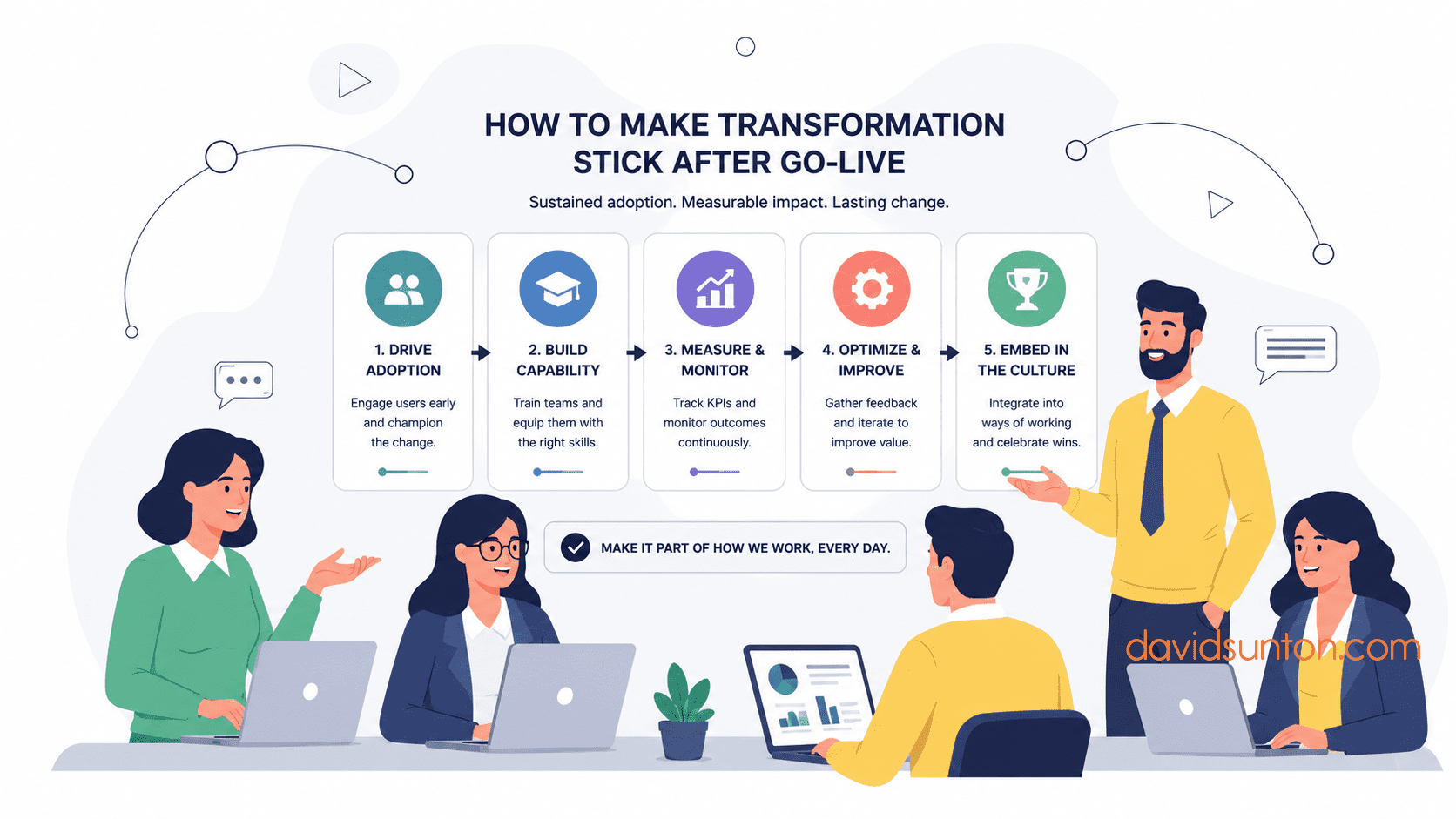
Why Transformation Often Fails After Launch
Transformation can fail after go-live for many reasons, but the pattern is usually familiar.
The project team moves on.
Executive attention shifts.
Training is treated as complete.
Managers return to operational priorities.
Old workarounds remain available.
Success is measured by delivery rather than adoption.
Benefits are assumed rather than tracked.
Feedback is collected too late or not acted on.
Governance becomes unclear once the project structure is removed.
People are left to interpret the new way of working for themselves.
The result is a gap between project completion and organisational change.
This gap is often invisible at first. In the early days after launch, there may still be attention, energy and support around the change. People may use the new system because they are expected to. Leaders may speak positively about the initiative. Early reports may show activity.
But over time, the real pattern emerges.
Some teams adopt the change well. Others comply superficially. Some managers reinforce it. Others quietly tolerate old behaviours. Some users trust the new process. Others create workarounds. Some benefits appear. Others remain theoretical.
This is why leaders need to manage the post-go-live period deliberately.
The question is not, “Did we launch?”
The better question is, “Is the new way becoming the normal way?”
Adoption Must Be Measured, Not Assumed
One of the most common mistakes after go-live is assuming that usage equals adoption.
A system may show that people have logged in. A workflow may show that cases have been submitted. A dashboard may show that the new process is active. But activity alone does not prove that the transformation is working.
Adoption means people are using the new way as intended, with the right behaviours, in the right workflow, for the right purpose.
For example, a team may use a new CRM but still maintain separate spreadsheets because they do not trust the data. A service team may use a new workflow system but continue resolving exceptions through informal messages. Employees may access an AI assistant but only for low-risk questions because they do not trust it for real work. Managers may approve a new process but still reward the speed and shortcuts of the old one.
These are not small issues. They show that adoption is incomplete.
Leaders should measure adoption through a combination of indicators:
- usage frequency
- quality of usage
- process compliance
- reduction in old workarounds
- behaviour change
- manager reinforcement
- user confidence
- exception patterns
- customer or operational outcomes
- benefit movement
For AI transformation, adoption measurement should also include responsible use. Are people reviewing AI outputs appropriately? Are they escalating uncertain cases? Are they following governance rules? Are they over-relying on the tool or under-using it because of low trust?
Good adoption measurement helps leaders see where the change is working, where it is fragile, and where intervention is needed.
Without measurement, leaders often mistake launch activity for lasting change.
Reinforcement Is A Leadership Discipline
People do not sustain new behaviours simply because they have been trained.
Training introduces the change. Reinforcement makes it stick.
Reinforcement happens through what leaders notice, measure, ask about, reward, tolerate and repeat. It happens in team meetings, one-on-one conversations, performance reviews, dashboards, governance forums, onboarding processes and daily management routines.
If leaders say the new way matters but continue asking for reports in the old format, the old behaviour will survive.
If managers say the new workflow is mandatory but allow high performers to bypass it, the workaround becomes the real process.
If executives celebrate go-live but never ask about adoption, the organisation learns that launch mattered more than behaviour change.
If benefits are promised but not reviewed, transformation becomes a story rather than a discipline.
Reinforcement requires consistent leadership signals.
Leaders should keep asking:
Are teams using the new process?
What is making adoption difficult?
Where are people reverting to old habits?
What support do managers need?
What exceptions are appearing?
What early benefits are visible?
What needs to be adjusted?
The goal is not to police people into compliance. The goal is to make the new way easier to understand, easier to use and harder to ignore.
Sustained transformation depends on sustained leadership attention.
Middle Managers Decide Whether Change Becomes Real
After go-live, middle managers become one of the most important forces in transformation.
They are close enough to daily work to see what is really happening, and influential enough to shape local behaviour. They know whether teams are using the new process properly, whether the system is helping or hindering, whether workload pressure is causing shortcuts, and whether people are confident or confused.
They also send powerful signals.
If a manager treats the new way as optional, the team will too.
If a manager does not understand the change, the team will struggle.
If a manager continues rewarding old behaviours, the old behaviours will continue.
If a manager creates space for questions, practice and feedback, adoption becomes easier.
This is why middle managers should not be treated only as recipients of change communication. They should be equipped as adoption leaders.
After go-live, they need practical tools:
- clear expectations for what changes in daily work
- talking points for team conversations
- guidance on handling resistance
- visibility of adoption metrics
- escalation paths for issues
- coaching resources
- examples of desired behaviours
- authority to remove local barriers
- regular forums to share feedback
For AI-enabled transformation, managers also need to understand the boundaries of responsible use. They need to know when AI outputs require review, what risks to watch for, how to handle user concerns, and how to reinforce trust without encouraging blind reliance.
If middle managers are not prepared to lead adoption, the transformation may remain a central initiative rather than a local reality.
Benefits Realisation Starts Before Go-Live But Proves Itself After
Many organisations create a business case before transformation begins, but fail to manage benefits after implementation.
This creates a common problem: the project delivers its outputs, but nobody clearly owns the ongoing benefits.
Benefits realisation should not be treated as a finance exercise at the end. It should be a leadership discipline throughout the transformation.
Before go-live, leaders should define the expected benefits clearly:
- What value are we trying to create?
- What metric will show progress?
- What behaviour must change for the benefit to appear?
- What process performance must improve?
- Who owns the benefit after launch?
- How often will benefits be reviewed?
- What will we do if benefits are not appearing?
After go-live, leaders should track whether the expected value is actually emerging.
This may include productivity gains, cost reduction, faster cycle times, fewer errors, improved customer experience, better compliance, improved decision quality, stronger data capture, reduced rework or increased revenue opportunities.
In AI transformation, benefits should be measured carefully. A generative AI tool may save drafting time, but does it improve quality? Does it reduce rework? Does it create new review burden? Does it improve customer responsiveness? Does it introduce risks that require additional controls? Does it shift work rather than reduce it?
The real question is not whether the tool is being used.
The real question is whether the organisation is capturing sustained value from the new way of working.
Benefits realisation keeps transformation honest.
It prevents leaders from confusing activity with impact.
Governance Must Continue After The Project Ends
During implementation, governance is usually clear. There may be a steering committee, project sponsor, delivery lead, workstream owners, risk forums and regular status reporting.
After go-live, that structure often disappears.
This can create a governance gap.
Who owns the process now?
Who approves changes?
Who monitors risk?
Who manages exceptions?
Who reviews adoption?
Who decides whether the workflow needs improvement?
Who is accountable for the benefits?
If these questions are unclear, the transformation may drift. Issues may be handled inconsistently. Users may create local workarounds. Data quality may decline. Process ownership may become ambiguous. Risk controls may weaken.
For AI-enabled transformation, ongoing governance is even more important.
AI systems may need monitoring for accuracy, bias, data quality, user behaviour, security, privacy, escalation patterns, exception rates and model performance. Policies may need updating. Human review thresholds may need adjustment. New use cases may emerge. Users may find creative but risky ways to use the tool.
Go-live should therefore trigger a shift from project governance to operational governance.
Leaders should define:
- process ownership
- system ownership
- data ownership
- AI governance responsibilities
- risk and compliance review routines
- exception management
- change control
- adoption reporting
- continuous improvement forums
- benefits ownership
Transformation sticks when governance becomes part of the operating rhythm, not just the project structure.
Old Workarounds Must Be Managed Deliberately
Every organisation has workarounds.
Some are harmful. Some are practical. Some exist because the official process does not reflect reality. Some were created by experienced people trying to get work done despite system limitations.
After go-live, old workarounds become an important adoption signal.
If people continue using them, leaders need to understand why.
Maybe the new process is too slow.
Maybe the system is difficult to use.
Maybe the old spreadsheet provides information the new system does not.
Maybe the workaround supports an exception the formal process missed.
Maybe managers still ask for outputs in the old format.
Maybe people do not trust the new data.
Maybe the official process is right in theory but impractical under pressure.
The wrong response is to simply ban workarounds without understanding them.
The better response is to examine them.
Some workarounds should be removed because they undermine the transformation. Some should be redesigned into the official process because they reveal legitimate operational needs. Some should be temporarily tolerated while issues are fixed. Some should trigger further training or system improvement.
In AI transformation, workarounds may appear when people do not trust AI outputs, when escalation rules are unclear, when the AI cannot handle real-world exceptions, or when the tool creates more effort than expected.
Workarounds show where the new operating model is not yet strong enough.
Leaders should treat them as diagnostic signals, not just compliance failures.
Feedback Loops Keep Transformation Alive
No transformation design is perfect at launch.
The real operating environment will always reveal things that were missed during planning. Users will encounter unexpected scenarios. Customers will respond differently than expected. Data issues will appear. Process exceptions will increase in some areas. Some teams will adapt faster than others. Some benefits will emerge quickly while others take longer.
This is why feedback loops are essential after go-live.
Feedback should be structured, regular and actionable.
Leaders need to know:
- what is working
- what is not working
- where users are confused
- where the process breaks
- where exceptions are increasing
- where managers need support
- where customers are affected
- where governance needs adjustment
- where benefits are emerging or lagging
Feedback can come from adoption dashboards, manager forums, user surveys, frontline listening sessions, champion networks, helpdesk data, process performance metrics, customer feedback and after-action reviews.
But collecting feedback is not enough.
The organisation must act on it.
When people provide feedback and nothing changes, trust weakens. When feedback leads to visible improvement, participation increases.
This is particularly important for AI solutions. Users need to see that their concerns about accuracy, usability, governance or workflow fit are being reviewed and addressed. Otherwise, they may conclude that the AI initiative is being pushed regardless of operational reality.
Feedback loops turn transformation from a one-time rollout into a learning system.
Change Fatigue Must Be Managed
By the time a transformation reaches go-live, many people are already tired.
They may have participated in workshops, training, testing, communications and transition activities while still doing their normal work. They may have experienced multiple other initiatives at the same time. They may be dealing with operational pressure, staffing constraints or customer demands.
After go-live, leaders may feel relief.
Employees may feel fatigue.
This gap matters.
If leaders immediately move on to the next initiative without supporting the transition, people may feel abandoned. They may revert to old habits not because they reject the change, but because they lack the energy, time or support to embed it properly.
Sustaining change requires leaders to manage the human energy of transformation.
That means simplifying where possible, removing unnecessary activity, celebrating meaningful progress, recognising effort, providing support, and giving people time to build competence.
It also means avoiding the temptation to declare victory too early.
Change fatigue is not solved by motivation slogans. It is managed by making the change practical, paced, supported and worthwhile.
For AI adoption, this is especially important. If teams are expected to learn new AI tools while also maintaining full productivity and managing uncertainty about role impact, adoption may suffer. Leaders need to create space for experimentation, practice and learning.
The question after go-live is not only “Are people using it?”
It is also “Do people have the capacity to make this new way sustainable?”
Embedding Change Into The Operating Model
Transformation sticks when it becomes part of the operating model.
That means the change is no longer dependent on project energy or individual enthusiasm. It becomes embedded into how the organisation works.
Leaders should look at several areas.
Processes: Are the new workflows documented, used and improved?
Systems: Do the tools support the new way of working and discourage old behaviours?
Data: Is the required data captured, maintained and trusted?
Roles: Are responsibilities clear?
Governance: Are decision rights, controls and ownership defined?
KPIs: Do performance measures reinforce the desired behaviour?
Routines: Do meetings, reports and management conversations review the right indicators?
Onboarding: Are new employees taught the new way from the beginning?
Capability: Do people have the skills and confidence to sustain the change?
Culture: Are leaders modelling the behaviours they expect from others?
This is where transformation becomes durable.
If the new way is not embedded into the operating model, it remains vulnerable. It may work while the project team is present, but weaken once attention shifts.
Embedding is the difference between a launched initiative and a sustained capability.
Continuous Improvement Prevents Transformation From Becoming Stale
Making transformation stick does not mean freezing the organisation in a new fixed state.
The new way of working should continue to improve.
Markets change. Customers change. Systems change. Risks change. AI capabilities change. People discover better ways of working once they begin using the new process in real situations.
A transformation that cannot adapt may become outdated quickly.
This is why continuous improvement should be built into the post-go-live model.
Leaders should create regular opportunities to review:
- adoption metrics
- process performance
- user feedback
- exception trends
- customer impact
- benefit progress
- risk indicators
- system usability
- training needs
- improvement opportunities
For AI systems, continuous improvement may also include reviewing prompt quality, knowledge sources, model performance, response accuracy, human review outcomes, escalation patterns and governance settings.
The goal is not endless change for its own sake.
The goal is to keep the transformation aligned with business value and operational reality.
A transformation sticks not because it never changes again, but because it becomes part of the organisation’s learning and improvement rhythm.
A Practical Post-Go-Live Stickiness Lens
Leaders can use a simple lens after go-live to test whether the transformation is becoming durable.
Purpose: Do people still understand why the change matters?
People: Are the right groups adopting the new way, and do they have the support they need?
Process: Is the new workflow being followed in real work, including exceptions?
Systems: Are tools and data supporting the intended behaviour?
Governance: Are ownership, controls, decisions and escalation paths clear?
Reinforcement: Are managers, KPIs, routines and leadership signals reinforcing the change?
Benefits: Are measurable outcomes being realised and sustained?
This lens helps leaders move beyond the launch event and into the real work of embedding transformation.
It also creates a practical review structure for executives, sponsors, project teams and business owners.
Instead of asking only whether the project was delivered, leaders can ask whether the organisation has actually changed.
What Leaders Should Do In The First 90 Days After Go-Live
The first 90 days after go-live are critical.
This is when new behaviours are still forming, old habits are still available, and the organisation is deciding whether the change is real.
Leaders should use this period deliberately.
In the first 30 days, focus on stabilisation.
Make sure people can use the new process or system. Resolve urgent issues quickly. Provide visible support. Monitor early adoption. Identify confusion, risk and major barriers. Keep communication practical and grounded in real use.
In days 31 to 60, focus on reinforcement.
Review adoption metrics. Work with middle managers. Address workarounds. Share early wins. Clarify expectations. Adjust training. Strengthen governance. Make sure the old way is not quietly becoming the default again.
In days 61 to 90, focus on benefits and improvement.
Assess whether the intended outcomes are emerging. Review process performance. Identify improvement opportunities. Confirm ongoing ownership. Move from project support into operational governance. Decide what needs to be scaled, refined or stopped.
The exact timeline will vary, but the principle is consistent.
The post-go-live period should be actively led, not passively observed.
Why This Matters For AI Transformation
AI transformation makes post-go-live leadership even more important.
AI systems can behave differently across use cases, users, data conditions and operational contexts. People may need time to develop trust. Governance may need adjustment. Human review rules may need refinement. Edge cases may appear. New risks may emerge as people find different ways to use the tool.
If leaders treat AI go-live as the end, they may miss the most important learning period.
After launch, leaders should monitor not only whether the AI is being used, but whether it is being used appropriately, safely and effectively.
They should ask:
Are users confident?
Are outputs trusted?
Are humans reviewing the right things?
Are exceptions escalating properly?
Are there signs of over-reliance or under-use?
Are policies clear?
Are benefits visible?
Are risks controlled?
Are managers reinforcing responsible adoption?
AI adoption is not only about technical performance. It is about integrating AI into real work with the right trust, judgement and accountability.
That takes leadership after go-live.
Final Thought
Go-live is not the end of transformation.
It is the moment when the organisation begins proving whether the change can survive contact with real work.
The system may be live, but adoption may still be fragile.
The process may be documented, but old habits may still be stronger.
The business case may be approved, but benefits may still need to be realised.
The technology may work, but people may still need trust, support and reinforcement.
Transformation sticks when leaders stay engaged after launch.
They measure adoption.
They reinforce behaviour.
They support middle managers.
They manage workarounds.
They maintain governance.
They listen to feedback.
They track benefits.
They keep improving the operating model.
The goal is not simply to deliver change.
The goal is to make the new way of working last.
That is why the most important transformation question after go-live is not, “Did we launch successfully?”
It is:
“Is the organisation actually changing, and are the benefits starting to stick?”