AI projects are often described as technology projects.
A business identifies a use case, selects a platform, connects data, configures a model, runs a pilot and prepares for rollout. The focus naturally goes to technical feasibility: can the AI classify, summarise, predict, recommend, generate, route or automate the task?
That technical question matters.
But it is not enough.
Table of Contents
AI projects do not succeed simply because the model works. They succeed when people trust the output, change how they work, understand their role in the new process, follow the right controls, and use the technology in a way that creates measurable business value.
That is why AI projects are change projects.
AI does not only introduce new capability. It changes workflows, roles, decisions, accountabilities, behaviours and risk. It can alter how work enters a team, how information is interpreted, how decisions are made, how exceptions are escalated, how quality is reviewed and how value is measured.
When leaders treat AI as only a technology deployment, they often underestimate the organisational change required to make adoption stick.
The result is familiar.
The pilot looks promising, but usage remains low.
The tool is available, but teams keep using the old process.
The model performs well in testing, but users do not trust it in real work.
The system goes live, but managers do not reinforce the new behaviour.
The project is delivered, but the business benefit is not sustained.
This is not just an AI problem. It is a transformation problem.
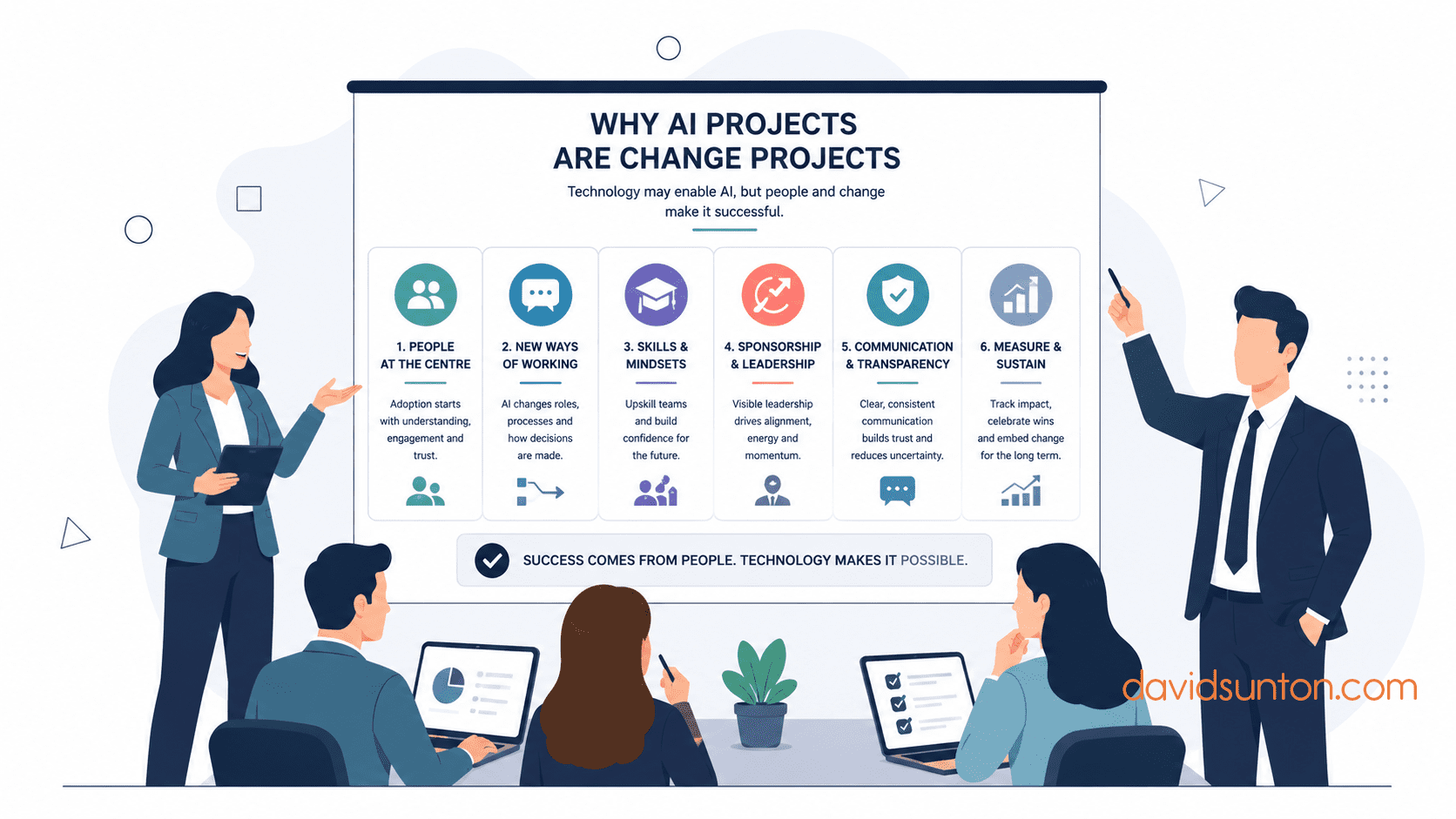
AI Changes Work, Not Just Technology
The first mistake is assuming that AI can be added to an existing process without changing the way work happens.
Sometimes this is possible for a narrow task. But most meaningful AI use cases affect the broader workflow around the task.
An AI assistant that summarises customer conversations changes how service teams review information.
An AI triage tool changes how cases are classified, routed and escalated.
An AI forecasting model changes how managers interpret demand, inventory, staffing or risk.
An AI document generation tool changes how people draft, review, approve and reuse content.
An AI agent that takes action across systems changes how permissions, accountability and exception handling are managed.
In each example, the technology is only part of the change.
The larger question is: how will the work change?
Leaders need to understand what the current process looks like, where AI will fit, what decisions it will support, where humans remain accountable, what exceptions may occur, what data is required, and how the new workflow will be governed.
If those questions are not answered, AI can make a poor process faster, more confusing or harder to control.
This is why AI transformation should begin with process understanding, not just tool selection.
Before asking, “Which AI solution should we use?” leaders should ask, “What work are we trying to improve, and what needs to change around it?”
AI Adoption Depends On Trust
Traditional systems can often be adopted through process compliance. If the organisation mandates a new CRM, finance platform or workflow system, employees may have little choice but to use it.
AI is different.
AI adoption depends heavily on trust.
People need to trust the data, the output, the review process, the governance, the boundaries of use and the accountability model.
If they do not trust the AI, they may avoid it, double-check everything manually, use it only for low-risk tasks, or quietly return to old methods.
This is particularly important when AI influences judgement.
A staff member may ask:
Can I rely on this recommendation?
What data was used?
What if the output is wrong?
Am I accountable if I follow it?
When should I escalate?
Is this allowed under our policies?
Will customers know AI was involved?
Will this affect my role?
These are not only technical questions. They are change questions.
Trust needs to be designed into the transformation. It cannot be assumed after deployment.
For leaders, this means being clear about what the AI can and cannot do. It means explaining how outputs should be reviewed. It means defining escalation rules, confidence thresholds, approval points and risk controls. It means training people not only on how to use the tool, but how to use it responsibly.
In AI projects, trust is not a soft issue.
It is an adoption requirement.
AI Use Case Evaluation Is Change Diagnosis
Many organisations evaluate AI use cases by asking whether the technology can perform the task.
Can it summarise documents?
Can it classify enquiries?
Can it forecast demand?
Can it generate marketing content?
Can it detect anomalies?
Can it automate a workflow?
These are useful questions, but they are incomplete.
A better AI use case evaluation should also ask:
What business problem are we solving?
What measurable value matters?
Who will use the AI, trust it or govern it?
Where does it fit into the workflow?
What data is required, and is that data reliable?
What risks need to be controlled?
What human judgement remains necessary?
What behaviour needs to change?
What will make adoption stick?
These questions connect AI opportunity assessment with change management.
A use case may be technically feasible but still not worth pursuing. It may be low value, poorly aligned to business priorities, difficult to adopt, high risk, data poor, or too complex for the organisation’s current capability.
Another use case may be technically modest but commercially valuable because it improves a painful workflow, reduces manual effort, strengthens compliance, improves response time or gives people better decision support.
The goal is not to pursue AI because it is impressive.
The goal is to pursue AI where it solves a real business problem and can be adopted in practice.
That makes use case evaluation a change diagnosis exercise, not just a technical screening exercise.
Data Readiness Is Also Organisational Readiness
AI projects often expose data problems that already existed but were easier to ignore.
Data may be available but not usable.
It may be incomplete, inconsistent, duplicated, outdated, poorly governed or spread across different systems. Ownership may be unclear. Teams may define the same terms differently. Critical knowledge may sit in documents, spreadsheets, inboxes or people’s heads.
When this happens, leaders may describe the issue as a data readiness problem.
That is true, but it is also an organisational readiness problem.
Data quality reflects how the organisation works. It reflects processes, accountabilities, incentives, governance and habits. If people enter data inconsistently, bypass systems, maintain private spreadsheets, or use different definitions across teams, the AI project is revealing a deeper operating model issue.
For example, an organisation may want to build an AI assistant that answers employee questions using internal policies and process documents. The technology may be capable. But if policies are outdated, ownership is unclear, and different teams maintain conflicting versions, the AI will struggle to provide trusted answers.
The problem is not only the AI.
The problem is the knowledge management system around the AI.
Similarly, a sales team may want AI to forecast pipeline risk. But if opportunity stages are inconsistently used, close dates are unreliable, and sales activity is not properly captured, the AI will inherit poor-quality signals.
Data readiness therefore requires more than technical integration.
It requires governance, ownership, standards, behaviours and ongoing maintenance.
That is change work.
Human-In-The-Loop Is A Workflow Design Decision
Many leaders say they want a human-in-the-loop approach to AI.
That is a good principle, but it needs to be designed properly.
Human-in-the-loop does not simply mean adding a manual review step somewhere in the process. It means being clear about where human judgement is required, why it is required, who is responsible, what they are reviewing, what authority they have, and what happens when they disagree with the AI.
In some cases, humans review every AI output.
In other cases, humans review only exceptions, low-confidence outputs, high-risk decisions or customer-sensitive scenarios.
Sometimes the human approves the final action.
Sometimes the human provides feedback to improve the system.
Sometimes the human handles escalation when the AI cannot proceed.
These are design choices.
If they are not made intentionally, human-in-the-loop can become a bottleneck, a false sense of control, or an unclear accountability layer.
For example, an AI system may draft responses to customer enquiries. If every response must be reviewed by a human, productivity gains may be limited. But if no review is required, quality and risk may suffer. A better design may classify responses by risk level, allowing low-risk drafts to be reviewed quickly while high-risk or sensitive cases require specialist approval.
The question is not simply, “Should a human be involved?”
The better question is, “Where does human judgement create the most value and control in this workflow?”
That is not only an AI design question.
It is a process and change question.
AI Governance Must Start Before Go-Live
Governance is often treated as something to finalise late in the project.
That is risky.
In AI transformation, governance should start during discovery and solution framing.
Leaders need to define how the AI will be used, what it is allowed to do, what data it can access, who can approve actions, how outputs will be reviewed, how exceptions will be handled, how performance will be monitored and how accountability will be maintained.
Without this clarity, adoption becomes harder.
People may avoid the tool because they are unsure what is allowed. Risk teams may slow the rollout because controls are unclear. Managers may apply inconsistent rules. Users may over-rely on AI in some areas and under-use it in others.
AI governance should not be seen as a blocker to innovation.
Good governance creates confidence.
It gives people boundaries. It explains where the AI is useful, where it is limited, and how risk is managed. It helps the organisation move faster because people know the rules of responsible use.
This is particularly important for agentic workflows, where AI may not only generate information but also trigger actions, update systems, route work or coordinate tasks.
The more autonomy an AI system has, the more important governance becomes.
Leaders should not wait until risk appears before defining controls.
Controls are part of the change design.
Agentic Workflows Require Process Orchestration
AI agents are often described as if they can independently complete work from beginning to end.
In reality, most business environments require orchestration.
An AI agent may classify a request, extract information, summarise a document, draft a response, update a system, recommend an action or escalate an exception. But that work usually sits inside a broader process involving people, systems, policies, approvals, data and governance.
This means leaders need to define:
What triggers the workflow?
What task is the agent responsible for?
What systems or data can it access?
What decisions can it make?
When must a human review or approve?
What happens when confidence is low?
What happens when information is missing?
What exceptions require escalation?
How will actions be audited?
How will performance be measured?
Without this process design, AI agents can create risk, confusion and inconsistent outcomes.
For example, an AI agent that handles supplier price-change requests may need to read emails, extract affected SKUs, compare current prices, identify margin impact, prepare recommended updates, request approval from a category manager, update the ERP and keep an audit trail.
The agent is not operating in isolation.
It is part of an orchestrated workflow.
The success of the project depends not only on the AI’s extraction accuracy, but on the design of the end-to-end process.
That is why AI agents need process design, governance and change adoption from the beginning.
Middle Managers Make Or Break AI Adoption
Executives may approve AI strategy, but middle managers often determine whether AI becomes part of daily work.
This group is critical because they translate the change into operational reality.
They decide whether teams have time to learn the new tool. They answer practical questions. They reinforce usage. They manage workload during transition. They address concerns. They decide whether old workarounds continue. They model whether the AI-enabled process is genuinely expected or just another optional experiment.
If middle managers are not engaged early, AI adoption can stall.
They may support the idea in principle but lack confidence in how to lead the transition. They may worry about team performance during the learning curve. They may not understand the governance rules. They may be unclear on what behaviour they are expected to reinforce. They may privately allow their teams to keep using old methods to protect short-term output.
Leaders should treat middle managers as adoption partners, not just communication channels.
They need to understand why the AI initiative matters, how the workflow changes, what benefits are expected, what risks are being managed, how to support their teams, and how adoption will be measured.
In AI transformation, the direct manager is often the most important trust signal.
If the manager does not use, support or reinforce the new way, the team is unlikely to adopt it deeply.
Resistance To AI Is Useful Data
Resistance to AI is often more nuanced than simple fear of technology.
People may resist because they have valid concerns.
The output may not be reliable enough.
The process may not reflect real work.
The data may be poor.
The governance may be unclear.
The tool may add steps rather than remove friction.
The AI may threaten professional judgement or identity.
The benefits may be obvious to leaders but not to users.
The change may arrive when teams are already fatigued.
These concerns should be diagnosed rather than dismissed.
Sceptics can become useful contributors. They can identify risks, test edge cases, validate workflows, review outputs, define exceptions and improve controls. Frontline users can help leaders understand whether the AI fits the reality of work. Subject matter experts can help define where human judgement remains essential.
This does not mean every objection should stop the project.
It means resistance should be used as design intelligence.
If people do not trust the AI, ask what evidence would increase trust.
If people fear loss of judgement, clarify where judgement remains central.
If people worry about risk, involve them in defining controls.
If people believe the process will not work, test it with real scenarios.
Resistance becomes dangerous when it is ignored.
It becomes valuable when it improves the solution and the adoption plan.
Go-Live Is Not AI Success
One of the most important mindset shifts is to stop treating go-live as success.
Go-live means the solution is available.
It does not mean the organisation has changed.
AI success should be measured through adoption, usage, behaviour change, process performance, risk control and sustained business outcomes.
Leaders should ask:
Are people using the AI in the intended workflow?
Are they using it responsibly?
Are they still relying on old workarounds?
Are managers reinforcing the new way?
Are outputs being reviewed appropriately?
Are exceptions being escalated correctly?
Is productivity improving?
Is quality improving?
Is customer experience improving?
Are risks being managed?
Are benefits being sustained?
These questions should be answered after go-live, but they should be designed before go-live.
If adoption metrics, governance routines and benefits ownership are not established early, the project may deliver a tool without delivering transformation.
This is why AI initiatives need benefits realisation planning, adoption tracking, reinforcement routines and continuous improvement.
The work does not end when the model is deployed.
In many ways, that is when the real change begins.
What Leaders Should Do Differently
If AI projects are change projects, leaders need to manage them differently from the beginning.
First, start with the business problem.
Do not begin with the tool, vendor or model. Define the problem, the outcome, the users, the workflow and the value.
Second, assess the use case beyond technical feasibility.
Consider value, data readiness, process fit, governance, risk, adoption and sustainment.
Third, map the workflow before introducing AI.
Understand the current process, future process, decisions, handoffs, exceptions, approvals and controls.
Fourth, design human-in-the-loop intentionally.
Clarify where human judgement is required, who is accountable, and what happens when the AI is uncertain or wrong.
Fifth, build governance early.
Define permissions, data access, review rules, escalation paths, auditability and performance monitoring before rollout.
Sixth, engage stakeholders as participants.
Use sceptics as risk advisors, frontline users as process testers, middle managers as adoption translators and champions as local support.
Seventh, measure adoption after go-live.
Track usage, behaviour, process outcomes, benefits, exceptions and risk indicators.
These actions do not slow AI transformation down.
They make it more likely to succeed.
A Practical Lens For AI Change Projects
Leaders can use a simple lens to diagnose AI initiatives before implementation.
Problem: What business problem are we solving?
Value: What measurable outcome matters?
Pattern: What type of AI capability fits the problem?
Data: Is the data available, reliable, governed and usable?
Process: Where does AI fit into the workflow?
People: Who needs to trust, use, review, approve or govern the AI?
Risk: What could go wrong, and what controls are required?
Adoption: What will make the change stick after go-live?
This lens helps leaders avoid a tool-led approach.
It connects AI opportunity assessment with process design and change adoption.
It also makes the transformation more practical, because it forces the organisation to consider not only whether AI can work, but whether it can create value in real operations.
Final Thought
AI projects are change projects because AI changes how work gets done.
It changes how information is interpreted, how decisions are supported, how risks are controlled, how people collaborate, how managers reinforce behaviour and how value is delivered.
The organisations that succeed with AI will not be the ones that simply deploy the most tools.
They will be the ones that choose the right opportunities, design the right workflows, build trust, govern responsibly and lead adoption with discipline.
AI may provide the capability.
Change leadership turns that capability into value.
That is why leaders should stop asking only, “Can the AI do this?”
They should also ask:
“What needs to change in the organisation for this AI initiative to work?”
That question is where successful AI transformation begins.