Executives are being asked to commit to an AI future state they cannot yet see in detail. The real skill is not predicting that future. It is making it visible enough to lead toward.
Table of Contents
Every AI transformation begins with the same uncomfortable gap.
Leaders are asked to fund a change, sponsor it, defend it to a board and ask their people to live through it, before anyone can show them exactly what the destination looks like.
They are told the future will involve AI. They are told work will be faster, smarter, more efficient and more scalable. They may even have seen a pilot that worked.
But when they ask the obvious question, the answers often become vague.
What will the work actually look like?
Who will still do what?
Where will AI act, and where will people stay in control?
How will decisions be made?
How will risk be managed?
How will we know whether it is working?
This is the moment many AI initiatives quietly stall. Not because the ambition is wrong, and not because the technology necessarily fails, but because leadership cannot yet picture the future state clearly enough to commit to it with confidence.
The instinct is to fix this with detail.
A comprehensive future-state blueprint. A target operating model. A three-year architecture. A roadmap that attempts to specify every workflow, role, system and dependency before the organisation has started learning.
That instinct is understandable.
It is also a trap.
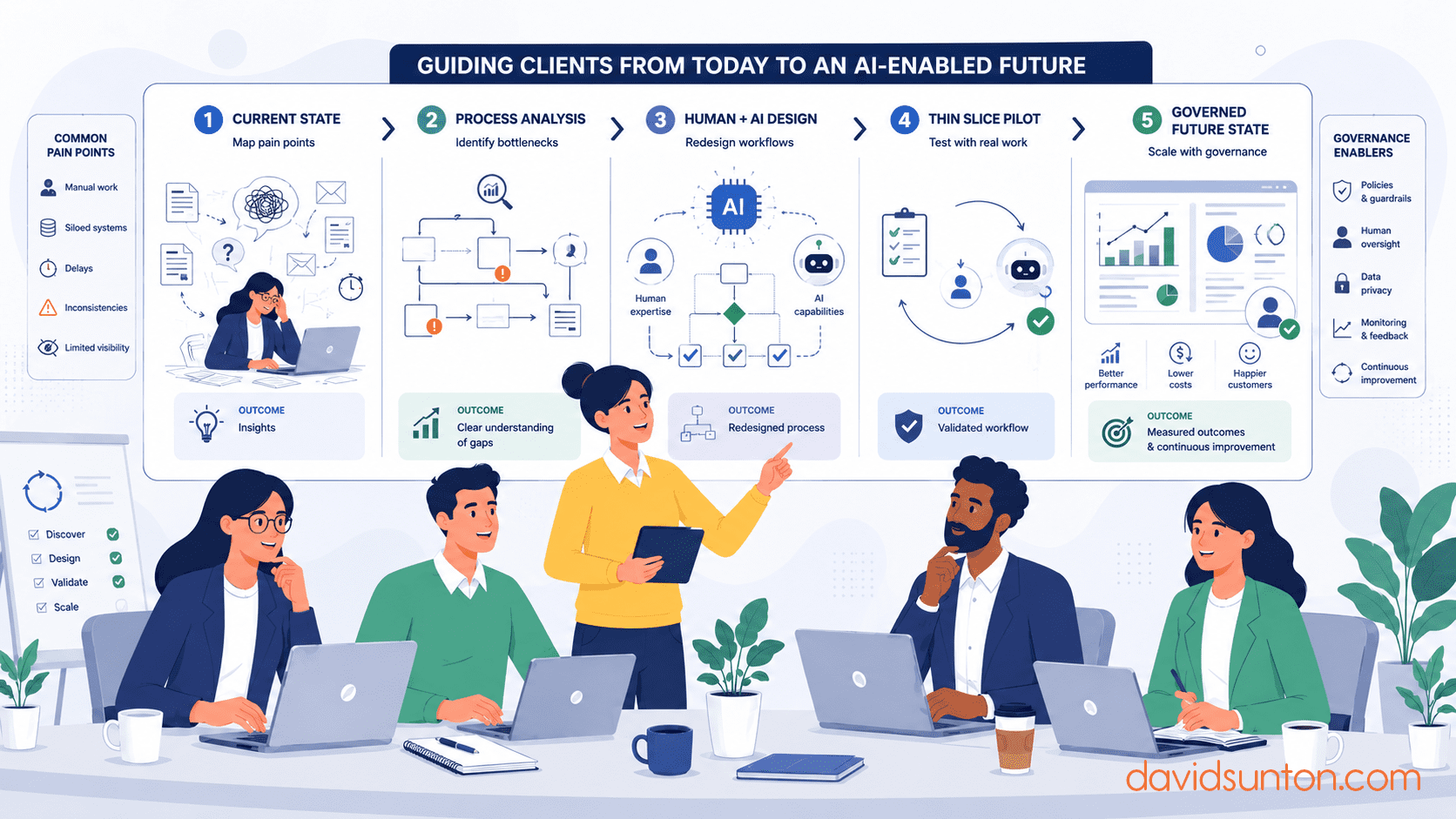
AI transformation requires a different approach. Leaders do not need to know the full future state before they begin. They need to make the future visible enough to act on, practical enough to test, governed enough to trust, and measurable enough to scale.
That future does not become visible by guessing.
It becomes visible by understanding today’s work, redesigning tomorrow’s work, and proving the future one thin slice at a time.
The Question Behind the Hesitation
When leaders hesitate on AI, the question they ask out loud is usually about cost, risk, readiness or capability.
The question underneath is often simpler.
They cannot see the future state, so they cannot judge whether the journey toward it is worth taking.
This is a reasonable position. Leaders are accountable for outcomes they can defend. Asking an organisation to change how work is done, how decisions are made, how customers are served and how people spend their time is a serious commitment.
It is difficult to make that commitment toward a destination that remains abstract.
So the request is fair.
Show me where this is going.
The mistake is in how that request is usually answered.
The Trap of the Detailed Blueprint
The conventional response is to remove uncertainty by adding detail.
A thick future-state document. A complete target operating model. A multi-year roadmap with every workflow specified, every role redefined and every system mapped before the work begins.
In a stable environment, that approach has merit.
In AI transformation, it often creates false precision.
The technology is moving quickly. The organisation will learn too much along the way. The first redesign will meet real data, real exceptions, real users and real customer behaviour, and it will change.
A future state specified in full detail on day one is not a plan.
It is a prediction.
And it is usually wrong.
Worse, leaders can sense this.
A future state that is too clean, too certain and too complete does not always build confidence. It can erode it. Experienced executives recognise the difference between a credible direction and an over-engineered guess.
The detailed blueprint tries to buy commitment with certainty it cannot honestly provide.
There is a better way to earn it.
A Better Definition of an AI Future State
Leaders do not need to know the full future state.
They need to see it clearly enough to commit to a direction, and trust that it will sharpen as the organisation learns.
This is the reframe that changes the conversation.
A future state is not a fixed destination that someone reveals. It is a direction made tangible, combined with a disciplined method for making it more specific over time.
That distinction matters because it changes what leaders are being asked to commit to.
They are not signing off on a frozen end-state they must defend in detail.
They are committing to a clear direction, a set of principles, a measurable intent and a way of working that gets sharper with every step.
This is a more honest promise. It is also a more durable one, because the specifics can evolve without breaking the commitment.
The work, then, is not to predict the future in detail.
The work is to make an uncertain future visible enough to act on.
The Future Starts With the Current Work
The AI future does not become visible by guessing what AI might do.
It becomes visible by understanding how work happens today.
Where does work slow down?
Where do people copy, reconcile, re-enter or search for information?
Where do customers wait?
Where are decisions delayed because the right data is hard to access?
Where does quality depend too heavily on individual experience rather than a consistent process?
Where are skilled people spending time on work that does not require their judgement?
Where do handoffs break down?
Where is governance handled after the fact instead of built into the process?
These are not just operational problems. They are signals.
They show where value is being lost, where human effort is being misapplied, where customers experience friction, and where AI may be able to improve speed, quality, consistency or scale.
This is why current-state analysis is not a preliminary exercise before the real AI work begins.
It is where the AI opportunity starts to become visible.
The current state shows where the organisation is constrained.
The future state shows how those constraints might be redesigned.
You do not make the AI future visible by guessing. You make it visible by understanding today’s work, redesigning tomorrow’s work, and proving the future one thin slice at a time.
Redesign the Work, Not Just the Tool
Once the current work is understood, the next step is not to choose an AI tool.
It is to redesign the work.
The most common error is to imagine the future state as the current organisation with AI tools added on top.
That is not transformation.
That is decoration.
AI creates value when it changes how work is done, not when it is bolted onto a process that was never designed for it.
The future state is not “our current process, plus a tool.”
It is a process redesigned around what humans and machines are each genuinely good at.
AI is suited to scale, speed, consistency, pattern recognition, summarisation, generation and tireless repetition.
People are suited to judgement, exceptions, relationships, ethics, context, accountability and trust.
A well-designed future state assigns work deliberately between the two. It makes clear where AI acts, where humans decide, where review is required, where escalation occurs, and where accountability remains.
This is the heart of AI-enabled process design.
The future state is not a smarter tool.
It is a redesigned way of working, in which the role of the human and the role of the machine are both intentional.
Once leaders understand that, the question becomes practical.
How do we make that future visible before it fully exists?
How to Make an Uncertain Future Visible
There are five practical ways to make an AI-enabled future state tangible enough for leaders to commit to, while remaining honest about what is not yet known.
None of them depends on false certainty.
All of them give leaders something concrete to react to, challenge and shape.
1. Anchor the Future in Outcomes, Not Technology
Leaders cannot always picture an orchestration layer, an agentic workflow or a retrieval pipeline.
They can picture a result.
A customer query resolved on first contact instead of escalated three times.
A quote produced in two hours instead of two days.
A claims assessment completed with fewer manual checks.
A service team spending more time on complex cases and less time searching for information.
A manager receiving a clear summary of operational risks before they become visible in lagging reports.
When the future state is defined by what changes in the business, the technology becomes an implementation detail rather than the thing leaders must understand first.
The conversation moves from “How does the AI work?” to “What becomes true for the business?”
That is the conversation executives are equipped to have.
Define the future by its outcomes first.
The architecture can come later.
2. Map the Work With Humans and AI in Separate Lanes
Outcomes set the direction.
A process map makes the future debatable.
This is where structured process design earns its place. A clear workflow that shows the future state, with AI work and human work in separate lanes, does something no slide deck can.
It makes the future concrete enough to argue with.
It shows where AI acts.
It shows where a human picks up.
It shows where the judgement gate sits.
It shows where AI runs unsupervised, and where it must not.
It shows where data enters the process.
It shows where quality is checked.
It shows where accountability remains human.
When leaders can see the work laid out this way, they stop being an audience and become co-designers.
They can point at a specific step and say, “No, a person needs to approve that.”
That single sentence is worth more than a hundred pages of vision, because it means leadership is now shaping the future state rather than being sold one.
A future you can point at is a future you can lead toward.
3. Describe a Day in the Life, Not an Architecture
People understand work as lived experience, not as boxes and arrows.
One of the most effective ways to make a future state real is to narrate it from the perspective of an actual role.
Walk leadership through a Tuesday morning in the future state.
What lands on the analyst’s screen?
What has the AI already done before they arrive?
What decision are they now making?
What do they no longer touch?
Where do they intervene when something looks wrong?
What does the customer experience differently?
What does the manager see that they could not see before?
This turns abstraction into something people can imagine.
It also surfaces objections early, which is exactly what you want.
When a leader hears the day-in-the-life and says, “That step would never work for our most sensitive accounts,” that is not resistance.
It is design intelligence arriving at the right moment.
A future state described as a day in someone’s working life is far easier to evaluate than one described only as a system.
People do not adopt architectures.
They adopt new ways of working.
4. Build a Thin Slice and Let People Watch It Run
Nothing makes a future state more believable than seeing part of it work.
A thin slice is a single workflow, built end to end, with the human and AI handoffs actually happening in real conditions.
Not a broad transformation program.
Not a polished demo disconnected from operations.
Not a theoretical business case.
A narrow but genuine version of the future, running on real work.
Seeing beats describing.
A working slice collapses months of debate because leaders are no longer imagining the model. They have witnessed it.
They have seen where it performed well.
They have seen where it struggled.
They have seen where a human had to step in.
They have seen how the workflow handled an exception.
They have seen what users accepted, questioned or resisted.
This also reduces risk from the larger commitment. By proving one process before scaling, the organisation replaces argument with evidence.
Describe the future, and leaders will question it.
Let them watch a piece of it run, and they can start to believe it.
5. Commit to Guardrails, Not a Fixed Destination
The final method is the most honest.
The future state is often better expressed as a bounded space than a fixed point.
Rather than committing to a frozen blueprint, leadership commits to a clear set of principles and guardrails.
Where is AI allowed to act autonomously?
Where must a human remain accountable?
What data may the system use?
What data is off limits?
What does good look like?
What is unacceptable?
Where is the line between assistance and authority?
When must a decision be escalated?
What evidence is required before scaling?
Inside those guardrails, the specific design can evolve as the organisation learns, without anyone feeling the commitment has been broken.
Leaders are not agreeing to a fixed picture.
They are agreeing to a set of rules within which the future will take shape.
This is both more truthful and more resilient.
The destination can sharpen.
The principles hold.
Governance Is What Lets Leaders Commit
For an executive, governance is not a compliance footnote.
It is the thing that allows them to say yes.
The fear underneath most AI hesitation is accountability.
If the AI acts and something goes wrong, who is responsible?
If a recommendation is wrong, who was meant to catch it?
If sensitive data is involved, how is it protected?
If a customer is affected, who owns the outcome?
Strong governance answers these questions before they become incidents.
It should be framed as an enabler of speed rather than a brake on it.
We move faster because we have decided in advance where AI is allowed to act alone.
We move faster because review points, escalation paths and decision rights are clear.
We move faster because no one has to stop and ask who is accountable, since that was settled during design.
Governance designed this way does not slow the future down.
It makes leaders willing to commit to it in the first place.
It belongs inside the workflow, not in a separate policy document that sits outside the way work actually happens.
Governance is not the price of the future.
It is the permission to pursue it.
Define the Future in the Language of Outcomes
A future state is only worth committing to if its success can be recognised.
This means defining the future in the measures executives actually use, not in the language of technology adoption.
Cycle time.
Cost to serve.
Capacity freed for higher-value work.
Error and rework rates.
Customer experience.
Employee experience.
Decision quality and speed.
Conversion.
Retention.
Margin.
Risk reduction.
“AI adoption rate” is not a business outcome. It is an activity measure.
Leaders are right to be unmoved by it.
The future state should be expressed from the beginning in terms of the outcomes the organisation is trying to improve, with a baseline captured before change begins so that value can be proven rather than asserted.
This is the discipline that separates a transformation from an experiment.
Define the value.
Capture the baseline.
Redesign the work.
Test the thin slice.
Measure the change.
Scale only when the evidence supports it.
A future defined in outcomes is a future that can be judged.
A future defined in tools can only be admired.
What This Means for How Leaders Lead
All of this changes what is being asked of leadership.
Leaders are not being asked to predict the future of AI in their organisation. No one can do that with honesty.
They are being asked to do something harder and more valuable.
To commit to a clear direction.
To agree on the outcomes that matter.
To examine how work actually happens today.
To shape the design of tomorrow’s work.
To decide where people must stay in control.
To set guardrails within which the future can take form.
To demand evidence before scale.
To hold the work to measurable value.
This is a different posture from waiting for certainty.
It is leadership through a fog, with enough light to move safely and a method for sharpening the view with every step.
The organisations that succeed with AI will not be those that waited until the future was fully described.
They will be those whose leaders learned to move toward a future they could see clearly enough to commit to, while allowing the detail to arrive through disciplined delivery.
Final Thought
The hardest part of AI transformation is not always the technology.
It is asking people to commit to a future that cannot yet be drawn in full.
The temptation is to answer that uncertainty with false precision, to produce a detailed blueprint that promises a level of certainty no one can honestly deliver.
The better path is to make the future visible without pretending it is fixed.
Start with the current work.
Find where value is being lost.
Redesign the process around what humans and AI each do best.
Map the future in a way leaders can challenge.
Describe it through the lived experience of the people who will use it.
Build a thin slice and let people watch it run.
Set the guardrails, measure the outcomes and let the design sharpen through delivery.
Do this, and leadership no longer has to choose between blind commitment and paralysing doubt.
They can commit to a direction they understand, govern a future they can trust, and measure value as it appears.
You do not lead AI transformation by revealing the future.
You lead it by making the future visible, one honest step at a time.
If your organisation is working out how to move from its current state toward an AI-enabled future, and wants to make that future clear enough to commit to, I am always open to a conversation.