Knowing what good AI transformation looks like has become clearer. Making it happen has not.
Something has changed in the AI transformation conversation.
More leaders now recognise that AI transformation depends on more than technology. It requires business value, process design, data readiness, governance, human adoption and measurable outcomes.
That understanding matters.
But the real test is whether an organisation can turn that understanding into delivered change.
To make AI transformation work, leaders need to do six things well: choose the right problem, sequence the work, redesign the process, prepare people for adoption, govern the risks, and prove the value.
This is where AI transformation becomes practical.
A leader may understand that AI should start with a business problem, not a tool. They may understand that AI projects are change projects. They may understand that go-live is not the same as value.
But the real work is turning those principles into decisions, workflows, behaviours, controls and outcomes.
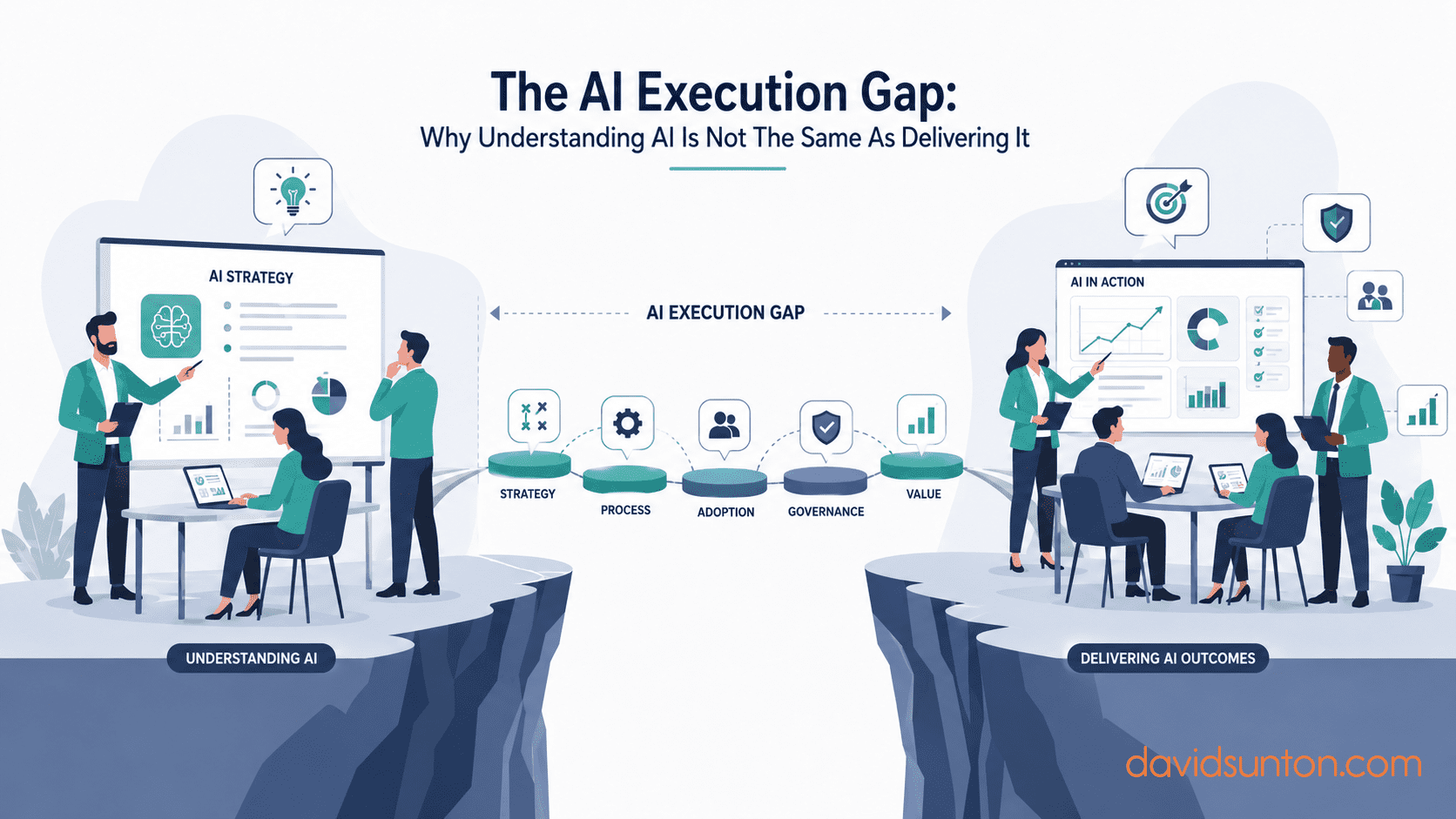
That is the AI execution gap.
Table of Contents
What AI Transformation Delivery Requires
Delivering AI transformation requires more than a strategy, a roadmap or a promising pilot. It requires a disciplined delivery system that connects the idea to the operating reality of the business.
That starts with choosing the right problem. Not every AI use case deserves investment. Leaders need to assess where AI can create meaningful business value, whether the data is ready, whether the process can absorb the change, and whether the organisation has the appetite and capability to adopt it.
It then requires sequencing. AI transformation cannot be delivered as a collection of disconnected experiments. Someone needs to decide what happens first, what depends on what, what should be paused, what can be scaled, and where risk needs to be managed before the work moves forward.
The process also needs to be redesigned around how work actually happens. AI only creates value when it fits into real workflows, decision points, handoffs, exceptions and accountability. The tool may be powerful, but the operating model determines whether it becomes useful.
Adoption must also be planned deliberately. People need to understand why the change matters, how their work will change, where human judgement remains important, and what support they will receive after launch. Managers need to reinforce the new way of working, not simply announce it.
Governance needs to operate while the work is moving. That means clear ownership, human review points, escalation paths, risk controls and decision rights. Governance should not be theatre. It should help the organisation move responsibly.
Finally, value needs to be proven. Leaders should define the expected outcome before launch, capture the baseline, measure adoption, track benefits and test whether the AI initiative has created actual business value rather than theoretical improvement.
This is the work that turns AI transformation from intention into execution.
The Six Delivery Disciplines
The AI execution gap is not random. It usually appears in predictable places.
These are the six delivery disciplines leaders need to manage carefully if they want AI transformation to move from understanding to outcomes.
1. Choose The Right Problem
AI transformation should begin with a business problem worth solving.
That sounds simple, but it is one of the most important delivery decisions. Many AI initiatives start with a tool, a model, a vendor demonstration or a general ambition to “use AI.” The result is often a solution looking for a problem, rather than a practical use case tied to value.
Choosing the right problem means asking sharper questions.
What business outcome are we trying to improve?
Where is the current process slow, costly, inconsistent, risky or difficult to scale?
What decision, workflow or customer interaction would improve if better information, automation or intelligence were available?
What would make the initiative worth doing?
What would make it worth doing now?
A strong AI opportunity has a clear link to business value. That value may come from productivity, cost reduction, revenue growth, customer experience, compliance, quality, speed, risk reduction or better decision-making.
But value alone is not enough.
The use case also needs to be feasible. The data needs to be available and fit for purpose. The process needs to be ready for change. The risk needs to be governable. The people affected need to be able and willing to adopt the new way of working.
This is why AI opportunity assessment is so important before implementation begins. Leaders need a practical way to test whether an idea is valuable, feasible, adoptable and governable before they commit significant time and resources.
For a deeper view of this early-stage discipline, see AI Opportunity Assessment Before The AI Project and The AI Use Case Scorecard.
The aim is not to slow innovation.
The aim is to focus it.
The best AI transformation work starts by selecting problems where AI can create meaningful value and where the organisation has a realistic path to delivery.
2. Sequence The Work
Strategic intent is a sentence. Delivery is a sequence.
A clear intent such as “use AI to reduce manual effort and improve customer responsiveness” is useful, but it does not tell anyone what to do on Monday.
Someone still needs to decide which use case goes first, what depends on what, what can run in parallel, what should wait, and what needs to be resolved before the work moves forward.
This is where many AI programs lose momentum.
The ambition may be sound. The use case may be promising. The technology may be capable. But without sequencing, the work becomes fragmented. Teams move at different speeds. Data problems surface too late. Governance is added after risk has already appeared. Adoption is treated as a launch activity rather than a delivery discipline.
Good sequencing turns AI ambition into an executable path.
It clarifies the order of decisions.
It identifies dependencies.
It shows where data readiness needs to be addressed.
It defines what should be piloted and what should not.
It prevents teams from scaling before the operating model is ready.
It gives leaders a way to manage trade-offs as conditions change.
Sequencing also protects focus. AI creates many possible directions, and organisations can easily become distracted by too many experiments. A disciplined sequence helps leaders decide which opportunities deserve attention now, which should be refined, and which should be paused.
This does not mean every step must be perfect before the next begins. AI transformation often requires learning through iteration.
But iteration still needs structure.
A strong delivery sequence gives the organisation room to learn without losing control of direction, risk or value.
3. Redesign The Work
AI only creates value when it changes how work is done.
That means leaders need to design the work, not just select the tool.
A model may classify information. A chatbot may answer questions. An agent may trigger actions. A workflow automation may reduce manual effort. But none of these capabilities creates value in isolation.
The value appears when the capability is embedded into a real process.
That requires understanding how work actually happens.
Where does the work start?
Who touches it?
What decisions are made?
What information is needed?
Where do delays occur?
What exceptions appear?
Where is judgement required?
What needs approval?
What happens when the AI is uncertain?
Who remains accountable?
This is practical process design. It is also where many AI initiatives become more complex than expected.
Documented processes often do not reflect real work. People rely on workarounds. Exceptions are more common than leaders expect. Data fields may not mean what they appear to mean. Teams may interpret the same process differently. Responsibilities may be unclear.
AI exposes these issues because it depends on structure, data, decisions and workflow clarity.
That is why AI-enabled process design is not only about automation. It is about redesigning the operating environment around the AI capability.
Leaders need to decide where AI belongs in the workflow, where humans remain in control, where review is required, how exceptions are escalated, and how the process will be monitored after launch.
The strongest AI initiatives do not begin with the question, “What can the tool do?”
They begin with the question, “How should the work flow so that AI can create value safely, reliably and usefully?”
4. Prepare People For Adoption
AI transformation depends on adoption.
That does not mean sending a launch email, running one training session or assuming people will use the tool because it is available.
Adoption needs to be designed.
People need to understand why the change matters, how the new way of working affects them, where AI will support them, where human judgement remains important, and how success will be measured.
They also need to trust the change.
Trust is not created through slogans. It is created through usefulness, transparency, support and reinforcement.
Users need to see that the AI-enabled process helps them do better work, not simply adds another system to manage. Managers need to understand how to coach the change, reinforce the right behaviours and respond when people fall back into old ways of working.
Resistance should also be treated carefully.
In transformation, resistance is often a signal. It may point to unclear communication, poor workflow design, weak training, low trust, unresolved risk, workload pressure or a previous history of failed change.
The delivery task is not simply to overcome resistance. It is to understand what the resistance is telling the organisation and respond in a practical way.
For more on this, see How To Turn Resistance To Change Into Participation.
Adoption also needs attention after launch.
This is especially true for AI transformation because users may still be learning when to trust the output, when to challenge it, when to escalate, and how to use the tool responsibly in real situations.
The work does not end at go-live.
After launch, leaders need feedback loops, manager reinforcement, performance visibility, issue resolution and benefits tracking. Otherwise, the new way of working can slowly collapse back into old habits.
For more on sustaining change after launch, see How To Make Transformation Stick After Go-Live.
AI adoption is not an event.
It is a delivery discipline.
5. Govern The Risks While Moving
AI transformation needs governance that works in motion.
Most leaders understand that AI requires oversight. The harder task is designing governance that is practical enough to support delivery and strong enough to manage risk.
Governance should answer operational questions, not only policy questions.
Who owns the use case?
Who owns the data?
Who approves changes?
Who reviews outputs?
Where must a human intervene?
What risks are acceptable?
What happens when the AI is wrong?
How are exceptions escalated?
Who decides whether the solution is ready to scale?
How will the organisation monitor performance after launch?
These questions matter because AI changes accountability.
If an AI tool supports a decision, who is responsible for the outcome?
If an AI agent performs a task, who monitors whether it has acted correctly?
If a model produces a recommendation, how should users decide whether to accept, modify or reject it?
If customer, employee or operational data is used, how is privacy, security and appropriate use protected?
Good governance does not mean creating unnecessary bureaucracy. It means giving the organisation enough structure to move responsibly.
The goal is to avoid two common extremes.
One extreme is moving too quickly without enough control. This can create risk, confusion and loss of trust.
The other extreme is creating governance so heavy that progress becomes impossible. This can cause teams to bypass the process or abandon valuable opportunities.
The right governance model should match the use case, risk level, data sensitivity, decision impact and operating context.
It should be clear enough to guide action and flexible enough to support learning.
Governance should not sit outside delivery.
It should be embedded into delivery.
6. Prove The Value
AI transformation needs measurable proof.
It is easy to claim that an AI initiative has created value. It is harder to prove it.
That proof needs to start before launch.
Leaders should define the expected business outcome early. They should identify the baseline, decide how value will be measured, clarify who owns the benefit, and determine what evidence will show whether the initiative has worked.
This matters because AI benefits can be easily overstated.
A time saving does not automatically become a business outcome.
A productivity gain does not automatically become capacity.
A faster process does not automatically improve customer experience.
A successful pilot does not automatically become sustained organisational value.
To prove value, leaders need to connect activity to outcomes.
If the goal is productivity, what will happen with the time saved?
If the goal is customer experience, what customer measure should improve?
If the goal is risk reduction, what risk event, error rate or control measure should change?
If the goal is revenue growth, how will AI influence conversion, retention, sales quality or customer value?
If the goal is better decisions, how will decision quality be assessed?
Value measurement also needs to continue after launch.
Initial usage is not enough. Leaders need to understand whether adoption is sustained, whether the workflow is improving, whether users trust the system, whether risks are being managed, and whether the expected benefits are actually appearing.
This is where many AI initiatives lose credibility.
They move quickly to implementation but slowly to proof.
A stronger approach is to build benefits realisation into the delivery model from the beginning.
Define the value.
Capture the baseline.
Measure adoption.
Track the benefit.
Review what is working.
Adjust what is not.
Scale only when the evidence supports it.
Asserting value protects the project.
Proving value protects the organisation.
What Execution Looks Like In Practice
Principles describe the work. An example shows it.
Consider an organisation that wants to use AI to help its customer service team handle a high volume of incoming enquiries. The ambition is reasonable. The team is under pressure, response times are slipping, and many enquiries are repetitive. This is the kind of opportunity many organisations would move on quickly.
A delivery approach works through the six disciplines in order.
It starts by choosing the right problem. The team does not ask, “Where can we use AI?” It asks which enquiries are high in volume, low in complexity, well supported by existing knowledge, and low in risk if handled with AI assistance. It identifies a specific category, such as routine account and billing questions, where the value is clear and the path to delivery is realistic. It sets the expected outcome early: reduce average handling time for that category while maintaining quality and customer satisfaction.
It then sequences the work. The team decides to begin with AI-assisted drafting for agents rather than fully automated responses to customers. This lowers risk, builds trust, and creates a controlled environment to learn before any decision to expand. Data preparation for the relevant knowledge base is scheduled before the build, not during it.
It redesigns the work. The team maps how an enquiry actually flows, including the exceptions agents handle informally. It decides where the AI drafts, where the agent reviews, what happens when the AI is uncertain, and how unusual cases are escalated. Human review is designed into the workflow as a defined role, not assumed as a general safeguard.
It prepares people for adoption. Agents are shown how the AI supports their work rather than replaces their judgement. Team leaders are equipped to coach the new approach and reinforce it after launch. Early agent feedback is treated as a design input, not as resistance to be managed away.
It governs while moving. Ownership is clear. Review points are defined. There is an agreed answer to what happens when the AI produces a poor draft, and who remains accountable for the final response to the customer.
It proves the value. Before launch, the team captures a baseline for handling time, quality and customer satisfaction in the chosen category. After launch, it tracks whether handling time improved, whether quality held, whether agents actually used the tool, and whether the benefit was sustained beyond the first few weeks. Only when the evidence supports it does the team consider expanding to the next category.
The figures in an example like this are illustrative. The discipline is the point.
The AI capability here is not unusual. What separates a sustained outcome from a stalled pilot is not the model. It is the sequence of decisions, the design of the work, the adoption of the change, the governance around it, and the proof that it created value.
That is execution.
Why Frameworks And Technology Are Not Enough
Frameworks and technology both matter.
Frameworks help leaders structure the work. They create shared language, reduce obvious mistakes and support better decisions around value, risk, data readiness, governance, adoption and process fit.
Technology provides the capability. Better tools can reduce friction, improve performance, automate tasks, support decisions and make new operating models possible.
But neither frameworks nor technology deliver transformation by themselves.
A framework can tell leaders what to consider. It cannot make the judgement calls for this organisation, with these constraints, this data, these people and this operating reality.
A technology platform can create new capability. It cannot decide which problem matters most, redesign the workflow, earn user trust, govern accountability or prove business value.
That is the role of delivery.
Delivery is where frameworks become decisions.
Delivery is where technology becomes workflow.
Delivery is where strategy becomes behaviour.
Delivery is where AI potential becomes measurable business change.
This is why AI transformation should not be treated as a handover from strategy to technology. It needs an execution model that connects strategy, solution framing, process design, governance, change management and benefits realisation from the beginning.
The organisations that succeed will not be those that simply have the best AI ideas or the newest tools.
They will be those that can translate AI into practical operating change.
The Difference Between Advice And Delivery
There is an important distinction between describing AI transformation and delivering it.
Description explains what should happen.
Delivery shows what actually happened when the idea met real people, real data, real workflows, real politics and real constraints.
Someone can describe why adoption matters.
But someone who has delivered change can explain what they did when adoption stalled, what they got wrong, what they changed, and what finally shifted behaviour.
Someone can describe why governance matters.
But someone who has delivered can explain how governance worked when a decision became uncomfortable, when speed and risk were in tension, or when accountability was unclear.
Someone can describe why go-live is not the finish line.
But someone who has delivered understands the difficult period after launch, when the project energy fades, old habits remain available, and the organisation decides whether the change is real.
This distinction matters because organisations can mistake clear explanation for delivery capability.
Clear thinking matters. It should earn attention.
But execution capability should be tested through evidence.
The better question is not only:
“Can you explain what good looks like?”
It is also:
“Can you show where you have produced it?”
A Practical Execution Lens
Understanding can be assessed by listening. Execution capability needs to be tested.
The following lens helps leaders move the conversation from what someone knows to what they can actually produce.
Problem: Can they define the business problem clearly enough that AI is connected to value, not novelty?
Value: Can they explain the measurable outcome the initiative is expected to create?
Sequence: Can they turn broad intent into an ordered set of decisions and dependencies?
Design: Can they show how the work will change, including exceptions, handoffs, human review and accountability?
Data: Can they assess whether the data is ready enough for the use case, risk and workflow? For more on this, see Why Data Readiness Can Make Or Break AI Projects.
Adoption: Can they explain how people will be supported, trained, reinforced and measured after launch?
Governance: Can they design controls that operate in the workflow, not only in a policy document?
Proof: Can they show how value will be measured, baselined, tracked and reviewed?
A strong answer is grounded in something practical.
A weak answer restates the principle.
The difference between the two is the difference between understanding AI transformation and being able to deliver it.
What Leaders Should Look For
When choosing who leads or supports an AI initiative, the instinct is often to look for the clearest strategist or the strongest technical expert.
Both matter.
But AI transformation also needs delivery leadership.
Look for people who can connect strategy to execution.
Look for people who understand process, adoption, governance and value measurement.
Look for people who can work across executives, managers, frontline users, technology teams, risk owners and external partners.
Look for people who can talk about what stuck, not only what launched.
Look for people who can describe what they got wrong and what they changed, because real transformation rarely follows the first plan cleanly.
Look for people who are comfortable being held to measurable outcomes.
Be cautious of transformation stories that sound too clean. Real delivery is rarely clean. It involves trade-offs, friction, uncertainty, resistance and adjustment.
The aim is not to undervalue strategy.
The aim is to stop treating strategy as the finish line.
In AI transformation, strategy sets direction.
Execution turns direction into value.
Make Delivery Visible
The field has matured in what it understands about AI transformation. The next step is to make delivery visible.
Evidence is the standard worth aiming for.
A strong account of delivery does not rest on confidence or vocabulary. It shows a clearly defined problem, a baseline captured before the work began, a measured outcome, and an honest description of what was adjusted along the way.
This is the standard organisations should expect. It is also the standard leaders should be able to meet.
It is what builds trust. When a leader can point to what changed, what stuck, and what it produced, the conversation moves from “this sounds right” to “this has been done.” That shift is what gives an organisation the confidence to commit.
Making delivery visible is not self-promotion. It is accountability.
It is the difference between describing the destination and showing the road already travelled.
The organisations and leaders who can do this will set the benchmark for AI transformation, because they turn a credible argument into demonstrated capability.
Why This Matters For AI Transformation
AI raises the stakes on execution.
AI initiatives can change more than systems. They can change workflows, decisions, roles, customer interactions, quality controls, risk ownership and management behaviour.
They can also create new forms of uncertainty.
People may not trust the output.
Managers may not know how to reinforce responsible use.
Governance may be unclear.
Data may be less ready than expected.
Benefits may be harder to prove than the business case assumed.
The tool may work, but the workflow may not.
This is why AI transformation requires more than awareness, ambition or experimentation.
It requires practical execution.
It requires leaders to connect AI to business value, design the operating model around real work, earn adoption, govern responsibly, measure outcomes and keep improving after launch.
The organisations that succeed with AI will not only be the ones that understand its potential.
They will be the ones that can turn that potential into adopted, governed and measurable business change.
Final Thought
AI transformation is too important to treat as a technology exercise alone.
Understanding the opportunity matters.
Choosing the right use cases matters.
Selecting the right technology matters.
But none of these, on their own, guarantees business value.
Value is created when AI is connected to the way the organisation actually works: its processes, decisions, people, governance, customers and measures of success.
That is why execution is the discipline that matters most.
Understanding sets the direction. Execution creates the value. And evidence is what proves the difference.