Agentic Orchestration matters because AI agents are often discussed as if autonomy is the goal.
The more an agent can do on its own, the more impressive it sounds.
It can read an email.
It can understand intent.
It can retrieve information.
It can draft a response.
It can update a system.
It can trigger an action.
It can coordinate tasks.
These capabilities are powerful. But in business transformation, the real value is not created by what an agent can do in isolation.
The real value comes from how AI agents are coordinated across people, systems, data, decisions and governance to deliver a reliable business outcome.
Table of Contents
The better question is:
How should AI agents, people, systems, data and controls work together to deliver a reliable business outcome?
That is the role of agentic orchestration.
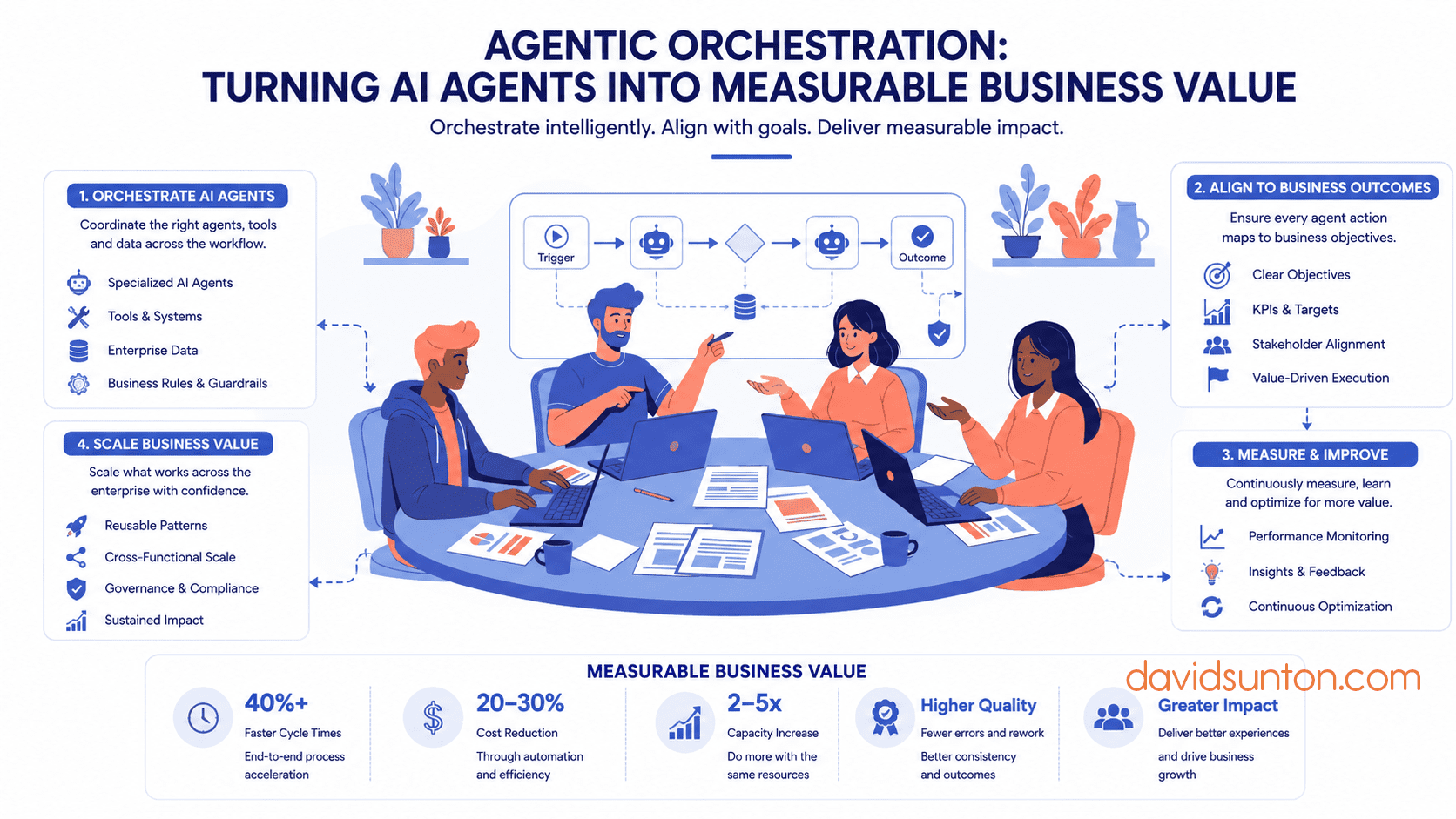
Agentic orchestration is what turns AI agents from isolated task performers into part of a governed business workflow. It defines when an agent should act, what it is allowed to do, what data it can use, what systems it can access, where human judgement is required, how exceptions are handled, how actions are logged, and how the workflow creates measurable value.
Without orchestration, AI agents may produce useful outputs but still fail to change how work gets done.
With orchestration, AI agents become part of a practical operating model.
They support real workflows.
They work within boundaries.
They escalate when needed.
They involve humans at the right points.
They improve business execution, not just task completion.
That distinction matters.
Because AI transformation does not succeed when an agent performs a task in isolation. It succeeds when AI capability is embedded into a process that people can trust, govern, adopt and improve.
What Is Agentic Orchestration?
Agentic orchestration is the coordination of AI agents within a broader business workflow.
It brings together:
- AI agents
- human roles
- business rules
- process steps
- system actions
- data sources
- decision points
- escalation paths
- governance controls
- audit trails
- performance measures
An individual AI agent might classify a customer enquiry, summarise a document, draft a response or recommend a next action.
Agentic orchestration defines how those actions fit into the end-to-end process.
For example, a customer service workflow may involve several steps:
A customer sends an enquiry.
An AI agent identifies the customer intent.
Another agent retrieves relevant knowledge.
Another agent drafts a response.
A human reviews the response if the case is sensitive.
The system logs the final action.
The workflow escalates unresolved cases.
Managers monitor quality, response time and exception patterns.
The value does not come from one agent alone.
The value comes from the coordinated workflow.
That is agentic orchestration.
It is not just AI autonomy. It is AI coordination inside a designed business process.
Why AI Agents Alone Are Not Enough
AI agents can appear impressive in demonstrations.
A single agent can complete a task that previously required manual effort. It can interpret text, use a tool, retrieve data, generate content or take an action.
But business operations are rarely that simple.
Most business work involves multiple people, systems, rules, approvals, data dependencies and exceptions.
A customer complaint may require service, legal, finance and management involvement.
A supplier price change may affect purchasing, inventory, margins, customer pricing and ERP records.
A sales opportunity may involve CRM updates, proposal drafting, approval workflows, follow-up tasks and manager reviews.
A compliance issue may require investigation, documentation, escalation, review and audit.
An AI agent may support part of this work, but the end-to-end business outcome depends on how the work is coordinated.
Without orchestration, several problems can appear.
The agent may produce an output that no one uses.
It may update a system without the right approval.
It may escalate to the wrong person.
It may act on incomplete data.
It may duplicate work already being done elsewhere.
It may create a new exception that no one owns.
It may perform well in a narrow scenario but fail when the workflow becomes complex.
This is why AI agents need orchestration.
Autonomy without process design can create risk.
Orchestration turns autonomy into reliable execution.
Agentic Workflows vs Agentic Orchestration
Agentic workflows and agentic orchestration are related, but they are not exactly the same.
An agentic workflow describes how AI agents support or perform tasks within a process.
Agentic orchestration is the coordination layer that connects those tasks across people, systems, decisions and controls.
A simple agentic workflow might be:
An email arrives.
An AI agent summarises it.
The summary is sent to a staff member.
That is useful, but limited.
Agentic orchestration asks what happens before, during and after that summary.
Who sent the email?
Is the sender verified?
What type of request is it?
What data should the agent use?
Should the agent retrieve a policy?
Should the case be routed?
Does the response need approval?
What happens if the email is unclear?
What system should be updated?
What should be logged?
Who owns the final outcome?
This is the difference.
Agentic workflows show where AI agents assist or act.
Agentic orchestration coordinates the broader execution environment that makes those agents useful, safe and scalable.
What Needs To Be Orchestrated?
Agentic orchestration is not only about connecting software.
It is about coordinating the full operating context around AI-enabled work.
Several elements need to be designed.
1. Triggers
Every workflow begins somewhere.
A trigger may be an email, a form submission, a phone call transcript, a document upload, a CRM update, a system alert, a scheduled task or a human request.
Agentic orchestration defines what starts the workflow and under what conditions an agent should become involved.
For example, should an AI agent act on every inbound customer email, or only on emails sent to a particular service inbox?
Should it process every supplier document, or only approved document types?
Should it respond automatically, or wait until a human initiates the workflow?
Clear trigger design prevents agents from acting too broadly or too narrowly.
2. Tasks
An agent needs a defined task boundary.
“Handle customer enquiries” is too broad.
A clearer task might be:
Classify the enquiry.
Summarise the customer issue.
Retrieve relevant policy information.
Draft a suggested response.
Route the case to the right team.
Each task has different risk, data and governance requirements.
An agent that summarises information is different from an agent that sends a customer response.
An agent that recommends an action is different from an agent that performs the action.
An agent that updates an internal note is different from an agent that changes a financial record.
Orchestration defines what the agent does and what remains outside its authority.
3. Decisions
Workflows contain decisions.
Some decisions can be automated.
Some can be AI-assisted.
Some require human judgement.
Some require formal approval.
Agentic orchestration defines decision rules.
Can the agent classify a request automatically?
Can it recommend escalation?
Can it approve a refund?
Can it update a system?
Can it send a message to a customer?
Can it proceed only when confidence is high?
What happens when the case is sensitive, unclear or high risk?
Decision design is essential because AI agents can influence outcomes. Leaders need to know which decisions can be delegated, which can be supported and which must remain human-led.
4. Humans
Human-in-the-loop is not a vague principle. It is a workflow design choice.
Agentic orchestration defines where humans review, approve, override, escalate or remain accountable.
Humans may act as:
Reviewers
Approvers
Exception handlers
Supervisors
Accountable owners
Subject matter experts
Process owners
Risk controllers
For example, an AI agent may draft a customer response, but a human may approve it before sending if the topic is sensitive.
An AI agent may prepare a supplier price update, but a category manager may approve the final system change.
An AI agent may recommend next-best actions for a sales opportunity, but the account manager remains accountable for the customer relationship.
The goal is not to put humans everywhere.
The goal is to place human judgement where it creates the most value, trust and control.
5. Systems
AI agents often need to interact with systems.
They may read from a CRM, retrieve documents from a knowledge base, update a ticketing system, create a task, check inventory, send a notification or trigger a workflow.
Agentic orchestration defines system boundaries.
What can the agent read?
What can it write?
What can it update?
What is prohibited?
What requires approval?
What must be logged?
This is critical because agentic AI can move from information support to operational action.
The more an agent can do across systems, the more important permissions, controls and auditability become.
6. Data
Agents depend on data and context.
They may need customer records, product information, policies, transaction history, documents, call transcripts, pricing data, inventory records, CRM notes or knowledge articles.
Agentic orchestration must define which data sources are approved, reliable, current and appropriate for the use case.
Poor data readiness weakens agentic workflows.
If the agent retrieves outdated policy information, users will stop trusting it.
If it uses incomplete customer data, recommendations may be wrong.
If it cannot distinguish between approved and outdated documents, governance risk increases.
Data readiness is not just a technical issue. It is part of orchestration.
7. Exceptions
Exceptions are where many AI workflows fail.
The normal path may be simple. But real work is full of complexity.
The customer request is ambiguous.
The data is missing.
The system is unavailable.
The AI confidence is low.
The issue is sensitive.
The policy is unclear.
The document format is unexpected.
The customer is angry.
The action requires approval.
The case falls outside the agent’s scope.
Agentic orchestration defines what happens when the normal path fails.
Who receives the exception?
What information is passed to them?
How urgent is the escalation?
What does the agent do while waiting?
How is the exception recorded?
Who reviews recurring exceptions?
Exception handling turns agentic workflows from demos into operational systems.
8. Governance
Governance is what makes agentic orchestration trustworthy.
It defines accountability, controls, monitoring, permissions, escalation, auditability and continuous improvement.
Governance should answer:
Who owns the workflow?
Who owns the agent?
Who owns the data?
Who approves changes?
Who monitors performance?
Who reviews exceptions?
Who is accountable for outcomes?
How are risks tracked?
How are actions audited?
Without governance, agentic workflows can become difficult to trust and difficult to scale.
With governance, organisations can innovate with clearer boundaries.
Example: Customer Service Agentic Orchestration
Customer service is a useful example because it includes high-volume work, unstructured language, knowledge retrieval, human judgement and escalation.
A simple AI agent might answer customer questions.
Agentic orchestration designs the full workflow.
The trigger is an inbound customer enquiry through email, web chat, phone transcript or messaging platform.
The first agent classifies the enquiry type.
A second agent summarises the customer issue and extracts key details.
A retrieval agent searches approved knowledge sources.
A drafting agent prepares a suggested response.
A gateway checks risk level, confidence and topic sensitivity.
Low-risk, high-confidence responses go to a service agent for quick review.
Sensitive cases, complaints, refund requests or legal issues escalate to a specialist.
Missing information triggers a clarification request.
Final responses are logged in the case management system.
Managers monitor response time, escalation volume, customer satisfaction and exception patterns.
This is not simply an AI chatbot.
It is an orchestrated service workflow.
The AI agents support classification, summarisation, retrieval and drafting. Humans remain involved where judgement and accountability matter. Governance controls what can be automated, what must be reviewed and what must be escalated.
That is agentic orchestration in practice.
Example: Supplier Price-Change Orchestration
Now consider a supplier price-change process.
The business receives supplier emails with attached price lists. Staff manually read the documents, identify affected SKUs, compare current prices, check margin impact, request approval and update the ERP.
An agentic orchestration approach would design the workflow differently.
The trigger is a supplier email or uploaded price document.
An AI agent identifies the document type and extracts key fields.
Another agent matches SKUs to product records.
Another checks effective dates, price changes and margin impact.
A decision gateway identifies whether the change is standard, incomplete, conflicting or margin-sensitive.
Standard changes move to category manager approval.
Missing information triggers a supplier clarification draft.
Margin-impact exceptions escalate to commercial review.
Approved updates are posted to the ERP.
All changes are logged for audit.
This workflow may use several agentic capabilities, but the business value comes from orchestration.
The process coordinates document reading, data validation, commercial decision-making, human approval, system update and auditability.
The agent is not the whole solution.
The orchestrated workflow is the solution.
Why Agentic Orchestration Needs Human-In-The-Loop Design
Human-in-the-loop design is central to agentic orchestration because AI agents can influence actions and decisions.
The question is not whether a human should be involved somewhere.
The question is where human judgement creates the most value.
Human review may be required when:
The AI confidence is low.
The case is sensitive.
The decision has financial impact.
The action affects a customer.
The output could create compliance risk.
The information is incomplete.
The recommendation conflicts with policy.
The process reaches an exception path.
Human approval may be needed before an agent sends a message, updates a record, applies a price change, escalates a case or triggers a financial action.
But too much human involvement can create bottlenecks.
Agentic orchestration must balance speed and control.
It should define which cases can proceed automatically, which require light review, which require formal approval and which must be escalated to specialists.
Human-in-the-loop design is not an add-on.
It is part of the workflow architecture.
Why Agentic Orchestration Needs Governance
As agents become more capable, governance becomes more important.
An agent that only drafts text has one level of risk.
An agent that updates records has a higher level of risk.
An agent that interacts with customers has higher risk again.
An agent that triggers financial, legal, operational or compliance actions needs stronger governance.
Governance should define:
Agent permissions
Approved data sources
Human approval rules
Escalation pathways
Audit logs
Monitoring routines
Exception reporting
Performance measures
Accountability
Change control
Good governance does not prevent AI adoption.
It makes adoption safer and more trusted.
People are more likely to use AI agents when they understand what the agent can do, what it cannot do, when humans are involved and who remains accountable.
Governance creates confidence.
The Role Of Process Design
Agentic orchestration depends on process design.
Before deploying agents, leaders should map the workflow.
What starts the work?
What outcome should be produced?
What tasks are involved?
Where are decisions made?
What systems are used?
Where are delays and errors occurring?
Where does human judgement matter?
Where could AI assist or act?
Where are exceptions likely?
What must be governed?
This process view prevents organisations from deploying agents into confusion.
It also helps identify whether the process needs an agent, automation, orchestration or redesign.
Sometimes a problem does not need agentic AI.
It may need clearer rules, better data, system integration or a simpler workflow.
Process design helps leaders make that distinction.
From Process Map To Agentic Orchestration
A process map can become a blueprint for agentic orchestration.
It can show:
The trigger that starts the workflow.
The tasks performed by people, systems and agents.
The decisions that determine the path.
The points where AI assists or acts.
The human review and approval steps.
The systems and data sources involved.
The exception paths.
The governance controls.
The final outcome.
This turns a static process map into a practical design for AI-enabled execution.
For example, a BPMN 2.0 process model can help teams visualise events, tasks, gateways, handoffs, roles, systems and exceptions. It can make clear where an AI agent fits, where a human needs to intervene and where controls must be embedded.
The map is not the transformation.
But it helps leaders design the transformation more clearly.
The Adoption Challenge
Agentic orchestration is not only a technical challenge.
It is also an adoption challenge.
People need to understand how the workflow changes.
They need to know what agents do, what humans still own, where review is required, how exceptions are handled and how success will be measured.
Managers need to reinforce the new way of working.
Risk and compliance teams need confidence in controls.
Users need to trust the AI outputs.
Process owners need to monitor performance.
Executives need to focus on value, not novelty.
If people do not adopt the orchestrated workflow, the agents will not create sustained value.
This is why agentic orchestration should be designed with change management from the beginning.
It is not enough to deploy the agents.
The organisation must embed the new way of working.
Common Mistakes In Agentic Orchestration
Several mistakes appear frequently.
The first is starting with the agent instead of the process.
Leaders become excited about what an agent can do before defining the workflow it should support.
The second is giving agents unclear authority.
If no one knows what the agent can decide, recommend or act on, trust and governance weaken.
The third is ignoring exceptions.
Demos often show the happy path. Real operations depend on exception handling.
The fourth is treating human-in-the-loop as a vague safeguard.
Human review must be designed into the workflow with clear triggers, roles and authority.
The fifth is underestimating data readiness.
Agents need trusted, current and relevant data.
The sixth is overlooking system boundaries.
Agents need clear permissions for reading, writing and updating information.
The seventh is measuring deployment instead of value.
Go-live is not success. Adoption, workflow performance and business outcomes are success.
Avoiding these mistakes can significantly improve the quality of agentic AI initiatives.
A Practical Agentic Orchestration Lens
Leaders can use a simple lens when designing agentic orchestration.
Purpose: What business outcome should the workflow improve?
Trigger: What starts the process?
Tasks: What work must be completed?
Agents: Where can AI classify, summarise, retrieve, draft, recommend or act?
Humans: Where is review, judgement, approval or escalation required?
Decisions: What can the agent decide, recommend or not touch?
Systems: What tools or platforms are involved?
Data: What information is required, and is it reliable enough?
Exceptions: What happens when the normal path fails?
Governance: What must be controlled, logged, approved or audited?
Adoption: Who needs to trust and use the new workflow?
Benefits: What measurable value should improve?
This lens keeps the focus on business execution rather than AI novelty.
It also helps leaders avoid deploying agents without the operating model required to support them.
Final Thought
Agentic orchestration is the missing layer between AI agents and business value.
AI agents can perform tasks, but business outcomes depend on coordinated workflows.
Agents need triggers, tasks, data, systems, decision rules, human review, exception handling, governance and adoption support.
Without orchestration, agents may remain isolated capabilities.
With orchestration, they become part of reliable business execution.
The strongest AI leaders will not ask only:
“What can an AI agent do?”
They will ask:
“How should people, agents, systems and controls work together to deliver a better business outcome?”
That is the shift from AI experimentation to AI transformation.
And that is why agentic orchestration matters.