AI transformation is already on the executive agenda. The important question is how organisations prioritise the right opportunities and turn AI ambition into measurable business value.
That is the purpose of Value-Led AI Transformation.
It is a way of looking at AI transformation through a CEO-level prioritisation lens: how organisations connect AI investment to strategic value, customer outcomes, operational performance, decision quality, future capability and responsible adoption.
Table of Contents
Value-Led AI Transformation does not begin with isolated tools, vendor demonstrations or scattered pilots. It begins with a clear view of where AI can create value, whether the organisation is ready to pursue that value, and what needs to be designed, governed and adopted for the value to be realised.
This matters because AI is no longer only a technology conversation. It now touches strategy, operating models, customer experience, workforce capability, governance, data, risk and how work gets done.
The practical challenge is not whether AI has potential. It does.
The more important question is which AI initiatives deserve focus, investment and leadership attention.
That means asking where AI can improve performance, strengthen customer experience, reduce operational friction, improve decision-making, build future capability and be adopted responsibly across the business.
It also means recognising that a high-value AI opportunity can still fail if the data is unreliable, the process is unclear, the risk is not governed, managers are not prepared, or users do not trust and adopt the new way of working.
In this sense, Value-Led AI Transformation is not primarily about deploying more AI.
It is about choosing the right problems, designing the right operating model, building the right governance, and leading the change required to turn AI capability into measurable business value.
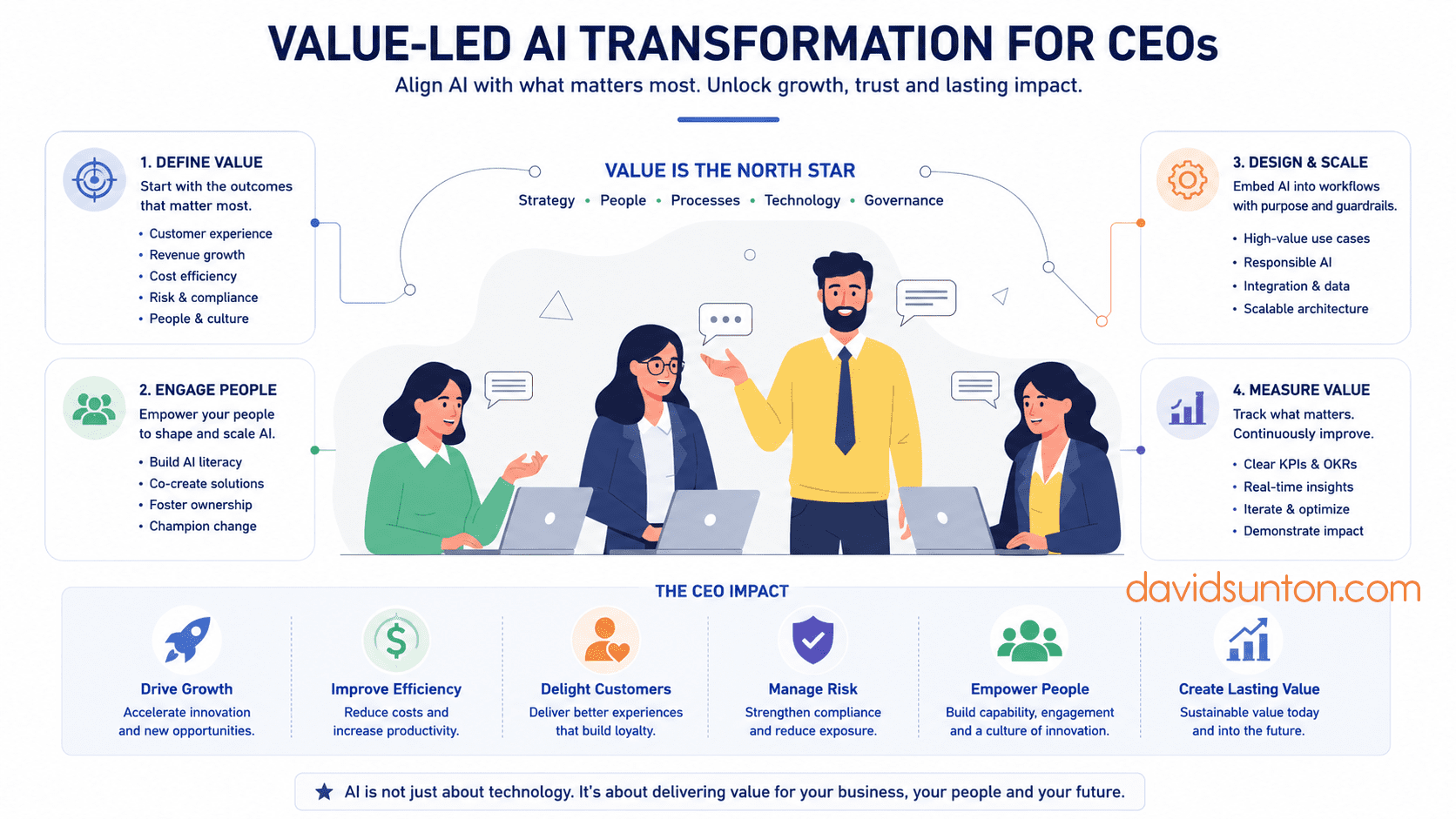
AI Transformation Is An Enterprise Value Decision
AI transformation affects more than technology.
It can influence strategy, customer experience, operating models, workforce capability, decision-making, risk management, data governance, service delivery and competitive advantage.
That is why AI transformation cannot be treated only as a technology program.
Technology teams are essential. They understand architecture, platforms, integration, security and delivery. But the AI transformation agenda cannot be defined by technology capability alone.
Business units are also essential. They understand customers, operations, pain points and value. But if every function pursues AI independently, the organisation can quickly end up with fragmented tools, duplicated effort and inconsistent governance.
Vendors can bring useful capability. But if vendor capability leads the conversation, the organisation risks becoming solution-led instead of value-led.
A CEO-level prioritisation lens connects AI to enterprise direction.
It brings the conversation back to business priorities.
Where is the organisation trying to grow?
Where are margins under pressure?
Where are customers experiencing friction?
Where is work too slow, costly or inconsistent?
Where is decision-making limited by poor information?
Where are people spending time on low-value manual work?
Where is risk increasing?
Where does the organisation need to build future capability?
These are business questions before they are AI questions.
AI transformation becomes meaningful when it is connected to the organisation’s strategic priorities and translated into focused execution.
Start With Strategic Intent, Not Technology Selection
Many AI conversations begin too far downstream.
A tool is presented.
A use case is suggested.
A pilot is proposed.
A vendor demonstrates what is possible.
A team starts experimenting with generative AI.
None of this is wrong. Exploration is useful. Experimentation is part of learning. But exploration should not be confused with enterprise prioritisation.
Value-Led AI Transformation starts with strategic intent.
The organisation needs to be clear about what AI is expected to contribute to the business.
It may be about improving productivity.
It may be about strengthening customer experience.
It may be about increasing speed.
It may be about reducing cost.
It may be about improving decision quality.
It may be about managing risk.
It may be about building future capability.
A weak strategic intent sounds like this:
“We need to use AI.”
A stronger strategic intent sounds like this:
“We will prioritise AI initiatives that improve customer responsiveness, reduce manual work, strengthen decision quality and build scalable capability, while maintaining strong governance and human accountability.”
The difference matters.
The first statement creates activity.
The second creates direction.
Strategic intent gives the organisation a filter. It helps leaders decide which opportunities matter, which should wait, and which are not aligned to business priorities.
Without this filter, AI activity can quickly scatter across the organisation.
One team explores chatbots.
Another tests AI-generated reporting.
Another automates content creation.
Another experiments with AI agents.
Another looks at knowledge search.
Another asks vendors for demonstrations.
These efforts may all be interesting. Some may even be useful. But without strategic intent, they may not add up to transformation.
Value-Led AI Transformation Requires A Broader View Of Value
A value-led approach requires a broader view of value.
Financial return matters, but it is not the only form of value AI can create.
AI transformation can also create strategic value, customer value, operational value, decision value, capability value, governance value and adoption value.
This broader view is important because not every AI initiative should be judged in the same way.
Some initiatives should deliver near-term productivity improvement.
Some should improve customer experience.
Some should reduce operational friction.
Some should improve decision-making.
Some should build the foundations for future AI capability.
Some should strengthen governance, risk control or knowledge management.
The question is not simply whether AI can perform a task.
The question is whether AI can create value that matters to the organisation and whether that value can be realised in a practical, governed and sustainable way.
That is what makes the transformation value-led.
Strategic Value
Strategic value asks whether AI strengthens the organisation’s future position.
This may include competitive advantage, market responsiveness, new service models, differentiation, scalability or the ability to build capabilities competitors cannot easily copy.
Not every AI initiative needs to be strategic. Some initiatives are operational improvements, and that is still valuable.
But there is an important distinction between AI that improves today’s work and AI that helps shape tomorrow’s organisation.
For example, an internal AI assistant that helps employees find policy information may improve productivity. That is useful.
But if the same initiative also improves knowledge governance, standardises organisational memory, supports faster onboarding and becomes a foundation for future customer-facing service capability, it may also create strategic value.
The value is not only in the first use case.
The value is in the capability it helps build.
A strong AI portfolio usually needs both: initiatives that improve immediate business performance and initiatives that build future capability.
Financial Value
Financial value asks whether AI can improve revenue, cost, margin, productivity or asset utilisation.
This may include reducing manual effort, increasing sales conversion, lowering cost-to-serve, improving utilisation, reducing rework or improving forecasting.
But financial value needs to be treated carefully.
AI business cases often overstate benefits because they assume time saved automatically becomes cost saved.
It rarely works that simply.
If AI saves time but the organisation does not change processes, capacity, roles, priorities or service levels, the financial benefit may remain theoretical.
A team may complete work faster, but the organisation may not capture the value.
A process may become more efficient, but old workarounds may continue.
A tool may reduce manual effort, but new review steps may create different workload.
The useful question is not only:
How much time will AI save?
The more practical question is:
How will that time saving translate into measurable business value?
That may mean redeploying capacity, reducing cycle time, increasing service volume, improving quality, shortening sales response time or enabling teams to focus on higher-value work.
Value must be designed into the operating model. It cannot simply be assumed from a productivity estimate.
Customer Value
Customer value asks whether AI improves the experience, speed, personalisation, quality or responsiveness customers receive.
This matters because many AI initiatives are justified internally as productivity projects, but experienced externally as service changes.
A customer-facing AI initiative should not be assessed only by efficiency.
It should also be assessed by trust, quality and customer impact.
A chatbot that reduces call volume but frustrates customers may not create real value.
An AI agent that speeds up responses but gives inconsistent answers may weaken trust.
A recommendation engine that improves relevance but feels intrusive may damage confidence.
AI can create strong customer value when it reduces friction, improves responsiveness, supports personalisation, increases availability or helps staff serve customers better.
But customer value should be designed, not assumed.
A useful test is whether the initiative makes the customer experience better, or only makes the internal process cheaper.
The strongest AI initiatives often do both.
They improve productivity while also improving customer experience.
They reduce internal effort while improving service quality.
They make operations faster while making customers feel better supported.
That is the difference between cost-led automation and value-led transformation.
Operational Value
Operational value asks whether AI improves how work gets done.
This includes cycle time, process consistency, error reduction, handoff quality, backlog reduction, service levels, quality control and reduced rework.
This is where AI transformation often becomes most practical.
Many organisations have processes that are slow, manual, fragmented or dependent on repeated judgement.
People copy information between systems.
Managers wait for reports.
Customers repeat the same information.
Staff search for policy guidance.
Teams manually classify requests.
Approvals sit in inboxes.
Exceptions are handled through informal messages.
These areas can create strong AI opportunities.
But AI should not simply automate poor processes.
If the underlying process is unclear, fragmented or poorly governed, AI may accelerate confusion.
Operational value comes from combining AI with process design.
The better question is not:
Can we automate this task?
The better question is:
How should this work flow, and where can AI improve speed, quality, consistency or control?
A value-led AI initiative should improve the process, not just insert a tool into it.
That means understanding the current state, designing the future state, clarifying handoffs, defining decision points, managing exceptions and ensuring the new way can be adopted.
Decision Value
Decision value asks whether AI improves the speed, quality or consistency of decisions.
This may include forecasting, risk detection, scenario analysis, customer insight, operational planning, management reporting or investment prioritisation.
This is an important executive value area because many organisations do not only suffer from slow execution. They also suffer from slow or inconsistent decision-making.
Leaders may rely on delayed reports.
Teams may use different data definitions.
Managers may lack visibility across functions.
Risks may be identified too late.
Forecasts may be driven by incomplete information.
AI can help by identifying patterns, surfacing signals, summarising information, detecting anomalies and supporting better prioritisation.
But decision-support AI needs clear accountability.
AI may support the decision.
It should not remove responsibility for the decision.
This matters especially where AI is used for financial, legal, health, HR, compliance, customer or strategic decisions.
The value is not only in faster insight.
The value is in better judgement, supported by better information, within clear accountability.
Capability Value
Capability value asks whether AI helps the organisation build reusable capability.
This includes AI literacy, data maturity, process discipline, governance maturity, automation capability, knowledge management, workflow orchestration and organisational learning.
Some AI initiatives create value beyond the immediate use case.
A knowledge assistant may expose gaps in document governance.
A customer service AI pilot may reveal weak escalation rules.
A reporting AI initiative may force agreement on data definitions.
An agentic workflow pilot may help the organisation understand human-in-the-loop controls and exception handling.
These lessons matter.
AI transformation is not only about individual projects. It is also about building the organisation’s ability to repeatedly identify, design, govern, adopt and scale AI-enabled improvements.
A useful value test is whether the initiative helps build a capability the organisation can reuse.
This is especially important when balancing quick wins with long-term transformation.
A quick win may create immediate momentum.
A capability-building initiative may create long-term advantage.
A mature AI transformation portfolio needs both.
Trust, Risk And Governance Value
Trust and governance value asks whether AI can be scaled safely, responsibly and with appropriate control.
This includes privacy, security, transparency, auditability, human review, compliance, model risk, data leakage, bias, customer impact and accountability.
Trust is not a soft issue.
It is a business requirement.
If employees do not trust the AI, they will not use it.
If customers do not trust AI-enabled service, the experience may suffer.
If risk and compliance teams do not trust the controls, scaling will be blocked.
If leaders cannot explain accountability, confidence will weaken.
Good governance should not be treated as anti-innovation.
Good governance creates the confidence required to scale.
Important questions include:
What data can AI use?
What systems can AI access?
What decisions can AI support?
Where is human review required?
What must be logged?
Who is accountable?
What risks are acceptable?
Which use cases are not appropriate yet?
These questions should shape prioritisation before implementation begins.
A value-led approach does not ignore risk. It manages risk so that valuable AI initiatives can be adopted with confidence.
Adoption Value
Adoption value asks whether the organisation can realistically adopt and sustain the new way of working.
This is where many AI initiatives fail.
The project may launch.
The tool may work.
The pilot may show promise.
The system may be available.
But if people do not trust it, use it, change behaviour or embed it into the workflow, the value will not stick.
Adoption should be part of the investment decision.
Who needs to change how they work?
Will managers reinforce the new process?
Do users understand the purpose?
Do people trust the outputs?
What resistance is likely?
What old habits need to stop?
What training is required?
How will adoption be measured?
What happens after go-live?
Adoption is not a communication issue at the end.
It is a value condition from the beginning.
An AI initiative that cannot be adopted cannot create sustained value.
Evidence Should Shape Prioritisation
CEO-level prioritisation should be based on evidence, not hype.
That does not mean every technical detail needs to be resolved upfront. It means AI opportunities should be supported by credible business evidence.
The most useful evidence usually comes from several sources.
Business performance data shows where financial or operational outcomes are under pressure. This may include revenue trends, margin pressure, productivity metrics, cost-to-serve, sales conversion, pipeline velocity, service levels, operating cost and quality indicators.
Customer and market data shows where AI may improve experience or competitiveness. This may include customer complaints, satisfaction scores, churn data, support ticket themes, response times, sales objections, competitor activity and changing customer expectations.
Operational process data shows where work is slow, manual, repetitive or error-prone. This may include cycle times, rework rates, manual handling volume, approval delays, backlog volumes, exception rates, handoff failures and duplicated data entry.
Workforce and capability data shows whether the organisation can adopt AI. This may include AI literacy, skills gaps, employee workload, role impacts, manager readiness, change fatigue and adoption history from previous transformations.
Technology and data readiness shows whether the organisation has the foundation to support AI. This may include data quality, data ownership, system integration maturity, cybersecurity posture, legacy constraints, knowledge management maturity and CRM or ERP data reliability.
Risk and compliance data shows what must be governed before AI can scale. This may include privacy obligations, security risk, regulatory exposure, vendor risk, audit requirements, decision accountability and customer impact risk.
AI prioritisation should not rely only on vendor presentations or executive enthusiasm.
Good AI prioritisation comes from combining top-down strategic direction with bottom-up operational reality.
Top-down direction ensures AI aligns with strategy.
Bottom-up evidence ensures AI solves real problems.
Both are needed.
Moving From AI Ambition To Focus
Most organisations can identify many possible AI opportunities.
The issue is not usually a lack of ideas.
The issue is focus.
One team wants an AI assistant.
Another wants customer service AI.
Another wants reporting automation.
Another wants document processing.
Another wants agentic workflows.
Another wants content generation.
Another wants forecasting.
Another wants knowledge search.
All of these may have merit.
But they cannot all be first.
A useful prioritisation lens should include problem clarity, business value, strategic alignment, data readiness, process fit, risk, governance, user adoption, implementation complexity, scalability and benefits ownership.
This prevents AI transformation from becoming a collection of disconnected pilots.
The goal is not to say yes to every AI idea.
The goal is to build a focused portfolio of AI initiatives that are valuable, feasible, governable and adoptable.
This is one of the clearest differences between a technology-led AI agenda and a value-led AI transformation agenda.
A technology-led agenda asks:
Where can we use AI?
A value-led agenda asks:
Which AI opportunities matter most, and what conditions are required for them to create measurable value?
Balancing Quick Wins And Strategic Capability
Quick wins matter.
They build confidence.
They create momentum.
They show that AI can produce practical value.
They help the organisation learn.
Examples may include internal knowledge search, meeting summarisation, document drafting, support triage, reporting assistance or simple workflow automation.
But quick wins are not enough.
If the organisation only pursues easy AI use cases, it may create activity without building strategic capability.
Longer-term AI transformation may require deeper work: process redesign, data governance, system integration, AI operating models, risk frameworks, workforce capability and change adoption.
The AI portfolio should work across different horizons.
Some initiatives should produce near-term productivity benefits.
Some should improve customer or operational performance.
Some should build reusable capability.
Some should prepare the organisation for more advanced AI-enabled workflows and agentic orchestration.
The right mix depends on the organisation’s strategy, maturity and readiness.
A value-led portfolio should not be made up only of quick wins.
It should include quick wins that build momentum, strategic initiatives that build capability, and carefully chosen use cases that prove AI can create value in real operations.
Choosing The First AI Initiatives
The first AI initiatives matter because they shape organisational belief.
If the first initiatives are too small, they may not be taken seriously.
If they are too complex, they may fail and damage confidence.
If they are too technology-led, they may not connect to business value.
If they ignore adoption, they may go live but not stick.
A strong first AI initiative should solve a real business problem, create visible value, use data that is ready enough, fit a process that can be improved, carry manageable risk, have a clear business owner, involve users early, and create learning that can be reused.
The best first initiatives are not always the easiest pilots.
They are the ones that create useful learning and credible value.
A pilot should test more than whether the technology works.
It should test whether the use case works in the organisation.
That means testing value, data, workflow, governance, user adoption and scalability.
This is important because a successful pilot is not only a technical proof point.
It is an organisational learning exercise.
It should help leaders understand what it takes to turn AI capability into business value.
Establishing The AI Operating Model
AI transformation needs an operating model.
Without one, AI activity can become fragmented across teams, vendors, tools and experiments.
The operating model should clarify ownership and accountability.
Who sponsors the AI transformation program?
Who owns the roadmap?
Who owns data governance?
Who owns risk and compliance?
Who owns adoption?
Who owns benefits realisation?
Who decides which tools are approved?
Who manages vendor risk?
Who monitors AI usage?
Who supports business units?
Who decides when to scale?
The operating model does not need to be overly bureaucratic. But it does need enough structure to prevent confusion.
A good AI operating model balances enterprise governance with business-led innovation.
Some things should be centralised, such as AI policy, risk standards, security, data governance, approved platforms and compliance requirements.
Other things should remain close to the business, such as use case discovery, process redesign, workflow testing, user adoption and benefits ownership.
This balance matters.
Too much centralisation can slow innovation.
Too much decentralisation can create risk and fragmentation.
AI transformation needs enough governance to scale safely and enough business ownership to remain connected to real value.
Governance Before Scale
Governance should begin early.
This does not mean every AI experiment needs heavy bureaucracy. It means risk should be understood and controlled at the right level.
A low-risk internal productivity tool may need simple usage guidelines.
A customer-facing AI agent may need stronger controls around data, escalation, review, auditability and customer experience.
An AI system supporting financial, legal, health, HR or compliance decisions may need formal governance, human approval and documented accountability.
A practical AI governance model should cover data use, security, privacy, approved tools, human review, decision accountability, auditability, vendor risk, customer impact, regulatory compliance, monitoring and escalation.
Governance should not be positioned as a blocker.
Good governance is what allows AI to scale with confidence.
It gives people clarity.
It gives managers confidence.
It gives risk teams visibility.
It gives users boundaries.
It gives customers protection.
It gives executives assurance that AI is being adopted responsibly.
Adoption As A Leadership Responsibility
AI transformation requires change leadership.
People need to understand why AI is being introduced, how their work will change, what support they will receive, what risks are being managed and what behaviours are expected.
Managers need to reinforce the new way of working.
Users need training and practice.
Resistance needs to be understood.
Benefits need to be tracked.
This is especially important because AI can affect trust, identity and accountability.
Employees may ask:
Will AI replace part of my role?
Can I trust the output?
What am I allowed to use?
What if the AI is wrong?
Who is accountable?
Will customers know AI was involved?
How will my performance be measured?
These questions are not barriers to progress.
They are adoption realities that must be addressed.
AI transformation sticks when people understand the purpose, trust the design, have the capability to use it, and are supported by managers, governance and reinforcement.
Adoption is not an operational detail.
It is the difference between AI activity and AI transformation.
Measuring AI Transformation Success
AI transformation should not be measured by the number of pilots launched or tools deployed.
Those are activity measures.
The focus should be on outcome measures.
Depending on the initiative, success may include productivity improvement, cost reduction, cycle-time reduction, revenue uplift, conversion improvement, customer satisfaction, service quality, error reduction, risk reduction, decision quality, employee experience, adoption rates, usage quality and benefits realised after go-live.
The measurement approach should be defined before implementation.
If benefits are not defined early, they are difficult to prove later.
Adoption should also be measured, not assumed.
Usage alone may not prove adoption.
People may log into a system but still rely on old workarounds. They may use AI for low-risk tasks but avoid it where it matters. They may accept outputs without meaningful review. They may use the tool but not change the workflow.
The real test is whether AI changes how work gets done and whether that change creates measurable value.
That is the ultimate test of Value-Led AI Transformation.
What To Avoid
Several patterns can weaken AI transformation.
The first is starting with tools before problems.
This leads to solution-led activity rather than value-led transformation.
The second is launching too many pilots without prioritisation.
This creates noise, fatigue and fragmented learning.
The third is treating AI as an IT project.
AI changes work, decisions, processes, governance and behaviour.
The fourth is ignoring data readiness.
Having data does not mean the data is reliable, accessible or usable for AI.
The fifth is underestimating governance.
Risk, privacy, accountability and human review need to be designed early.
The sixth is assuming adoption will happen naturally.
AI creates value only when people use it, trust it and embed it into daily work.
The seventh is measuring activity instead of impact.
The number of AI tools or pilots is not the same as transformation value.
Avoiding these patterns helps keep the AI agenda focused on business outcomes rather than technology activity.
Recommended Next Reading
If you are considering where to begin with AI transformation, these related articles expand on the key decisions covered in this guide.
- The CEO’s Guide To AI Patterns: Matching AI Use Cases To The Right Business Problems And Value Pathway
- Before The AI Project: Why Opportunity Assessment Matters
- From AI Idea To AI Use Case
- The AI Use Case Scorecard
- Why Data Readiness Can Make Or Break AI Projects
- Why AI Transformation Needs Solution Framing And Change Management
- Why AI Projects Are Change Projects
- Why AI Agents Need Process Design
- Agentic Orchestration: Turning AI Agents Into Measurable Business Value
- Human-In-The-Loop Workflow Design For AI Systems
- How To Make Transformation Stick After Go-Live
Final Thought
AI transformation starts with prioritisation, not tools.
The most important early decision is not which platform to buy or which model to use.
The most important decision is where AI should matter most to the organisation.
That requires a clear view of strategy, value, customer impact, operations, data readiness, governance, risk, capability and adoption.
A value-led AI transformation agenda is not driven by hype, isolated experiments or vendor capability alone.
It is driven by business priorities.
It is shaped by evidence.
It is governed responsibly.
It is adopted by people.
It creates measurable value.
That is what makes the transformation value-led.
The strongest AI transformation programs begin with a better question:
Where can AI help create strategic value, and what must change across the organisation to make that value real?