AI projects should not be treated as one generic category. A conversational assistant, document recognition tool, forecasting model, anomaly detection system, personalised recommendation engine, goal-driven optimisation system and autonomous agent may all be described as AI, but each solves a different type of business problem and requires different data, governance, human oversight and implementation discipline.
For CEOs and executive teams, this distinction matters because AI prioritisation is not only about deciding whether an idea is interesting or whether a tool is capable. It is about understanding what type of AI pattern fits the business problem, what data the pattern needs, whether the organisation is ready to use that data, what risks need to be managed, and how the initiative will create measurable value.
This is where an AI pattern lens becomes useful. It helps leaders move from broad AI ambition to better-framed initiatives by connecting the business problem to the right AI capability, data requirement, process fit, risk profile, human role and value pathway. Before an organisation moves into pilots, vendor selection or implementation, it should understand the pattern behind the project.
This article explains seven practical AI patterns leaders should understand and how each one can help frame better AI use cases, stronger data readiness discussions, clearer governance decisions and more realistic AI transformation priorities.
Table of Contents
The Executive AI Pattern Lens
Not all AI projects are the same.
A conversational AI assistant, a document recognition tool, a forecasting model, an anomaly detection system, a hyperpersonalised recommendation engine, a goal-driven optimisation system and an autonomous system may all be described as “AI”, but they require different data, create different risks and need different governance.
For CEOs and executive teams, the value of understanding AI patterns is not technical detail. It is better prioritisation.
The pattern helps clarify:
- what business problem the AI is suited to solve
- what type of data the initiative will require
- whether the data is structured, unstructured or real time
- what level of quality, volume and context is needed
- what kind of human review or governance may be required
- whether the opportunity is ready to pursue, needs preparation, or should be delayed
A practical executive lens is:
Business problem → AI pattern → data requirement → process fit → risk → human role → value
This helps leaders avoid treating AI as one generic capability. It also reduces the risk of choosing a tool before understanding the type of AI problem being solved.
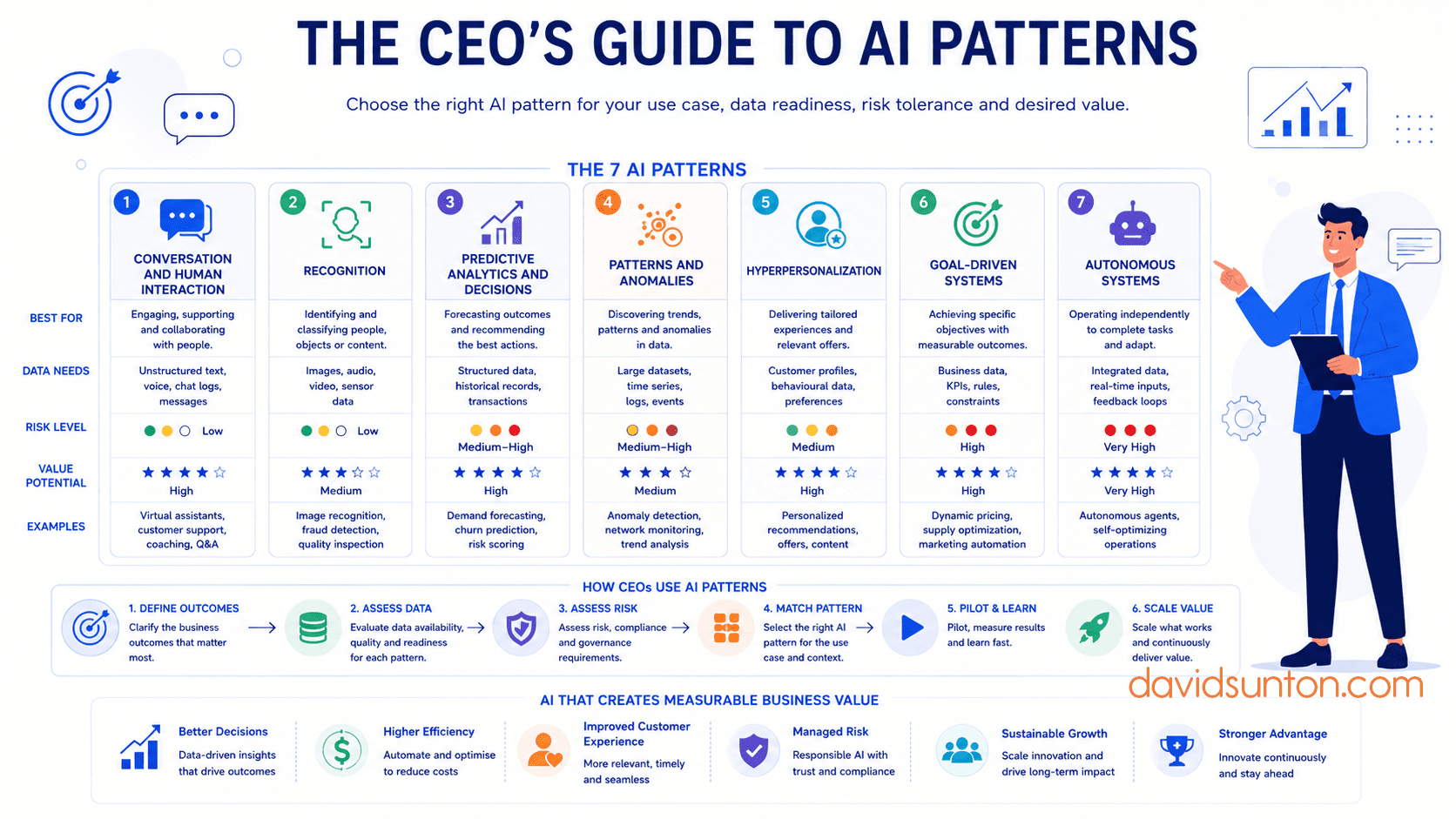
Seven AI Patterns: Executive Framing Guide
The following table provides a practical executive view of the seven AI patterns. It is not intended to explain the underlying algorithms. Its purpose is to help leaders quickly connect the business problem to the type of AI capability required, the data needed, and the key question that should be answered before the initiative moves into design, vendor selection or implementation.
| AI Pattern | Best suited for | Data required | Executive consideration |
|---|---|---|---|
| Conversation and Human Interaction | Chatbots, virtual assistants, employee support, customer service, guided interactions | Natural language text or speech from messages, questions, prompts and user interactions | Is there enough context for the AI to understand user intent, and how will unclear or sensitive interactions be escalated? |
| Recognition | Document processing, image recognition, voice/audio interpretation, form identification, visual inspection | Images, audio, documents or other unstructured items to identify, ideally with clear and consistent examples | Are the examples clear, consistent and varied enough for reliable identification? |
| Predictive Analytics and Decisions | Forecasting, churn prediction, demand planning, risk scoring, sales forecasting, operational planning | Historical and current data, usually structured, with enough depth to reveal patterns and trends | Is the historical data complete and reliable enough to support the prediction being made? |
| Patterns and Anomalies | Fraud detection, compliance monitoring, system alerts, operational exceptions, quality control | Streams of activity over time from logs, transactions, sensors, dashboards or monitoring systems | What counts as normal, what counts as abnormal, and who acts when an anomaly is detected? |
| Hyperpersonalization | Personalised offers, customer recommendations, next-best actions, tailored content, individualised service | Individual profiles, preferences, behaviours, past interactions and transaction history | Is the individual data accurate, current and appropriate to use, and how will personalisation avoid becoming intrusive? |
| Goal-Driven Systems | Optimisation, scheduling, routing, capacity planning, resource allocation, decision optimisation | Information about goals, constraints, available actions, outcomes and operating rules | Are the goals, boundaries and trade-offs clearly defined before the system optimises? |
| Autonomous Systems | Robotics, autonomous vehicles, real-time monitoring, industrial automation, self-directed operational systems | Real-time signals from sensors, cameras, LiDAR, radar, monitoring tools or environment data | Is the system operating in a controlled enough environment, and what safety, override and accountability controls are required? |
Why This Matters
The wrong AI pattern can create significant project risk.
An organisation may think it needs a chatbot, when the real problem is poor knowledge management.
It may want predictive analytics, but the historical data may be incomplete or unreliable.
It may want hyperpersonalisation, but customer profiles may be outdated or too thin.
It may want autonomous execution, but the process may not have clear boundaries, controls or escalation rules.
It may want anomaly detection, but the organisation may not have a stable definition of normal activity.
This is why AI pattern framing should happen before technology selection, vendor evaluation or pilot design.
The pattern tells leaders what kind of problem they are solving, what data must be ready, what risks need to be governed and what operating change may be required.
Why AI Patterns Matter Before The Project Starts
AI is often discussed as if it is one thing.
In business conversations, this can create confusion.
A leader may say the organisation needs an AI chatbot, when the real problem is poor knowledge management.
A team may ask for predictive analytics, when the historical data is too shallow or inconsistent.
A business unit may want hyperpersonalisation, when customer profiles are incomplete or consent boundaries are unclear.
An operations team may want anomaly detection, but may not have a stable definition of normal activity.
A company may want autonomous agents, but the process may not have clear rules, system boundaries, escalation paths or human accountability.
These are not small details.
They determine whether an AI initiative is ready, risky, premature or poorly framed.
AI patterns help leaders ask better questions before the organisation moves into pilots, vendor selection or implementation.
They help turn AI ambition into a more practical assessment.
What are we trying to improve?
What kind of AI capability fits this problem?
What data does the pattern need?
Is the data available and reliable?
What process will the AI support?
What decisions or actions will follow?
Where does human judgement remain important?
What risk does this introduce?
How will we know whether the initiative created value?
These questions are especially important at the beginning of an AI project, when assumptions are still easy to challenge and the cost of changing direction is still low.
1. Conversation And Human Interaction
The Conversation and Human Interaction pattern is used when people interact with technology through natural language, such as text or voice.
This pattern appears in chatbots, voice assistants, customer support assistants, employee helpdesks, document summarisation tools, content explanation tools and language translation.
The business problem is usually about improving access, responsiveness, support, knowledge use or communication.
Examples include a customer service assistant that answers common enquiries, an employee assistant that helps staff find HR or IT information, a sales assistant that summarises customer notes, a knowledge assistant that explains policies or procedures, or a voice assistant that helps users complete routine tasks.
The data required is natural language.
This may include messages, questions, prompts, call transcripts, support tickets, emails, chat logs, knowledge articles, policies or frequently asked questions.
The data is usually unstructured.
Quality matters because users express the same intent in different ways. The system needs enough examples of real questions, varied wording, context signals and common misunderstandings to interpret intent well.
The executive consideration is not only whether the AI can produce a fluent answer.
The real question is whether the answer is accurate, contextual, appropriate and safe to use.
For this pattern, leaders should ask:
Do we understand the common questions users ask?
Do we have approved knowledge sources?
Does the AI have enough context to interpret intent?
How will incorrect or overconfident answers be managed?
When should the interaction escalate to a human?
Should users be told they are interacting with AI?
How will sensitive, complex or emotional requests be handled?
Conversation systems are often appealing because they are easy to imagine and easy to demonstrate.
But they can fail when the organisation does not have trusted knowledge sources, clear escalation rules or controls around accuracy.
A chatbot is not only a user interface.
It is a knowledge, process, governance and trust problem.
2. Recognition
The Recognition pattern is used when AI identifies, detects or classifies unstructured inputs.
This may include images, audio, video, handwriting, documents, forms, emails, tickets or scanned records.
This pattern appears in document processing, image recognition, speech-to-text conversion, form classification, identity verification, quality inspection and audio interpretation.
The business problem is usually about turning raw information into a meaningful category or usable data.
Examples include reading invoices and extracting key fields, classifying incoming customer emails, identifying product defects from images, transcribing calls, recognising handwritten forms or sorting documents by type.
The data required is usually unstructured.
It may include images, audio files, video, scanned documents, PDFs, forms or text.
Data quality is especially important.
The AI needs clear, consistent and representative examples of the items it is expected to identify. It also needs variation across real-world conditions, such as different document formats, accents, image quality, lighting, handwriting styles or input sources.
The executive consideration is whether the examples are clear and representative enough for reliable identification.
For this pattern, leaders should ask:
What exactly does the system need to identify?
Do we have enough examples of correct identification?
Are the examples representative of real-world variation?
Are scans, images, audio or documents clear enough?
How will uncertain classifications be reviewed?
Who knows what a correct output looks like?
What happens when the AI misclassifies something?
Recognition systems can create strong productivity value because they reduce manual reading, sorting and data entry.
But they can also create risk if outputs are treated as correct without review.
The more important the classification, the more important it is to design human review, confidence thresholds and exception handling.
3. Predictive Analytics And Decisions
The Predictive Analytics and Decisions pattern is used when AI analyses historical and current data to estimate what may happen next.
This pattern appears in demand forecasting, churn prediction, risk scoring, sales forecasting, maintenance prediction, workforce planning, fraud risk prediction and scenario insights.
The business problem is usually about improving planning, prioritisation, risk detection or decision-making.
Examples include predicting which customers may churn, forecasting demand for a product, estimating the risk of late payment, predicting equipment failure, forecasting sales pipeline outcomes or identifying which leads are more likely to convert.
The data required is usually historical and current data.
It is often structured data from logs, records, transactions, measurements, time-based data, CRM records, ERP systems, finance systems or operational databases.
Data quality matters because predictions depend on meaningful signals.
The organisation needs enough historical depth to reveal trends, enough contextual data to explain outcomes, and current inputs that reflect the present situation.
The executive consideration is whether the past is a useful guide to the future.
For this pattern, leaders should ask:
What outcome are we trying to predict?
Do we have enough historical data?
Is the data complete and reliable?
Do we understand what factors influence the outcome?
Have conditions changed in a way that weakens the historical pattern?
How will confidence levels and assumptions be explained?
Who remains accountable for decisions informed by the prediction?
Predictive AI should be treated as decision support, not certainty.
A forecast can improve decision-making, but it does not remove judgement.
This is especially important where predictions affect customers, employees, financial outcomes, compliance or risk.
The value is not only in predicting the future.
The value is in improving the decisions made because of the prediction.
4. Patterns And Anomalies
The Patterns and Anomalies pattern is used when AI learns what typical activity looks like and flags unusual behaviour, deviations or emerging risks.
This pattern appears in fraud detection, compliance monitoring, cybersecurity alerts, quality control, operational monitoring, system performance monitoring, transaction monitoring and threat detection.
The business problem is usually about detecting issues earlier.
Examples include flagging unusual payment behaviour, detecting abnormal system activity, identifying unusual customer account activity, monitoring production quality, spotting unexpected changes in demand or identifying operational exceptions.
The data required is activity over time.
It may include transaction logs, system logs, sensor data, dashboard data, monitoring records, operational events or process data.
The data may be structured or semi-structured.
Quality matters because anomaly detection depends on consistent tracking.
The system needs reliable timestamps, stable formatting, enough baseline examples and enough normal activity to understand what typical behaviour looks like.
The executive consideration is not only whether the AI can flag anomalies.
The real question is what the organisation will do with the alert.
For this pattern, leaders should ask:
What counts as normal activity?
What counts as unusual activity?
Do we have enough baseline data?
Are timestamps and formats consistent?
How will false positives be handled?
Who reviews anomalies?
What is the escalation path?
What happens if the alert is serious?
Anomalies should be treated as items for investigation, not automatic conclusions.
This matters because unusual does not always mean harmful.
A spike in activity may be fraud, but it may also be seasonal demand.
A system alert may indicate a threat, but it may also reflect routine variation.
A value-led anomaly detection initiative needs clear review, escalation and response processes.
5. Hyperpersonalization
The Hyperpersonalization pattern is used when AI tailors recommendations, content, offers, experiences or guidance to individual users based on their behaviours, preferences and context.
This pattern appears in personalised recommendations, next-best action, personalised financial insights, adaptive learning, tailored marketing, customer engagement and personalised service.
The business problem is usually about improving relevance, engagement, conversion, retention or experience.
Examples include recommending products based on customer behaviour, suggesting next-best actions for sales teams, personalising learning paths for students, tailoring content to customer interests, providing personalised financial insights or customising customer service recommendations.
The data required is individual-level data.
This may include customer profiles, preferences, transaction history, browsing behaviour, interaction history, feedback signals, usage data and past responses.
The data may be structured and unstructured.
Quality matters because personalisation is only as good as the individual data behind it.
The data must be accurate, current and appropriate to use. There must also be enough data per individual to tailor outputs meaningfully.
The executive consideration is whether personalisation creates value for the individual, not only value for the organisation.
For this pattern, leaders should ask:
What individual data are we using?
Is the data accurate and up to date?
Do we have permission or a legitimate basis to use it?
Is personalisation helpful or intrusive?
Could the system reinforce bias or narrow exposure?
How will recommendations be explained?
How can users correct or influence their profile?
Hyperpersonalization can create strong value when it improves relevance and reduces friction.
But it can also weaken trust if customers feel watched, manipulated or misunderstood.
The line between helpful and intrusive matters.
A value-led approach should use personalisation where it genuinely benefits the individual and the business.
6. Goal-Driven Systems
The Goal-Driven Systems pattern is used when AI optimises toward a defined goal by testing actions, learning from outcomes and adjusting strategies over time.
This pattern appears in scheduling, routing, capacity planning, inventory optimisation, workforce allocation, dynamic pricing, bidding strategies, scenario simulation and resource optimisation.
The business problem is usually about improving decisions where there are constraints, trade-offs and competing outcomes.
Examples include optimising delivery routes, allocating staff to meet demand, improving inventory levels, scheduling jobs or appointments, optimising pricing within constraints or balancing service levels and cost.
The data required includes information about goals, available actions, constraints, outcomes and feedback indicators.
It may be structured or unstructured.
The system needs clear objectives, business rules, constraints, action history, outcome data and measures of progress.
Data quality matters because optimisation depends on the goal being clear and the trade-offs being understood.
The executive consideration is whether the goal is defined properly.
For this pattern, leaders should ask:
What exactly are we optimising for?
What constraints must be respected?
What trade-offs are acceptable?
What outcomes should not be sacrificed?
What feedback tells the system whether it is improving?
Who reviews recommended strategies?
How do we test safely before deployment?
Goal-driven systems can create major operational value.
But they can also create unintended consequences if goals are too narrow.
If the system optimises cost, it may weaken service quality.
If it optimises speed, it may increase risk.
If it optimises revenue, it may damage trust.
The value depends on defining the right goal, the right boundaries and the right measures.
7. Autonomous Systems
The Autonomous Systems pattern is used when AI senses its environment, makes decisions and takes action on its own within human-defined goals, constraints and safety boundaries.
This pattern appears in autonomous vehicles, robotics, autonomous software agents, autonomous business processes, real-time monitoring and self-directed operational systems.
The business problem is usually about enabling systems to operate with less step-by-step human control.
Examples include robots operating in a warehouse, autonomous vehicles or drones, AI agents that complete multi-step business tasks, software agents that monitor and act across systems, or autonomous workflow execution within defined boundaries.
The data required is real-time signals about the environment or system state.
This may include sensors, cameras, LiDAR, radar, monitoring tools, system events, workflow status, environmental data or operational signals.
The data is often structured or semi-structured.
Quality matters because autonomous systems rely on accurate and timely inputs.
The system needs real-time awareness, rules, boundaries, policies, safety constraints and continuous monitoring.
The executive consideration is not only what the system can do independently.
The real question is what it is allowed to do, under what conditions, and with what oversight.
For this pattern, leaders should ask:
What actions can the system take independently?
What actions require human approval?
What boundaries must not be crossed?
What real-time signals does the system rely on?
How will unsafe or unexpected behaviour be detected?
Who can intervene?
Who remains accountable?
How will the system be monitored after deployment?
Autonomous systems can create significant value, but they also require strong governance.
The more the system can act, the more important it is to define boundaries, oversight, auditability and accountability.
Autonomy should not mean absence of control.
It should mean controlled action within clearly defined limits.
Matching AI Patterns To Business Questions
The seven patterns help leaders move from broad AI ambition to better-framed AI initiatives.
A simple way to use the patterns is to match the business question to the AI pattern.
If the business question is:
How can people interact with systems more naturally?
The likely pattern is Conversation and Human Interaction.
If the question is:
How can we identify, classify or interpret documents, images, audio or text?
The likely pattern is Recognition.
If the question is:
What is likely to happen next?
The likely pattern is Predictive Analytics and Decisions.
If the question is:
What looks unusual or different from normal activity?
The likely pattern is Patterns and Anomalies.
If the question is:
How can we tailor experiences, recommendations or content to individuals?
The likely pattern is Hyperpersonalization.
If the question is:
How can we optimise decisions across goals, constraints and trade-offs?
The likely pattern is Goal-Driven Systems.
If the question is:
How can a system sense, decide and act within defined boundaries?
The likely pattern is Autonomous Systems.
This simple matching exercise can prevent many early mistakes.
It helps leaders avoid choosing a chatbot when the real issue is recognition.
It helps avoid choosing prediction when the data does not support forecasting.
It helps avoid choosing autonomy when the process needs basic workflow design first.
It helps avoid treating personalisation as a marketing tactic without considering data quality, consent and trust.
Why Data Requirements Differ By Pattern
One of the most important lessons from a pattern-based approach is that “we have data” is not enough.
Different AI patterns need different kinds of data.
Conversation systems need natural language inputs, context and examples of varied wording.
Recognition systems need clear, consistent and representative examples of the things being identified.
Predictive systems need historical data, current inputs and enough depth to reveal meaningful trends.
Anomaly detection needs activity over time, reliable timestamps, stable formatting and enough normal examples to detect what is unusual.
Hyperpersonalization needs accurate individual-level information, feedback signals and evolving inputs.
Goal-driven systems need clear objectives, action and outcome data, constraints and feedback indicators.
Autonomous systems need accurate, timely, real-time signals, rules, boundaries and continuous awareness.
This matters because data readiness is pattern-specific.
A company may have large amounts of data, but not the right data for the AI pattern it wants to pursue.
A business may have weekly sales reports, but not the granular behavioural data needed for personalisation.
It may have customer emails, but not an approved and current knowledge base for a conversational assistant.
It may have historical records, but not enough examples of rare events for prediction or anomaly detection.
It may have system logs, but not consistent timestamps or stable formats.
It may have process documentation, but not real-time data required for autonomous action.
The question is not simply:
Do we have data?
The better question is:
Do we have the right data for this AI pattern, at the right quality, volume, structure and level of context?
Why The Wrong Pattern Creates Project Risk
The wrong AI pattern can create project risk before the project has even started.
A business may ask for a chatbot because it wants a visible AI interface.
But if the real issue is poor knowledge management, outdated policies and inconsistent answers across teams, the chatbot will only expose the problem faster.
A business may ask for prediction because forecasting sounds valuable.
But if historical data is inconsistent, incomplete or no longer reflects current market conditions, the predictions may create false confidence.
A business may ask for hyperpersonalisation.
But if individual profiles are outdated, incomplete or poorly governed, personalisation may feel irrelevant or intrusive.
A business may ask for anomaly detection.
But if no one has defined normal activity, every alert may become noise.
A business may ask for autonomous agents.
But if process rules, permissions, escalation paths and accountability are unclear, the agent may create operational and governance risk.
A business may ask for goal-driven optimisation.
But if the goal is too narrow, the system may optimise one metric while damaging another.
These are not technology problems alone.
They are framing problems.
They happen when the organisation moves too quickly from AI possibility to AI project design.
A pattern lens slows the conversation down in the right way.
It helps leaders ask whether the project is properly framed before money, time and credibility are committed.
Pattern Framing Helps Avoid Common AI Project Failures
AI project failures often trace back to a few common issues.
The problem is not clearly defined.
The AI output does not fit the business workflow.
The data is not ready or not suitable.
The project is driven by technology enthusiasm rather than user value.
The infrastructure is not mature enough.
The organisation applies AI to a problem that is not a good fit.
The pattern lens helps reduce these risks.
It forces a clearer connection between the business problem and the AI approach.
It makes data requirements more explicit.
It highlights where human judgement is required.
It shows where process design matters.
It surfaces risk and governance questions early.
It helps leaders distinguish between use cases that are ready to pursue and use cases that need more preparation.
This is why AI patterns are useful before the project begins.
They help organisations frame the work before trying to deliver it.
How Leaders Can Use AI Patterns To Prioritise
AI patterns are useful because they support better prioritisation.
They help leaders compare AI opportunities more clearly.
For each opportunity, leaders can ask:
What business problem are we solving?
Which AI pattern best fits the problem?
What data does this pattern require?
Do we have that data?
Is the data reliable, current, representative and accessible?
Where will the AI output fit into the process?
What decision or action follows?
What risk does this create?
Where is human review required?
Who owns the outcome?
How will adoption be led?
How will value be measured?
This creates a more disciplined conversation.
It also helps avoid treating all AI ideas equally.
Some AI ideas may be high value and ready to test.
Some may be valuable but not yet ready because the data is weak.
Some may require process redesign before AI can be useful.
Some may require stronger governance.
Some may be better solved through simpler automation or rules.
Some may not be appropriate yet.
This is the difference between AI enthusiasm and AI prioritisation.
The goal is not to approve every AI idea.
The goal is to understand which ideas are worth investment, which need preparation, and which should be delayed or stopped.
AI Patterns And Human-In-The-Loop Design
Different AI patterns require different forms of human involvement.
Conversation systems may need human escalation for complex, sensitive or high-risk requests.
Recognition systems may need human review for low-confidence classifications or critical outputs.
Predictive systems may need humans to interpret assumptions, confidence levels and context before making decisions.
Anomaly systems need humans to investigate alerts and decide whether action is required.
Hyperpersonalisation systems need humans to define ethical boundaries, consent rules and customer experience principles.
Goal-driven systems need humans to define objectives, constraints, trade-offs and acceptable outcomes.
Autonomous systems need human oversight, monitoring, intervention rights and accountability.
Human-in-the-loop design should therefore match the AI pattern.
It should not be a vague reassurance.
It should define who reviews, what they review, when they intervene, what authority they have, what gets logged and who remains accountable.
This is especially important when AI moves from insight to action.
The more AI influences decisions or performs tasks, the more important it becomes to design the human role clearly.
AI Patterns And Governance
Governance also differs by pattern.
A low-risk internal summarisation tool may need simple usage rules, data boundaries and review expectations.
A customer-facing conversation system may need stronger controls around escalation, accuracy, disclosure and tone.
A prediction model used for business planning may need assumptions, confidence levels and monitoring.
An anomaly detection system may need alert thresholds, review procedures and escalation paths.
A hyperpersonalisation system may need privacy controls, consent management, bias checks and customer transparency.
A goal-driven system may need clear rules around trade-offs, unintended consequences and optimisation boundaries.
An autonomous system may need formal safety controls, system monitoring, override mechanisms and audit trails.
Good governance is not one-size-fits-all.
It should reflect the pattern, the risk, the data, the decision impact and the level of autonomy.
This is another reason AI patterns are useful for executive framing.
They help governance become practical rather than generic.
A Practical AI Pattern Assessment
Before approving or prioritising an AI initiative, leaders can use a simple pattern assessment.
Business problem: What problem are we solving, and why does it matter?
Pattern: Which AI pattern best fits the problem?
Data: What data does this pattern require?
Readiness: Is the data accurate, current, representative, accessible and governed?
Process: Where does the AI output fit into the workflow?
Decision: What decision or action will follow?
Risk: What could go wrong if the AI is wrong, incomplete or overconfident?
Human role: Where is review, approval, escalation or accountability required?
Governance: What rules, controls, monitoring or audit trails are needed?
Value: What measurable outcome should improve?
Adoption: Who needs to use, trust and sustain the new way of working?
This assessment can be used before a pilot, vendor selection or business case.
It helps ensure the AI initiative is not only technically possible, but also valuable, feasible, governable and adoptable.
Example: Customer Service AI
A company may want to improve customer service with AI.
At first, the request may sound simple:
“We need a chatbot.”
But the AI pattern lens makes the conversation more precise.
If the goal is to let customers ask questions in natural language, the pattern may be Conversation and Human Interaction.
If the goal is to classify inbound emails or support tickets, the pattern may be Recognition.
If the goal is to predict which customers are likely to churn, the pattern may be Predictive Analytics and Decisions.
If the goal is to identify unusual complaint patterns, the pattern may be Patterns and Anomalies.
If the goal is to tailor responses based on customer history, the pattern may be Hyperpersonalization.
If the goal is to optimise routing between service teams, the pattern may be Goal-Driven Systems.
If the goal is to let an AI agent resolve standard cases across systems, the pattern may move toward Autonomous Systems.
Each pattern changes the project.
Each pattern changes the data requirement.
Each pattern changes the risk.
Each pattern changes the workflow.
Each pattern changes the human role.
This is why pattern framing matters.
The organisation may still decide to build a chatbot. But it will do so with a clearer understanding of whether the real need is conversation, recognition, prediction, personalisation, optimisation or autonomous execution.
Example: Finance AI
A finance team may want to use AI to improve invoice processing.
At first, the project may be described as automation.
But the pattern lens shows several possible AI patterns.
If AI reads and extracts information from invoices, the pattern is Recognition.
If AI predicts which invoices are likely to be disputed or paid late, the pattern is Predictive Analytics and Decisions.
If AI flags unusual payments, duplicate invoices or suspicious transactions, the pattern is Patterns and Anomalies.
If AI optimises payment timing based on cash flow, supplier terms and constraints, the pattern is Goal-Driven Systems.
If AI prepares actions across systems, such as matching records, drafting supplier queries and routing approvals, the pattern may involve Autonomous Systems or agentic execution.
The data requirements differ for each.
Invoice recognition needs clear document examples.
Prediction needs historical payment and dispute data.
Anomaly detection needs transaction logs and baseline activity.
Optimisation needs goals, constraints and outcome data.
Autonomous execution needs workflow rules, system access, permissions, escalation and auditability.
This prevents the organisation from treating “finance AI” as one project.
It becomes a set of possible AI initiatives, each with different readiness requirements and value potential.
Example: Sales AI
A sales organisation may want to improve conversion and pipeline quality.
Again, there may be multiple patterns.
Conversation AI may help salespeople summarise calls, draft follow-ups or prepare customer responses.
Recognition may classify lead sources, customer requests or sales notes.
Predictive analytics may forecast close probability or identify deals at risk.
Patterns and anomalies may flag unusual pipeline movement or stalled opportunities.
Hyperpersonalization may recommend tailored content or next-best actions.
Goal-driven systems may optimise territory coverage, lead routing or campaign allocation.
Autonomous agents may support multi-step sales operations, such as preparing CRM updates, drafting follow-ups and triggering next actions with approval.
Each pattern requires different data.
Call summaries need transcripts and context.
Forecasting needs historical opportunity data.
Personalisation needs customer behaviour and preference data.
Optimisation needs goals, constraints and performance outcomes.
Agentic execution needs process rules, system access and human review.
The same business area can contain several AI patterns.
That is why leaders need to frame the project before selecting the solution.
Common Mistakes To Avoid
There are several mistakes leaders should avoid when using AI patterns.
The first is treating AI as one generic capability.
This leads to vague use cases and unclear data requirements.
The second is choosing a tool before identifying the pattern.
This can result in a solution that looks impressive but does not fit the business problem.
The third is assuming existing data is suitable.
Data that supports reporting may not support prediction, personalisation, recognition or autonomous action.
The fourth is ignoring the workflow.
AI outputs only create value when they fit into a process where decisions and actions happen.
The fifth is treating human review as an afterthought.
Different patterns require different forms of human involvement.
The sixth is underestimating governance.
Risk, privacy, transparency, auditability and accountability need to match the pattern.
The seventh is measuring activity instead of value.
A working model, pilot or tool is not the same as business impact.
Avoiding these mistakes helps move AI from experimentation to practical transformation.
Recommended Next Reading
If you are considering how to frame AI initiatives before projects begin, these related articles expand on the key themes covered in this guide.
- The CEO’s Guide To Value-Led AI Transformation
- Before The AI Project: Why Opportunity Assessment Matters
- From AI Idea To AI Use Case
- The AI Use Case Scorecard
- Why Data Readiness Can Make Or Break AI Projects
- Why AI Transformation Needs Solution Framing And Change Management
- Why AI Projects Are Change Projects
- Human-In-The-Loop Workflow Design For AI Systems
- Why AI Agents Need Process Design
- Agentic Orchestration: Turning AI Agents Into Measurable Business Value
- How To Make Transformation Stick After Go-Live
Final Thought
AI transformation improves when leaders stop treating AI as one generic capability.
A conversation assistant, recognition system, predictive model, anomaly detector, personalisation engine, goal-driven optimiser and autonomous agent may all be AI, but they are not the same kind of project.
They solve different problems.
They require different data.
They create different risks.
They need different governance.
They involve humans in different ways.
They create value through different pathways.
That is why AI patterns are useful.
They help organisations move from broad AI ambition to better-framed AI initiatives.
The better question is not only:
Can AI help?
The better question is:
What type of AI pattern fits the business problem, what data does it require, what risks must be governed, and what must change in the organisation for the value to be realised?
That is how leaders move from AI ideas to AI initiatives that are valuable, feasible, governable and adoptable.